

You send a simple text, and an hour later you are still rereading it. You replay a meeting comment on the drive home. You lie awake running through ten versions of a conversation that has not happened yet. If that sounds familiar, you are in very large company. So why do people overthink, especially when they know it is not helping?
The short answer: overthinking is a normal mental habit that has gotten stuck in a loop. Your brain is trying to protect you by solving a problem, avoiding a mistake, or making sense of something uncertain. The trouble is that past a certain point, more thinking stops producing answers and starts producing stress. This guide explains what is happening, the most common triggers, how to tell useful reflection from an unhelpful loop, and practical ways to step out of it.
A quick note: this article is educational and is not a substitute for professional advice. If overthinking is affecting your sleep, work, or relationships for weeks at a time, talking with a doctor or licensed therapist is a smart next step.
In this guide
What overthinking actually is
“Overthinking” is not a clinical diagnosis. It is an everyday word that usually covers two related thinking patterns that psychologists study closely:
- Rumination: going over the past again and again, often focusing on what went wrong, why it happened, and what it says about you. “Why did I say that? What is wrong with me?”
- Worry: running through possible future problems, usually in a “what if” format. “What if I fail the interview? What if they are upset with me?”
Both patterns feel productive while they are happening. That is what makes them sticky. Your mind is busy, the topic seems important, and it can feel irresponsible to stop. But researchers who study rumination, including the late Yale psychologist Susan Nolen-Hoeksema, found that repetitive, passive dwelling on problems tends to deepen low mood and make people worse at solving the problem, not better (American Psychological Association).
A useful way to picture it: healthy thinking moves forward like a path. Overthinking moves in a circle. You keep walking, but you end up in the same spot, only more tired.
Why do people overthink? 7 common reasons
There is rarely one single cause. Most people overthink because several of the following forces are working together.
1. The brain is built to scan for threats
Human minds are very good at noticing what could go wrong. Psychologists call one part of this tendency the negativity bias: negative information tends to grab more attention and feel more important than neutral or positive information. That was useful when missing a threat could be dangerous. Today, the “threat” might be an unanswered email or an awkward pause, but the same alarm system kicks in, and the mind keeps circling back to check it.
2. Uncertainty feels uncomfortable
Many people find not knowing harder to tolerate than a bad outcome. Overthinking is often an attempt to create certainty: if you analyze every angle, maybe you can predict what will happen. Research on intolerance of uncertainty links this discomfort with higher levels of worry. The catch is that most real-life uncertainty cannot be thought away, so the analysis never feels finished.
3. Overthinking feels like being responsible
A lot of overthinkers hold quiet beliefs such as “If I worry about it, I am prepared,” or “If I stop thinking about my mistake, I will repeat it.” These beliefs make the loop feel like a duty. Therapists who work with chronic worry often focus on exactly these beliefs, because once you question them, the loop loses much of its power.
4. Perfectionism and fear of judgment
If you hold yourself to very high standards, every decision carries more weight. Choosing a restaurant, phrasing a message, or giving feedback becomes a test you could fail. Fear of what others think adds fuel: you replay social moments looking for evidence that someone disapproved. Most of the time, other people are far less focused on your small slips than you are. Psychologists have a name for that, too: the spotlight effect, our tendency to overestimate how much others notice us.
5. Too many choices
Modern life is full of options, from which phone plan to buy to which of fifty reviews to trust. More options can mean more comparison and more second-guessing, a pattern sometimes called decision fatigue or choice overload. When every option has pros and cons, the mind can keep weighing them indefinitely.
6. Stress, tiredness, and low mood
Overthinking gets louder when your resources are low. A stressful week, poor sleep, or feeling down makes it harder to redirect attention, and the mind is more likely to latch onto problems. This is one reason worries feel so much bigger at 2 a.m. than they do the next morning.
7. It has become a habit
Finally, overthinking can simply be learned. If you have spent years responding to stress by analyzing, the response becomes automatic. A certain trigger, such as a vague message from your boss, starts the loop before you consciously decide anything. The good news: habits can be changed with practice, which is what the rest of this guide is about.
Overthinking vs. problem-solving: how to tell the difference
Not all deep thinking is a problem. Reflecting on a mistake, planning for a big decision, and thinking carefully about a relationship are all healthy. The question is whether your thinking is moving you forward. Use this quick comparison:
| Helpful problem-solving | Unhelpful overthinking |
|---|---|
| Focuses on what you can do | Focuses on what might go wrong or what already went wrong |
| Has a clear question (“Which job offer fits my goals?”) | Asks unanswerable questions (“Why am I like this?”) |
| Ends with a decision or next step | Ends with more doubt and the same questions |
| Feels effortful but leaves you calmer | Feels urgent and leaves you more anxious or drained |
| Has a natural end point | Restarts every time a new “what if” appears |
A simple test: after 10 to 15 minutes of thinking about something, ask yourself, “Do I know anything new, or have I decided anything?” If the answer is no, you have probably slipped from problem-solving into overthinking.
What overthinking costs you
Overthinking is common, but it is not harmless when it becomes a daily pattern. People who ruminate or worry a lot often notice:
- Slower decisions: analysis paralysis, where you delay choosing because no option feels perfect.
- Poorer sleep: a busy mind at bedtime makes it harder to fall asleep and stay asleep.
- Lower mood: dwelling on problems tends to magnify them, which can feed sadness or anxiety.
- Procrastination: when every task feels like a high-stakes decision, avoiding it can feel easier. (Our guide on how to stop procrastinating covers this link in detail.)
- Strained relationships: replaying conversations can lead to reassurance-seeking or avoiding people altogether.
- Mental fatigue: constant analysis is tiring, which leaves less energy for focus and enjoyment.
Recognizing these costs is not meant to add one more thing to worry about. It is a reminder that stepping out of the loop is worth practicing.
How to stop overthinking: 9 strategies that actually help
You cannot simply order your mind to stop thinking about something. (Try not to picture a white bear, and see what happens.) What works better is changing your relationship with the thoughts and giving your attention somewhere better to go. Pick two or three of these to start.
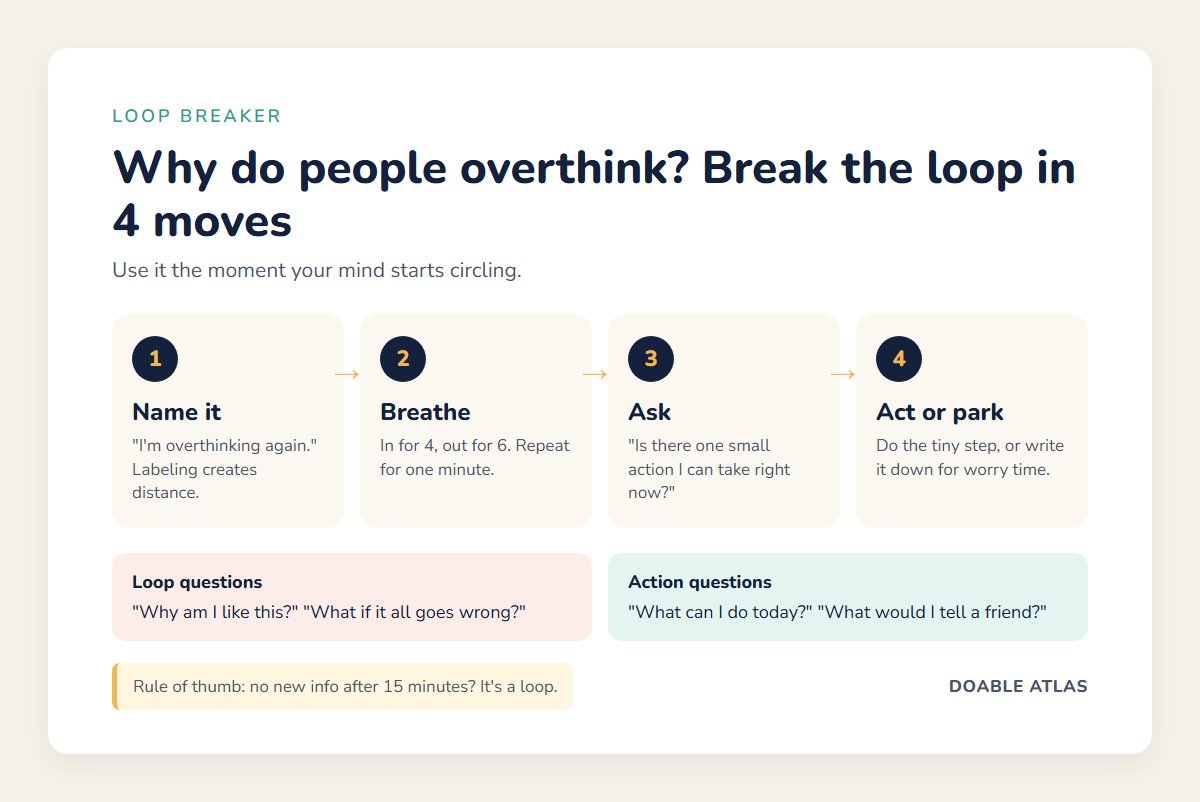
1. Name the loop
When you notice yourself circling, say it plainly, out loud or in your head: “I am overthinking again.” Labeling the pattern creates a small gap between you and the thought. You move from being inside the loop to observing it, which makes the next step easier.
2. Schedule a worry window
Set aside 15 to 20 minutes at the same time each day, ideally not right before bed, as your “worry time.” When a worry pops up during the day, jot it down and tell yourself you will deal with it in the window. This technique, sometimes called worry postponement or stimulus control, has been used in cognitive behavioral approaches since the 1980s. Many people find that by the time the window arrives, half the worries no longer feel urgent.
3. Turn questions into actions
Overthinking loves “why” and “what if” questions. Problem-solving uses “what” and “how” questions. Convert the loop:
- “What if the presentation goes badly?” becomes “What is one thing I can do today to prepare?”
- “Why did I say that?” becomes “Is there anything I want to clarify or apologize for?”
If there is an action, do the smallest version of it. If there is no action available, that is a sign the thought belongs in the “let it pass” category.
4. Write it down
Thoughts that feel enormous in your head often look manageable on paper. Spend five minutes writing everything you are thinking, without editing. Then circle anything you can act on and cross out anything outside your control. Writing turns a swirl into a list, and lists have endings.
5. Use self-distancing
Psychologist Ethan Kross and colleagues have studied a simple trick: thinking about your problem in the third person or from a distance. Instead of “Why am I so anxious?”, try “Why is Sam feeling anxious about this?” Or ask, “What would I tell a close friend in this situation?” Stepping back like this tends to make problems feel less overwhelming and makes wiser advice easier to find.
6. Set a decision deadline
For choices that keep you stuck, decide when you will decide. “I will choose a gym by Friday at noon.” Pair the deadline with a “good enough” standard: list the two or three things that matter most, and pick the first option that meets them. Perfect information rarely exists, and waiting for it is often the most expensive choice.
7. Move your body
A brisk 10-minute walk, stretching, or any physical task can interrupt a mental loop. Movement shifts your attention to your senses and often lowers the physical tension that keeps worry going. Many people notice that solutions appear more easily after a walk than after an hour of sitting and thinking.
8. Ground yourself in the present
Overthinking lives in the past and the future. Bring your attention back to now with a quick grounding exercise, such as the 5-4-3-2-1 method: notice five things you can see, four you can feel, three you can hear, two you can smell, and one you can taste. Mindfulness practice builds the same skill over time: noticing a thought, letting it pass, and returning to what you are doing.
9. Protect your evenings
Since overthinking spikes when you are tired, a simple wind-down routine can help. Do a quick brain dump before bed, keep your phone out of reach, and save big decisions for the morning. If you want ideas for building a calmer start and end to your day, see our guide to a morning routine for productivity.
A 3-minute reset when your mind is racing
When you are in the middle of a spiral and need something fast, try this short sequence:
- Pause and label (30 seconds): “This is an overthinking loop.”
- Breathe slowly (60 seconds): breathe in for about four counts, out for about six. A longer exhale tends to feel calming.
- Ask one question (30 seconds): “Is there one small action I can take right now?”
- Act or park (60 seconds): if yes, do the first tiny step. If no, write the worry down for your worry window and turn your attention to the next task.
It will not erase the thought, and that is not the goal. The goal is to stop feeding the loop and get back to your day.
Overthinking in relationships and social situations
Social overthinking deserves its own mention because it is so common. You might reread messages looking for hidden meaning, worry that a friend is annoyed, or replay a joke that did not land. A few gentle reminders help here:
- Short replies are usually just short replies. People are busy, distracted, or typing on their phones.
- Ask instead of guessing. If something truly matters, a simple “Hey, are we good after yesterday?” resolves in one minute what overthinking could not resolve in a week.
- Limit reassurance-seeking. Asking for reassurance again and again brings short relief but keeps the worry cycle alive.
- Practice clear communication. When you say what you mean kindly and directly, there is less to decode later. Our guides on how to have difficult conversations and how to set boundaries politely include scripts you can borrow.
When overthinking may need extra support
Everyone overthinks sometimes. It may be time to talk with a professional if:
- Worry or rumination takes up hours of your day, most days, for several weeks.
- It is regularly disrupting your sleep, work, school, or relationships.
- You feel persistently low, hopeless, or on edge.
- You are using alcohol or other substances to quiet your thoughts.
Persistent worry and rumination are linked with conditions such as generalized anxiety disorder and depression, and effective treatments exist, including cognitive behavioral therapy. A primary care doctor is a good place to start. If you ever have thoughts of harming yourself, contact emergency services or, in the United States, call or text 988 to reach the Suicide and Crisis Lifeline.
Frequently asked questions
Is overthinking a mental illness?
No. Overthinking is a common thinking pattern, not a diagnosis. However, intense and persistent worry or rumination can be part of conditions like anxiety disorders or depression, which a professional can assess.
Why do people overthink at night?
At night there are fewer distractions, you are often tired, and there is nothing practical you can do about most problems. That combination gives the mind space to circle. A brief brain dump and a consistent wind-down routine can help.
Are some people more likely to overthink?
Yes. Perfectionism, high sensitivity to uncertainty, stressful life circumstances, and past experiences can all make overthinking more likely. It is also a learned habit, which means it can be unlearned with practice.
Can overthinking ever be useful?
Careful thinking is useful. The problem starts when thinking becomes repetitive and stops producing decisions or actions. A good rule of thumb is to ask, “Is this helping me decide or do something?” If not, it is time to step out of the loop.
What is the fastest way to stop overthinking?
There is no instant off switch, but a quick reset helps: name the loop, take a few slow breaths, and either take one small action or write the worry down for later. Physical movement is also a fast way to shift your attention.
Your next step
So, why do people overthink? Because the mind is trying to protect us from mistakes, uncertainty, and judgment, and sometimes it does not know when to stop. Understanding that makes it easier to be patient with yourself. You are not broken; your brain is doing an old job a little too enthusiastically.
Today, choose just one strategy from this guide. Try naming the loop the next time it starts, or set up a 15-minute worry window this afternoon. Small, repeated practice is what turns a racing mind into a calmer, clearer one.