

You walk into a coffee shop you have never visited, in a city you have never been to. The barista turns, the light hits the counter at a certain angle, and suddenly a strange certainty washes over you: I have been here before. This exact moment has happened. A few seconds later, the feeling is gone, leaving only a slightly eerie aftertaste. That is deja vu, French for “already seen,” and about two out of three people say they have experienced it.
So why do we get deja vu? Is it a glitch in the brain, a memory from a dream, a sign of something supernatural? This guide explains what scientists have actually learned, busts the most popular myths, and shows you why this unsettling feeling is usually a sign that your memory is doing its job well.
Quick answer
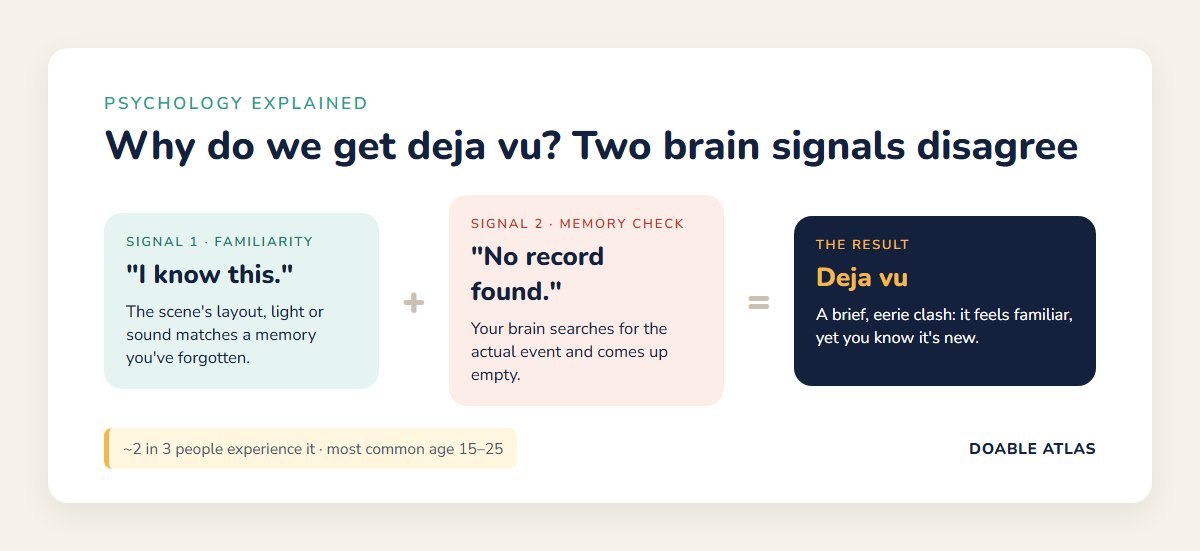
Why do we get deja vu? The leading explanation is that part of your brain flags a situation as familiar, often because it resembles something you have seen before, while another part checks your memory and finds no matching event. That conflict between “this feels familiar” and “I know this is new” is the deja vu feeling. It is common, usually harmless, and most frequent in young adults.
In this guide
What is deja vu?
Deja vu is the feeling that a new experience has happened before, combined with the knowledge that it cannot have. That second part is important. If you simply mistook a new place for an old one, you would just be confused. In deja vu, you feel familiarity and, at the same time, you know it is false. That clash is what makes the experience so strange.
Psychologist Alan Brown, who reviewed decades of research on the topic, found that roughly two-thirds of people report having had at least one deja vu experience, and that it becomes less frequent as people get older (Brown, 2003). Episodes are usually brief, lasting from a few seconds to under a minute, and they tend to happen more often when people are tired or stressed.
Why do we get deja vu? The main scientific explanations
Because deja vu is fleeting and unpredictable, answering why do we get deja vu in a lab is hard. Still, researchers have developed several explanations that fit the evidence well. They are not mutually exclusive; different episodes may have different causes.
1. Familiarity without recollection
Memory researchers distinguish between two kinds of remembering. Recollection is when you retrieve specific details: where you were, who was there, what happened. Familiarity is the vaguer sense that you have encountered something before, without being able to say when or where. Think of recognizing a face in a crowd but being unable to place the person.
One leading explanation of why we get deja vu is that a familiarity signal fires strongly while recollection comes up empty. Your brain says “known,” but when you search for the matching memory, there is nothing there.
2. The scene resembles something you have seen before
Psychologist Anne Cleary and her colleagues tested this idea with virtual reality. Participants toured virtual scenes, and later saw new scenes that had the same layout as earlier ones but completely different objects and decorations. When a new scene shared the spatial layout of a scene they had forgotten, people were more likely to report deja vu (Cleary et al., 2012).
In everyday life, this could mean the coffee shop feels familiar because its layout echoes a restaurant you visited years ago and have long forgotten: the counter on the left, the window on the right, the table in the corner. Your brain detects the match, but you cannot consciously recall the original.
3. Your brain’s fact-checker catching an error
Researchers at the University of St Andrews, led by Akira O’Connor, induced a deja vu-like state in volunteers using a classic false-memory technique and scanned their brains. When people reported deja vu, the most active regions were not the memory areas but frontal areas associated with decision making and conflict monitoring (Urquhart et al., 2018).
The interpretation is fascinating: deja vu may happen when your brain’s checking system notices a mismatch between a feeling of familiarity and what you actually know. In other words, it might be a sign of a healthy memory system catching a small error, not a malfunction.
4. A brief misfire in the brain’s timing
Another long-standing idea is that deja vu arises from a tiny glitch in neural processing, for example, information reaching one brain pathway slightly before another, so the second arrival feels like a repeat. This “dual processing” idea is harder to test, but it remains part of the discussion, especially because deja vu can be triggered by unusual brain activity.
5. Divided attention
Brown and others have suggested that sometimes you glimpse a scene briefly while distracted, for instance glancing at a room while checking your phone, and then a moment later take it in fully. The second, attentive look feels familiar because you really did see it a second ago, but you do not remember the first glance.
Myth vs fact: what deja vu is not
Ask the internet why do we get deja vu and you will find plenty of popular theories. Here is how the most common ones hold up.
Who gets deja vu most often?
Part of answering why do we get deja vu is looking at who gets it. Research summarized by Brown points to a few patterns in who experiences deja vu and when:
- Younger adults: deja vu is most common in people roughly between 15 and 25 and gradually becomes less frequent with age.
- People who travel more: visiting more new places gives the brain more chances to notice resemblances between scenes.
- People who are tired or stressed: fatigue and stress are frequently reported around deja vu episodes.
- People who remember their dreams: some surveys link better dream recall to more frequent deja vu.
Why does it fade with age? One possibility is that the brain’s checking processes become less sensitive to small mismatches. Another is that younger people simply encounter more novel situations. Researchers are still debating the answer, which is part of what makes the question of why we get deja vu so interesting.
Quick self-check: how often do you get deja vu?
Curious where you fall? Answer these four questions honestly, then read what your answers suggest. This is not a diagnosis, just a fun way to connect the research on why we get deja vu to your own life.
- How many times have you felt deja vu in the past year? (Never / 1 to 3 times / about monthly / weekly or more)
- Does it tend to happen when you are tired, stressed or traveling?
- Can you usually point to something in the scene that might have felt familiar, such as a layout, sound or smell?
- Do episodes ever come with other sensations, such as confusion, unusual smells, or lost time?
What your answers mean: a few episodes a year, especially when tired or in new places, is completely typical. If you can often spot a familiar detail, you are seeing the resemblance explanation in action. If question 4 is a yes, or episodes suddenly become weekly, that is the pattern worth mentioning to a doctor.
Most people who ask why do we get deja vu fall squarely in the first group: occasional, brief and harmless episodes that simply reflect a busy, pattern-seeking brain.
Deja vu and the brain: where it happens
Brain research adds another piece to the puzzle of why do we get deja vu. Much of what we know about the brain basis of deja vu comes from people with temporal lobe epilepsy. For some of them, a deja vu feeling can be part of the warning sensation, called an aura, that comes before or at the start of a seizure. Neurologists who stimulated parts of the temporal lobe during surgery have also been able to trigger deja vu-like feelings.
The temporal lobes contain structures that are central to memory and familiarity, including the hippocampus and surrounding areas. This suggests that deja vu in healthy people may involve brief, harmless activity in the same memory networks, while the frontal checking systems identified by O’Connor’s team notice that something does not add up.
Related feelings: jamais vu and presque vu
Deja vu has some lesser-known cousins:
- Jamais vu (“never seen”): the opposite feeling, when something very familiar suddenly seems strange or new. Try repeating a common word out loud many times; eventually it may start to sound odd. That is a mild form of jamais vu.
- Presque vu (“almost seen”): the tip-of-the-tongue feeling, when you are sure you know a word or name but cannot quite retrieve it.
- Deja entendu (“already heard”): the feeling that you have heard a sound, phrase, or piece of music before in exactly this way.
All of these show the same underlying truth: the feeling of knowing something and the actual memory of it are handled by different processes, and they do not always agree. If you enjoyed our article on Mandela effect examples, you have already seen another side of this: memories that feel completely certain but turn out to be wrong.
Can you trigger deja vu on purpose?
Testing why do we get deja vu requires creating it on demand. Researchers have found ways to create deja vu-like experiences in the lab, which is how studies like Cleary’s and O’Connor’s work. The most common method uses lists of related words. For example, people hear words such as bed, pillow, night, dream, nap, and later are asked whether they heard a word starting with “s.” They know they did not hear sleep, yet it feels oddly familiar. That mismatch between feeling and knowledge resembles deja vu.
You can try a version of this with friends. Read out a list of related words, then ask whether a closely related word that was not on the list appeared. Many people will hesitate, and some will feel that strange “I know, but I don’t” sensation. It is a fun, harmless way to explore how memory works.
What to do when deja vu happens
Knowing why do we get deja vu also makes it easier to respond calmly. For most people, deja vu needs no action at all. But if you would like to make the most of it, or if it unsettles you, here are a few ideas:
- Pause and notice. Instead of feeling spooked, observe the experience. What in the scene might resemble somewhere you have been? The layout, the light, a smell?
- Write it down. Some people keep a short log of deja vu episodes. Over time, you may spot patterns, such as more episodes when you are short on sleep.
- Check your rest. If deja vu becomes more frequent during stressful or sleep-deprived periods, that can be a gentle reminder to rest. Our guide to an evening reset routine can help.
- Do not over-interpret it. Deja vu is not a message or a prediction. Treat it as an interesting window into your brain, similar to the thinking patterns described in why people overthink.
When deja vu might be a sign to see a doctor
Occasional deja vu is normal. However, it is worth talking to a doctor if:
- Deja vu happens very frequently, for example several times a week, and is a new change for you.
- It comes with other symptoms such as a rising feeling in the stomach, unusual smells or tastes, confusion, staring spells, involuntary movements, or loss of awareness.
- You lose track of time or cannot remember what happened during or after the episode.
- It is accompanied by memory problems that affect daily life.
These can occasionally be signs of focal seizures or other neurological conditions, which are treatable. A doctor can help you figure out what is going on. For the vast majority of people, though, deja vu is simply one of the stranger features of a healthy brain.
Why deja vu is actually good news
It is easy to think of deja vu as a mistake. But the latest research suggests a more reassuring view. If O’Connor’s team is right, deja vu happens when your brain’s monitoring system catches a false sense of familiarity and flags it. In other words, the feeling of “this is strange” is the sound of your memory’s quality control working properly.
That may also help explain why deja vu fades with age. As the checking system becomes less sensitive, fewer of these small errors get flagged. So the next time you feel that eerie sense of repetition, you can enjoy it as a sign that your brain is paying close attention. It is one more example of the strange but true ways our minds work, just like the unbelievable coincidences that really happened.
Frequently asked questions
Why do we get deja vu so suddenly?
Deja vu is triggered when something in the current moment, such as a layout, sound, or smell, closely matches a stored memory you cannot consciously recall. The familiarity signal fires instantly, which is why the feeling arrives suddenly and fades just as quickly.
Is deja vu a warning sign?
Usually not. Occasional deja vu is normal and common. It is worth seeing a doctor only if episodes become very frequent or come with symptoms such as confusion, unusual smells, staring spells, or memory loss.
Why do we get deja vu that feels like predicting the future?
No. During deja vu, people often feel they know what will happen next, but studies show those predictions are no more accurate than guessing.
Why do we get deja vu less as we get older?
Research shows deja vu peaks in young adulthood and declines with age. Possible reasons include fewer new experiences and a memory-checking system that becomes less sensitive to small mismatches.
Is deja vu related to dreams?
Sometimes. A new situation may resemble a fragment of a dream, which can feel familiar. However, most episodes are better explained by resemblance to real but forgotten experiences.
The takeaway
So, why do we get deja vu? The best current answer is that a new moment resembles something stored in your memory closely enough to trigger a feeling of familiarity, while your brain’s fact-checker knows the moment is new. The collision of those two signals produces one of the most intriguing sensations humans experience.
It is not a glitch in reality, a past life, or a glimpse of the future. It is your memory, working in layers, occasionally letting you see the seams. And now that you know why we get deja vu, the next time it happens you may find it less eerie and a lot more fascinating.