

The internet is full of morning routines that start at 4:30 a.m. and include an ice bath, an hour of journaling, and a perfectly plated breakfast. If that sounds exhausting rather than inspiring, you are not alone. A good morning routine for productivity does not need to be long, extreme, or identical to anyone else’s. It needs to help you start the day with a clear head and a clear priority.
This guide explains what actually makes a morning routine productive, how to build one that fits your life in about 30 minutes, sample routines for different schedules, and the common mistakes that cause most routines to fall apart within a week.
In this guide
Why mornings matter for productivity
Mornings are not magic, but they do have a few practical advantages. For many people, the first hours of the day come before meetings, messages, and other people’s requests start competing for attention. Using that time well can set the direction for everything that follows.
Routines reduce the effort of starting
A large share of what we do each day is habitual. In diary studies, psychologist Wendy Wood and colleagues found that a substantial portion of participants’ everyday behaviors were performed almost daily and usually in the same context, often while people were thinking about something else (Wood, Quinn & Kashy, 2002). Mornings are full of these repeated actions: waking up, making coffee, getting dressed. A routine uses that structure on purpose, so useful actions happen with less effort and fewer decisions.
Productive mornings start the night before
No routine can make up for chronic sleep loss. The Centers for Disease Control and Prevention recommends that adults get at least seven hours of sleep per night (CDC). If your routine requires waking up an hour earlier but you go to bed at the same time, you may be trading real energy for the appearance of productivity. Protecting your sleep is the foundation of any productive morning.
What makes a morning routine productive
The most effective morning routines share a few traits, regardless of how early they start or how long they last:
- They are short enough to survive busy days. A 20-minute routine you do five days a week beats a 90-minute routine you manage once.
- They protect attention. They delay the flood of messages and news until after you have set your own direction.
- They include one clear priority. You know what matters most before the day starts pulling you in other directions.
- They care for your body. Light, movement, water, and food help many people feel more alert.
- They fit your real life. Your routine should work with your job, family, and natural energy patterns, not against them.
How to build a morning routine for productivity: 7 steps
1. Start with your evening
A smooth morning usually begins the night before. Set a consistent bedtime that allows for enough sleep, and take five minutes to prepare: lay out clothes, pack your bag, and decide on breakfast. Our evening reset routine walks through a simple 15-minute version.
Preparation removes small morning decisions that otherwise eat time and energy.
2. Choose a realistic wake-up time
Pick a time you can keep most days, including weekends where possible. Consistency often matters more than how early you rise. If you want to wake earlier, shift gradually, for example 15 minutes earlier each week, while moving your bedtime earlier by the same amount.
If you are naturally more alert later in the day, a productive morning routine may simply be shorter and gentler, with focused work saved for your best hours.
3. Delay your phone for the first 20–30 minutes
Checking email, social media, or news first thing hands your attention to other people’s priorities before you have chosen your own. Try keeping your phone out of the bedroom and using a basic alarm clock instead. If you need your phone as an alarm, set it across the room and avoid opening apps until after your routine.
This one change often makes the biggest difference. If phone habits are a recurring struggle, our guide on how to focus without getting distracted includes more strategies.
4. Get light, water, and a little movement
Simple physical actions can help you feel more awake:
- Open the curtains or step outside for a few minutes of daylight.
- Drink a glass of water.
- Stretch, take a short walk, or do a few minutes of light exercise.
You do not need a full workout. Even five minutes of gentle movement can make the transition from sleep to activity easier.
5. Eat something that keeps you going
What and when you eat varies by person, and nutritional needs differ. In general, many people feel steadier with a breakfast that includes some protein and fiber rather than relying only on sugar or caffeine. If you prefer not to eat early, plan a simple mid-morning option so hunger does not derail your focus later.
6. Write your top priority for the day
This is the heart of a productive morning. Take two or three minutes to write down the single most important task for today, along with up to two smaller supporting tasks. Ask: “If I only complete one thing today, what should it be?”
Making a specific plan for when and where you will do that task strengthens follow-through. Research on implementation intentions suggests that if-then plans tend to improve goal achievement compared with vague intentions (Gollwitzer & Sheeran, 2006). For example: “When I sit down at 9:00, I will work on the client proposal before opening email.” Our guide to time blocking for beginners shows how to protect that time on your calendar.
7. Start your most important task early
If your schedule allows, begin your priority task soon after your routine, even for 20 or 30 minutes. Starting early builds momentum and makes the rest of the day feel lighter. If you tend to delay difficult tasks, our guide on how to stop procrastinating explains how to make the first step smaller.
Sample morning routines
There is no single best morning routine. Here are three examples you can adapt. The summary card below shows a simple 30-minute version you can save or print.
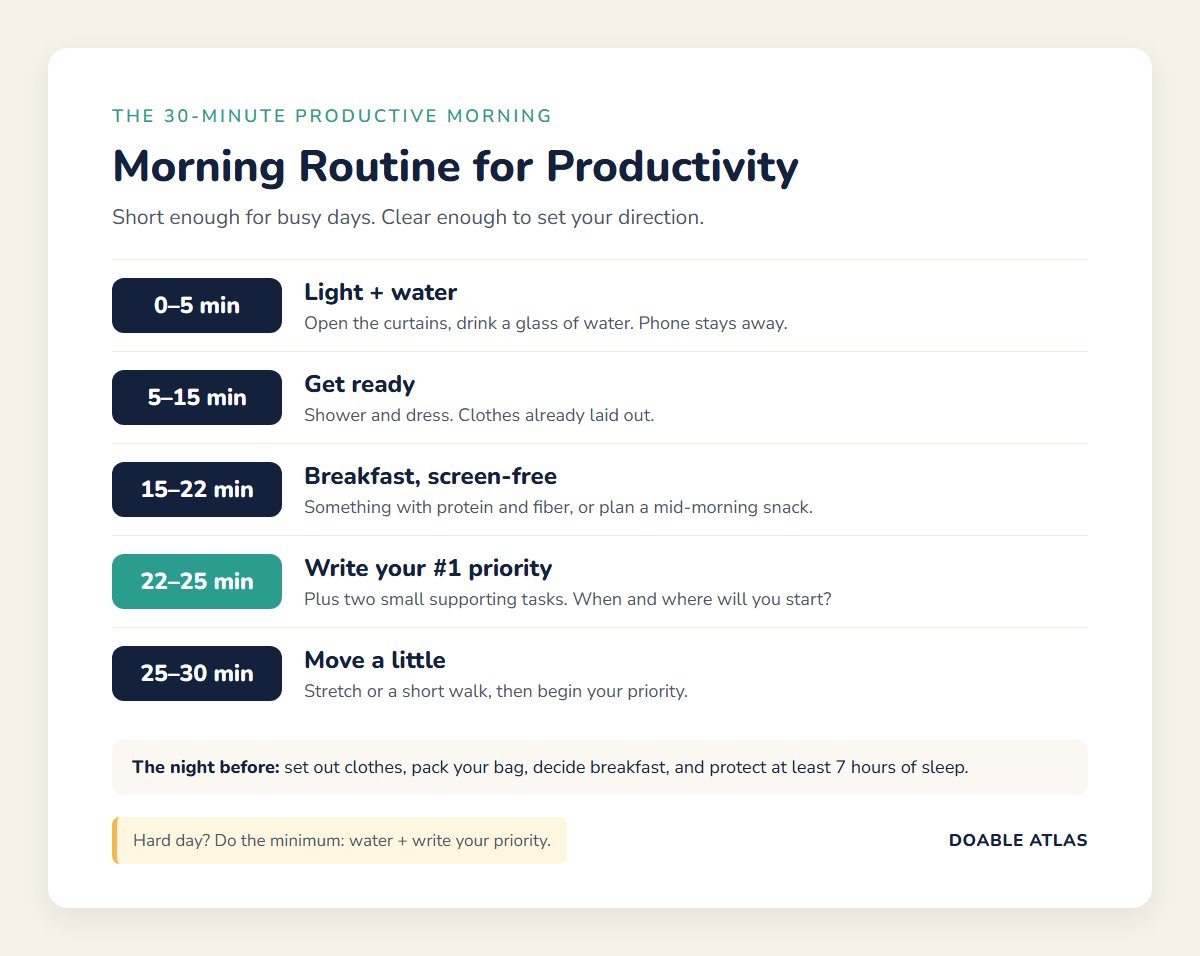
The 30-minute productive morning
- 0–5 minutes: Wake up, open the curtains, drink a glass of water.
- 5–15 minutes: Shower and get dressed.
- 15–22 minutes: Simple breakfast without your phone.
- 22–25 minutes: Write your top priority and two supporting tasks.
- 25–30 minutes: Quick stretch or short walk, then start your day.
The 15-minute busy-day routine
- Water and daylight (2 minutes)
- Get ready (8 minutes)
- Write one priority while your coffee brews (3 minutes)
- Two minutes of stretching or deep breathing
The parent morning routine
For parents and caregivers, the morning often belongs to someone else. A realistic routine might be just five minutes for yourself before the household wakes: water, a quick stretch, and your top priority written on a sticky note. Prepare lunches and bags the night before to make the rest of the morning calmer.
The remote-work routine
Without a commute, work and home can blur together. Create a short “start of day” ritual, such as a 10-minute walk around the block, to signal the transition. Then sit down, review your priority, and start before checking messages.
Morning routine ideas by goal
Different goals call for slightly different routines. Choose the focus that matters most to you right now and add one or two related actions to your basic routine.
If you want more energy
- Get outside for five to ten minutes of daylight soon after waking.
- Do a short burst of movement, such as a brisk walk or a few minutes of bodyweight exercises.
- Keep breakfast simple and steady rather than relying only on caffeine.
If you want sharper focus
- Keep your phone in another room until your first work block is finished.
- Review your priority list and break the first task into a clear first step.
- Start a 25- to 45-minute focus block before opening email.
If you want a calmer start
- Spend two or three minutes breathing slowly or sitting quietly with your coffee.
- Write down anything worrying you so it is out of your head and on paper.
- Leave a five-minute buffer before you need to leave, so you are not rushing.
If you want to make progress on a personal goal
- Give 15 to 20 minutes to your goal before the day gets busy: reading, studying, writing, or practicing a skill.
- Track each session with a simple mark on a calendar.
- Link it to a clear weekly target. Our guide on how to set achievable goals explains how.
A morning routine for night owls
Not everyone feels alert at 6 a.m., and that is normal. People differ in when they naturally feel most energetic. If you are a night owl, a productive morning routine can still help, but it may look different:
- Keep it short: Aim for a 15-minute routine that gets you out the door calmly rather than a long, ambitious one.
- Front-load preparation: Do more of the work the night before, when you have more energy, so mornings require fewer decisions.
- Save deep work for later: Use the morning for lighter tasks, such as planning, admin, and email, and protect your most alert hours later in the day for demanding work.
- Prioritize consistent sleep: A regular bedtime and wake-up time, even if later than average, usually matters more than forcing an early start.
The goal is not to become a morning person. It is to make mornings smoother so the rest of your day can go well.
Common morning routine mistakes
Copying someone else’s routine exactly
A routine that works for a CEO with a household staff may not work for you. Borrow ideas, but build a routine around your schedule, energy, and responsibilities.
Making it too long
Long routines are hard to maintain and easy to abandon on busy days. Start small, with three or four actions, and add more only once those feel automatic.
Sacrificing sleep
Waking earlier without going to bed earlier usually backfires. Fatigue undermines focus, mood, and decision-making for the rest of the day.
Starting with email and social media
Opening messages first often turns the morning into a reactive scramble. Set your own direction first, then respond to others.
Expecting perfection
Some mornings will go wrong: a sick child, a late night, an early meeting. Have a minimum version of your routine, such as water and writing your priority, so you keep the habit alive on hard days.
How to make your morning routine stick
Building a routine is a habit project. These principles help:
- Anchor new actions to existing ones: “After I start the coffee maker, I’ll write my top priority.”
- Prepare your environment: Leave your notebook and pen on the kitchen counter, and your walking shoes by the door.
- Track it simply: Mark a calendar each day you complete your routine.
- Review weekly: Once a week, notice what worked and what did not, and adjust.
- Restart quickly: If you miss a few days, start again the next morning instead of waiting for Monday.
For more on making habits last, see our guide on how to build better habits.
Frequently asked questions
What is the best morning routine for productivity?
The best routine is one you can repeat consistently. For most people, a productive morning includes enough sleep beforehand, a short delay before checking the phone, some light and movement, food that keeps you going, and writing down your top priority for the day.
How long should a morning routine be?
Anywhere from 10 to 60 minutes can work. Many people find 20 to 30 minutes is long enough to feel grounded and short enough to keep up on busy days.
Do I need to wake up early to be productive?
No. Productivity depends more on consistency, sleep, and how you use your time than on waking at a specific hour. Night owls can have productive mornings with a later, shorter routine.
What should I avoid in the morning?
Try to avoid checking email and social media immediately, rushing because nothing was prepared the night before, and skipping sleep to fit in more activities.
Your next step
A morning routine for productivity works best when it is simple, realistic, and built around your real life. Tonight, set out what you need for tomorrow and choose a bedtime that gives you enough sleep. Tomorrow morning, try three actions: delay your phone for 20 minutes, drink a glass of water near a window, and write down your single most important task.
Repeat those three steps for one week. Once they feel natural, add one more element if you want. Small, steady improvements tend to last far longer than an ambitious routine that collapses by Friday.