

Some conversations sit on your to-do list for weeks. Telling a coworker their missed deadlines are affecting your work. Asking a partner to share more of the housework. Bringing up money with a family member. Explaining to a friend that something they said hurt you. You know the conversation needs to happen, but every time you picture it, your stomach tightens.
Learning how to have difficult conversations does not mean becoming fearless. It means having a simple plan you can rely on when your heart is racing. This guide explains why these talks feel so hard, a seven-step method for preparing and holding them, phrases you can borrow, and what to do when the conversation goes sideways.
In this guide
Why difficult conversations feel so hard
Difficult conversations combine three ingredients: something important is at stake, people see the situation differently, and emotions are running high. Any one of these makes a conversation harder. All three together make many of us want to avoid it entirely.
Avoidance offers short-term relief, but the underlying problem usually grows. Resentment builds, small issues turn into big ones, and when the conversation finally happens, it often happens badly, in the middle of an argument rather than at a calm moment you chose.
How a conversation starts matters
Relationship researcher John Gottman and colleagues observed newlywed couples discussing areas of disagreement and followed them over several years. Patterns in those conversations, including how harshly discussions began and whether partners could de-escalate negativity, helped predict which couples later reported more happiness and stability (Gottman et al., 1998). While that study focused on married couples, the practical lesson applies widely: the first minute of a hard conversation often sets the tone for everything that follows.
Naming emotions can calm them
When we are upset, it can feel like putting emotions into words would make things worse. Research suggests the opposite may be true. In a brain-imaging study, simply labeling the emotion in a picture was associated with reduced activity in the amygdala, a brain region involved in emotional reactions (Lieberman et al., 2007). In everyday terms, saying “I’m frustrated” or “I’m feeling defensive right now” may help you stay calmer than silently fighting the feeling.
How to have difficult conversations: 7 steps
You can use these steps at work, at home, and in friendships. Some happen before you talk, some during, and one afterward.
1. Get clear on your goal
Before you say anything, ask yourself what a good outcome would look like. Do you want a specific change in behavior? To be understood? To solve a practical problem together? To repair a relationship?
Write one sentence: “After this conversation, I hope that ___.” Your goal should be about the situation and the relationship, not about proving you are right. A goal of “make them admit they were wrong” almost guarantees a defensive conversation.
2. Separate facts from your story
Most difficult conversations mix observable facts with our interpretations. Facts are what a camera would record. Stories are the meaning we attach to them.
- Fact: “You arrived 20 minutes late to the last three team meetings.”
- Story: “You don’t respect my time.”
Your story might be accurate, or it might not. Starting with facts gives the other person something specific to respond to, without immediately putting them on the defensive. You can still share your interpretation, but offer it as your perspective rather than as the truth.
3. Choose the right time and place
Timing affects how a conversation lands. Avoid raising a serious issue when someone is rushing out the door, exhausted, in front of others, or already upset about something else. A private, unhurried setting gives both of you a better chance.
It is often helpful to ask for the conversation in advance: “There’s something I’d like to talk through with you. Is tomorrow after lunch a good time?” This gives the other person a chance to prepare instead of feeling ambushed.
4. Start gently and clearly
Your opening sets the tone. A gentle start is not the same as being vague. Aim for a calm, direct opening that states the topic, shares that you care about the relationship or outcome, and invites their view.
A simple structure is:
- Intention: “I want us to work well together.”
- Observation: “I’ve noticed the reports have come in after the deadline the last few weeks.”
- Impact: “That has meant I’ve had to rush my part, and errors slipped through.”
- Invitation: “Can we talk about what’s happening and figure out a plan?”
Compare that with “We need to talk about your attitude.” The first opening invites problem-solving; the second invites self-defense.
5. Listen to understand, not just to reply
Once you have opened the conversation, your most important job is to listen. Ask open questions such as “How do you see it?” or “What’s been going on from your side?” Then reflect back what you heard before responding with your own view.
In a study of conversations between strangers, people who received active-listening responses, such as paraphrasing what they had said, reported feeling more understood than those who received other types of responses (Weger et al., 2014). Feeling understood lowers defensiveness, which makes the rest of the conversation easier. Our guide to active listening examples includes phrases you can practice.
Listening does not mean agreeing. You can say, “I hear that the workload has been overwhelming for you,” while still needing the deadlines to be met.
6. Share your perspective with “I” statements
When it is your turn, describe your experience rather than labeling the other person. “I” statements focus on what you observed and how it affected you:
- Instead of “You never help around the house,” try “I feel overwhelmed when I’m doing most of the cleaning after work.”
- Instead of “You’re always on your phone,” try “I miss having your attention when we’re at dinner.”
- Instead of “You embarrassed me,” try “I felt embarrassed when the mistake was brought up in front of the whole team.”
“I” statements are not magic, and tone still matters. But they make it easier for the other person to hear the problem without feeling attacked.
7. Agree on a next step and follow up
A difficult conversation that ends without any agreement can leave both people unsure what happens now. Before you finish, summarize what you have agreed and what each person will do. It might be a concrete change, a trial period, or simply a plan to talk again.
- “So you’ll send the draft by Thursday at noon, and I’ll review it by Friday morning.”
- “Let’s try splitting the evening chores this way for two weeks and check in next Sunday.”
Following up shows that the conversation mattered. A short check-in a week later can reinforce progress or catch problems early.
A 5-minute difficult conversation planner
Before an important talk, spend five minutes answering these questions. The summary card below makes it easy to save or print.
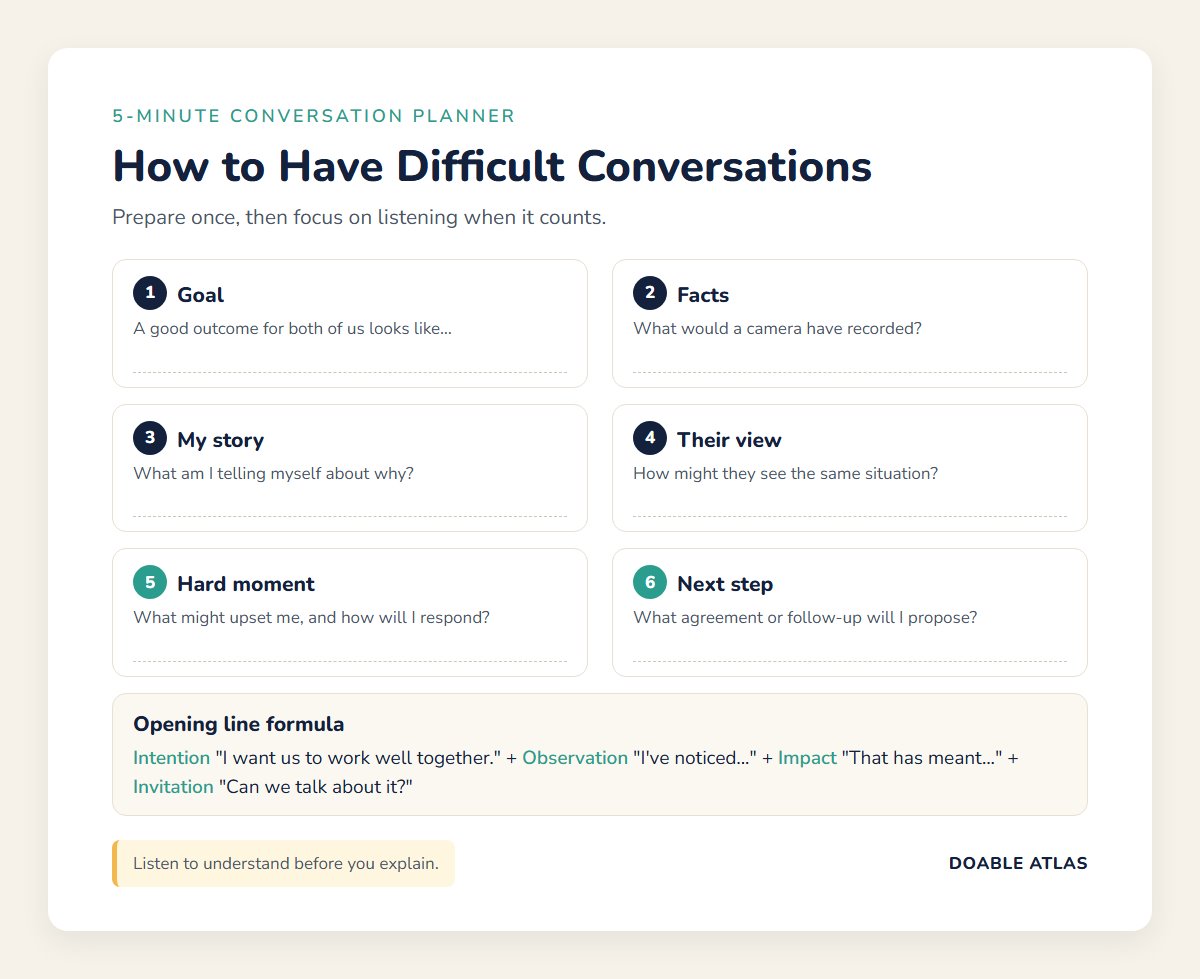
- Goal: What would a good outcome look like for both of us?
- Facts: What specific, observable things happened?
- My story: What am I telling myself about why it happened?
- Their view: How might they see the same situation?
- Opening line: How will I start, gently and clearly?
- Hard moment: What might they say that would upset me, and how will I respond?
- Next step: What agreement or follow-up would I propose?
Preparing yourself emotionally
Knowing how to have difficult conversations is partly about words and partly about your state of mind when you walk in. A few minutes of preparation can make a noticeable difference:
- Rehearse the opening out loud: Saying your first two sentences to a mirror or a trusted friend makes them easier to say under pressure.
- Expect some discomfort: Feeling nervous does not mean the conversation is going badly. It means it matters.
- Check your timing: If you are hungry, exhausted, or still very angry, it is usually better to wait a few hours.
- Decide what you can let go: Know in advance which points are essential and which ones you can drop if the conversation gets long.
- Plan something calming afterward: A short walk or a quiet cup of tea gives you space to process, whatever the outcome.
Treat each difficult conversation as practice. Even when a talk does not go perfectly, you learn what helped, what made things harder, and what you want to try next time.
Helpful phrases for difficult conversations
To open the conversation
- “I’d like to talk about something that’s been on my mind. Is now an okay time?”
- “This isn’t easy for me to bring up, but I think it’s important for us.”
- “I want to understand your side, and I’d also like to share mine.”
To show you are listening
- “So what I’m hearing is ___. Did I get that right?”
- “That makes sense. Tell me more about that.”
- “I hadn’t thought about it from that angle.”
To calm things down
- “I can feel myself getting defensive. Let me slow down.”
- “I think we both want the same thing here.”
- “Can we take a 10-minute break and come back to this?”
To move toward a solution
- “What would help from my side?”
- “What’s one thing we could try this week?”
- “Can we agree to check in about this next Friday?”
When the conversation goes sideways
Even well-planned conversations can become tense. These strategies help you recover instead of escalating.
If they get defensive
Defensiveness usually means someone feels attacked or misunderstood. Slow down, acknowledge their feelings, and restate your intention: “I’m not trying to blame you. I want us to figure out a better way to handle this.” Then return to listening.
If you get emotional
Strong emotions are normal. Name them briefly (“I’m feeling really frustrated right now”), take a slow breath, and pause if you need to. Speaking while flooded with anger or hurt rarely helps.
If the conversation turns into an argument
Suggest a short break with a clear plan to return: “I think we both need a few minutes. Let’s take 20 minutes and come back to this.” Pausing is different from avoiding, as long as you actually come back.
If they shut down or refuse to talk
Respect their need for space, but keep the door open: “It seems like this isn’t a good time. Can we try again tomorrow evening?” If someone repeatedly refuses to discuss an important issue, you may need to set a boundary about what you will do next. Our guide on how to set boundaries politely includes scripts for that situation.
Difficult conversations in different settings
At work
Keep the focus on behavior, impact, and solutions rather than personality. Prepare specific examples, choose a private setting, and if the issue involves a manager or ongoing conflict, consider whether to involve HR or document agreements in a follow-up email.
With a partner
Choose a calm moment, start softly, and remember that the goal is to solve the problem together rather than to win. It often helps to talk about one issue at a time instead of bringing up a long list of past grievances. Our guide to healthy communication skills covers habits that make these talks easier over time.
With family
Family conversations often carry long history. Focus on the present situation and what you need now. Accept that some disagreements may not be fully resolved, and decide what matters most to you.
With friends
Friendships can feel fragile when something goes wrong. A direct, kind conversation usually protects a friendship better than slowly pulling away. Lead with how much the friendship matters to you.
When a conversation is not safe
The steps in this guide assume both people are basically respectful, even if they disagree. If someone responds to hard conversations with threats, intimidation, or violence, or controls your money, phone, or relationships, the problem is not your communication skills. In that situation, focus on safety rather than on finding the perfect words. In the United States, the National Domestic Violence Hotline offers confidential support 24/7 at 1-800-799-7233. If you are in immediate danger, call 911.
Frequently asked questions
How do you start a difficult conversation?
Ask for a good time, then open with your intention, a specific observation, its impact, and an invitation to talk. For example: “I want us to work well together. I’ve noticed the reports have been late, and it’s made my part harder. Can we talk about it?”
What should you avoid in a difficult conversation?
Avoid blame, sarcasm, exaggerations such as “always” and “never,” bringing up unrelated past issues, and having the conversation in front of others or when either person is exhausted or rushed.
How do you stay calm during a hard conversation?
Prepare your opening, breathe slowly, name your emotions briefly, and take a break if you feel overwhelmed. Focusing on listening rather than planning your reply also helps.
What if the other person doesn’t change after we talk?
One conversation does not always solve a problem. Follow up, restate what you need, and decide what you will do if things do not change. Sometimes that means setting a clear boundary or involving someone else, such as a manager or counselor.
Your next step
Learning how to have difficult conversations is a skill you build one conversation at a time. Choose one conversation you have been avoiding. Spend five minutes with the planner above: define your goal, separate facts from your story, and write your opening line. Then ask the other person for a good time to talk.
The conversation may still feel uncomfortable, and that is okay. Clear, kind honesty usually leaves relationships stronger than silence ever could.