

A new year feels like a clean page, and it is tempting to fill it with big promises. But the people who make real progress usually do something less exciting and far more effective: they choose a few clear goals, break them into steps and build a simple system to keep going when motivation fades.
This guide walks you through how to set goals for the new year in eight practical steps: reviewing the past year, choosing life areas, writing specific goals, planning quarterly milestones, turning goals into weekly habits and reviewing your progress. You will also find goal examples, a one-page planning template and the mistakes that quietly derail most plans.
Quick answer
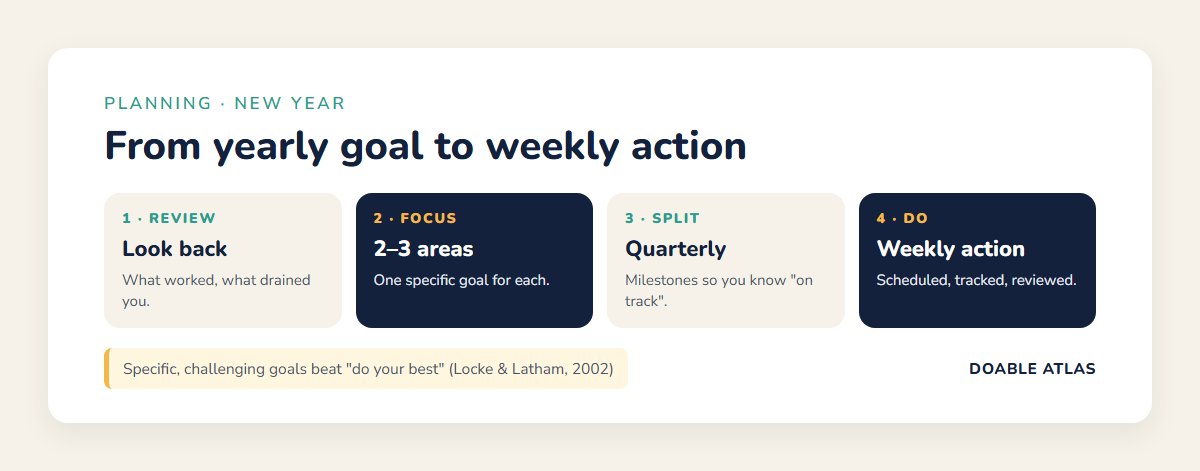
To set goals for the new year, review last year first, choose two or three life areas to focus on, write one specific and challenging goal for each, break every goal into quarterly milestones and weekly actions, schedule those actions in your calendar, track them simply and review progress monthly and quarterly. Fewer, clearer goals beat a long wish list.
In this guide
Why goals for the new year often fail
Most goals for the new year are written in a burst of December optimism and forgotten by February. The usual reasons are predictable:
- Too many goals competing for the same limited time and energy.
- Vague wording such as “be healthier” or “grow my career” that gives no clear next step.
- No plan between January and December. A year is too long to stay motivated without milestones.
- No link to daily life. Goals live in a notebook instead of in the calendar.
- No review. Without regular check-ins, small slips turn into giving up.
The steps below solve each of these problems.
What research says about setting goals
Goal-setting is one of the most studied topics in psychology. Summarizing 35 years of research, Edwin Locke and Gary Latham concluded that specific, challenging goals generally lead to higher performance than vague “do your best” goals, as long as people are committed to them and have the ability and feedback to progress (Locke & Latham, American Psychologist, 2002). In other words, “run a 5K in under 30 minutes by June” tends to work better than “get fitter”.
Researchers have also studied “if-then” plans, often called implementation intentions: “If it is Monday at 7 a.m., then I go for a run.” A widely cited meta-analysis by Peter Gollwitzer and Paschal Sheeran found that these plans helped people follow through on goals. Newer, larger analyses suggest the effect is smaller than first estimated, but still positive, so if-then plans remain a simple, low-cost tool worth using.
How to set goals for the new year: 8 steps
Step 1: Review the past year before setting goals for the new year
Before deciding where to go, look at where you have been. Spend 30 to 45 minutes answering a few honest questions: What went well? What was hard? What drained my energy? What do I want more of? Our list of year in review questions includes a free printable worksheet to guide you.
Step 2: Choose two or three life areas
Pick the areas that matter most for the coming year. Common choices include health, money, career, learning, relationships, home and personal wellbeing. Choosing only two or three keeps your goals for the new year focused and realistic.
| Life area | Question to ask |
|---|---|
| Health | What would help me feel more energetic day to day? |
| Money | What financial change would reduce stress the most? |
| Career | What skill or result would open the next door? |
| Relationships | Who do I want to spend more time with? |
| Home | What would make my space easier to live in? |
| Learning | What do I want to understand or be able to do by December? |
Step 3: Write one specific goal per area
Turn each area into a clear, measurable outcome with a deadline. A common tool is the SMART method: specific, measurable, achievable, relevant and time-bound. Our guide on how to set achievable goals explains it in detail.
- Instead of “save more money”, write “save $3,000 for an emergency fund by December 31”.
- Instead of “get fit”, write “run a 5K without stopping by June 30”.
- Instead of “read more”, write “read 12 books this year, one per month”.
Step 4: Make the goal challenging, but believable
Following the research above, aim for goals that stretch you a little. A good test: you should feel about 70% confident you can reach it with consistent effort. If you are 100% sure, it may be too easy; if you are 30% sure, scale it down or extend the deadline.
Step 5: Write down your “why”
Next to each goal, add one sentence about why it matters. “Save $3,000 so a surprise car repair doesn’t become a crisis” is far more motivating on a tired Tuesday than the number alone.
Step 6: Break each goal into quarterly milestones
A year is long. Split each goal into four quarters so you always know what “on track” looks like.
| Goal | Q1 | Q2 | Q3 | Q4 |
|---|---|---|---|---|
| Save $3,000 | $750 | $1,500 | $2,250 | $3,000 |
| Run a 5K | Walk-run 3x/week | Run 5K nonstop | Join a local race | Improve time |
| Read 12 books | 3 books | 6 books | 9 books | 12 books |
Step 7: Turn milestones into weekly actions
Goals are achieved through what you do this week, not what you plan for December. For each goal, decide the smallest repeatable action that moves it forward:
- Save $3,000: automatic transfer of $60 every payday.
- Run a 5K: three 25-minute sessions on Monday, Wednesday and Saturday.
- Read 12 books: 20 pages every evening before bed.
Then put those actions in your calendar. Our guides on time blocking for beginners and how to plan your week show how to protect that time. To make actions stick, attach them to existing routines, a technique explained in how to build better habits.
Step 8: Track and review your goals for the new year
Choose one simple way to track progress: a habit app, a spreadsheet or a paper calendar. Then schedule reviews:
- Weekly (10 minutes): did I do my actions? What gets in the way next week?
- Monthly (20 minutes): am I on pace for this quarter’s milestone?
- Quarterly (45 minutes): is this goal still right? Adjust the target, the plan or the deadline if needed.
Our weekly reset checklist fits neatly into the weekly review.
Examples of goals for the new year
Health
- Walk 8,000 steps on at least five days a week by March.
- Go to bed by 11 p.m. on weeknights for 12 weeks.
- Cook dinner at home four nights a week.
Money
- Build a $1,000 starter emergency fund by April 30.
- Track every expense for 90 days in a simple spreadsheet. See how to create a simple budget spreadsheet.
- Cut grocery spending by $50 a month using a meal plan. Our tips on how to save money on groceries help.
These examples are general information, not financial advice.
Career and learning
- Complete one online course in a job-relevant skill by June.
- Update your resume and LinkedIn profile by the end of January.
- Learn 500 words in a new language by December.
Relationships and wellbeing
- Have a phone-free dinner with family every Sunday.
- Call one friend or relative every week.
- Spend 15 minutes outdoors every day, even in winter.
Home and organization
- Declutter one room per month for six months. See how to declutter your home fast.
- Do a 10-minute tidy every evening before relaxing.
- Organize and back up all digital photos by March.
A one-page plan for your goals for the new year
Copy this template into a notebook or a document and fill it in for each goal:
| Field | Your answer |
|---|---|
| Life area | |
| Goal (specific, measurable, with a deadline) | |
| Why it matters | |
| Q1 / Q2 / Q3 / Q4 milestones | |
| Weekly action and when it happens | |
| If-then plan for obstacles | |
| How I will track it |
Questions that help you choose goals for the new year
If you are not sure which goals for the new year to pick, these questions help separate what you truly want from what you think you should want:
- If next December went perfectly, what would be different in my daily life?
- Which problem keeps coming back every year, and what would solve it?
- What would I start tomorrow if I knew I could not fail?
- Which goal would make several other areas of life easier? (Better sleep, for example, often helps health, mood and work.)
- What am I willing to give up to make room for this goal?
- Will I still care about this goal in June, when the excitement has worn off?
The last two questions are the most important. Every goal costs time, money or energy, and the goals that survive are the ones you are willing to pay for.
Tools to track your goals for the new year
You do not need fancy software. Choose one tool and use it consistently:
- Paper planner or wall calendar: simple, visible and satisfying to mark off.
- Spreadsheet: one row per week, one column per goal, with a monthly total.
- Habit tracker app: reminders and streaks for weekly actions.
- Task manager: recurring tasks for each weekly action. See our list of the best free task management apps.
- Notes app: a short weekly log of what you did and what you learned.
Whatever you choose, review it at the same time each week, such as Sunday evening, so tracking becomes part of your routine rather than an extra chore.
Goals for the new year at different life stages
Students
Focus on study habits and wellbeing: a fixed daily study block, a regular sleep schedule and one skill outside class, such as cooking or a part-time job. Quarterly milestones can follow the school calendar.
Young professionals
Good goals for the new year often combine career growth and money foundations: one new work skill, an updated resume, an emergency fund and a simple monthly budget.
Parents
Keep goals light and family-friendly: weekly family time, easier weeknight dinners and a few minutes of personal time each day. Small goals that fit around children are far more sustainable than ambitious solo plans.
People approaching or in retirement
Structure and connection matter most: a daily walk, a weekly social activity, a learning project and organized paperwork and documents. Goals can also include sharing skills through volunteering or mentoring.
Goals vs. resolutions vs. habits
These words are often used interchangeably, but separating them makes planning clearer:
- A goal is a result you want by a certain date: “save $3,000 by December”.
- A resolution is a promise to change behavior, often vague: “spend less”.
- A habit is the repeated action that produces the result: “transfer $60 every payday”.
The best goals for the new year combine all three: a clear result, a sincere commitment and a small habit that does the work. For help turning resolutions into habits, read new year resolutions that actually stick.
Common mistakes when setting goals for the new year
- Setting goals you think you should want. Choose what matters to you, not what looks impressive.
- Ignoring your current schedule. If your week is already full, something must come off before a new goal goes on.
- Focusing only on outcomes. You control actions more than results; track both.
- Never adjusting. Life changes. Updating a goal in April is smart, not a failure.
- Keeping goals hidden. Write them where you see them daily, and share them with one supportive person.
- Waiting for motivation. Start with the smallest action; motivation tends to follow progress. See how to stop procrastinating.
How to stay motivated on your goals for the new year after January
Motivation naturally dips in February and again in late summer. Plan for it in advance:
- Celebrate milestones, not just the final result. Hitting a quarterly target deserves a small reward.
- Use a “minimum version” for busy weeks: one short run instead of three, $20 saved instead of $60.
- Find a goal buddy and check in by text every Sunday.
- Reread your “why” whenever a goal starts to feel like a chore.
- Look at your tracker. Seeing weeks of progress is often the best motivation of all.
Setting goals for the new year as a family or couple
Shared goals can bring a household closer. Hold a relaxed planning session in late December or early January: each person names one personal goal and the group chooses one shared goal, such as a family trip fund, a weekly game night or a monthly hike. Write the shared goal on the fridge with a simple progress chart, and review it together at the end of each month. Children especially enjoy coloring in a savings thermometer or adding a sticker for every family walk.
Your first 30 days: a simple timeline
The first month sets the tone for the whole year. Here is a realistic plan for launching your goals for the new year:
- Days 1–3: finish your review, choose your areas and write each goal with its “why”.
- Days 4–7: set quarterly milestones, choose weekly actions and put them in your calendar. Set up your tracker.
- Week 2: do the weekly actions at their easiest level. Notice what gets in the way and write if-then plans for those obstacles.
- Week 3: adjust times or tools that are not working. Tell one supportive person about your goals.
- Week 4: hold your first monthly review. Celebrate what you did, fix one thing and plan February.
By the end of January, your goals for the new year should feel less like a wish list and more like part of your normal week.
Quick quiz: goals for the new year
1. According to goal-setting research, which works better: “do your best” or a specific, challenging goal?
Specific, challenging goals generally lead to higher performance, as long as you are committed and get feedback.
2. How many goals for the new year should you set?
Usually two or three, one per focus area.
3. What turns a yearly goal into daily progress?
Quarterly milestones plus a small weekly action scheduled in your calendar.
Goals for the new year FAQ
When should I set my goals for the new year?
Late December or the first week of January works well, after a short review of the past year. You can also set goals any time; a fresh start does not require January 1.
How many goals should I set?
Two or three is ideal for most people. More goals usually mean less progress on each.
What if I fall behind on a goal?
Review what got in the way, shrink the weekly action if needed and adjust the milestone. Falling behind is information, not failure.
Should goals be big or small?
Both. Set a meaningful yearly goal, then break it into small weekly actions you can complete even on busy days.
The bottom line
Setting goals for the new year works best when you keep it simple and practical: look back, choose two or three areas, write specific and slightly challenging goals, break them into quarterly milestones and weekly actions, and review regularly. Take one hour this week to fill in the one-page plan above, schedule your first weekly action, and let small, steady progress carry you through the year.