

You decide a new coworker is arrogant, and suddenly every comment they make sounds smug. You read one glowing review of a product you already want, and you skim past the complaints. You remember the one time your lucky socks “worked” and forget the dozens of times they did not. These are everyday confirmation bias examples, and they happen to all of us, often without our noticing.
This guide explains what confirmation bias is, shows how it plays out in daily life, at work, online, and in relationships, walks through a few classic experiments, and gives you practical tools to think more clearly. You will also find a short “test your belief” checklist you can use before making an important decision.
In this guide
What is confirmation bias?
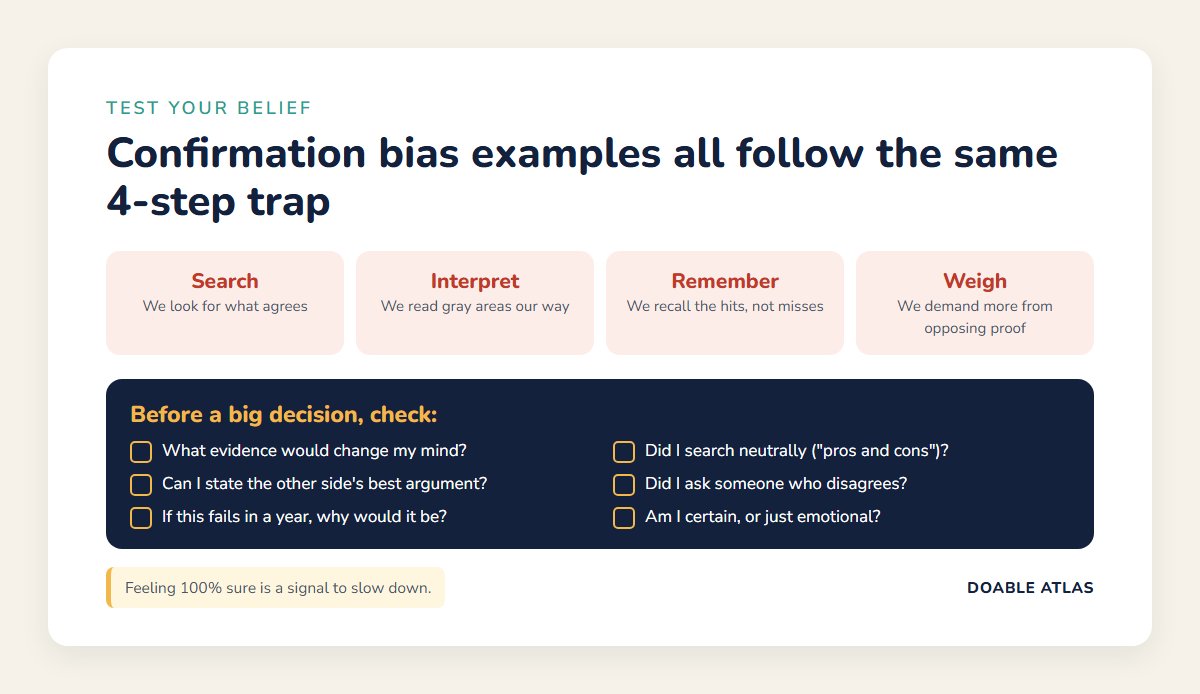
Confirmation bias is the tendency to search for, notice, interpret, and remember information in a way that supports what we already believe, while overlooking or discounting information that challenges it.
It works at several stages of thinking:
- Searching: we look for evidence that supports our view, such as typing “why X is good” rather than “is X good?”
- Interpreting: we read ambiguous information in the way that fits our expectations.
- Remembering: we recall the hits that confirm our belief more easily than the misses.
- Weighing: we hold opposing evidence to a much higher standard than evidence we like.
Confirmation bias is not a sign of low intelligence or bad character. It is a natural shortcut. Our brains handle huge amounts of information, and leaning on existing beliefs saves effort. The problem is that the shortcut can lead us confidently in the wrong direction.
15 confirmation bias examples in daily life
The examples below are grouped by area. As you read these confirmation bias examples, try to spot one you have experienced recently.
Everyday life
- Lucky charms. You wear the same shirt to every game your team wins and remember those wins vividly, while the losses in that shirt fade from memory.
- Horoscopes. A vague prediction like “a challenge will test you this week” feels uncannily accurate because you notice the events that fit and ignore the rest.
- The “full moon” effect. People who believe a full moon makes everyone act strangely tend to notice odd behavior on full-moon nights, even though large studies have generally not found a reliable link.
- Health trends. After starting a new supplement, you credit it for every good day and blame other causes for the bad ones.
Shopping and money
- Reading reviews. When you already want a product, five-star reviews seem trustworthy and one-star reviews seem written by cranks. Our guide on how to spot fake reviews helps you read both sides fairly.
- Defending a purchase. After buying an expensive gadget, you seek out articles that praise it and avoid ones that criticize it.
- Money decisions. Someone convinced a stock, a house, or a business idea will succeed may follow only the news that supports that view. Combined with the sunk cost fallacy, this can keep people invested long after the evidence has turned.
Work and school
- First impressions in hiring. An interviewer who likes a candidate in the first minute may ask easier questions and interpret neutral answers generously.
- Performance reviews. A manager who sees someone as a “star” may remember their successes and explain away their mistakes, while a struggling employee gets the opposite treatment.
- Labels in the classroom. When a student is labeled as “difficult” or “gifted,” teachers and classmates may notice behavior that fits the label.
- Project planning. Teams that are excited about a plan may dismiss early warning signs as minor issues.
Relationships
- “They always do this.” Once you believe a partner is careless, you notice every forgotten chore and overlook the ones they did.
- New crushes. In the early days of attraction, almost everything the other person does seems charming, and red flags are easy to miss.
Online and in the news
- Personalized feeds. Social media algorithms show you more of what you engage with, so your feed can gradually fill with posts that agree with you. This can amplify confirmation bias by making one view seem more common than it is.
- Searching for answers. Searching “proof that X causes Y” will usually turn up something that seems to agree, even if the weight of evidence points the other way.
Classic experiments on confirmation bias
The 2-4-6 task
In 1960, British psychologist Peter Wason gave people a simple puzzle. He told them the number sequence 2-4-6 fit a rule he had in mind, and asked them to discover the rule by proposing their own sequences. Most people guessed a rule like “even numbers increasing by two,” then tested sequences such as 8-10-12 and 20-22-24, which all fit. They became confident and announced their rule, and were often wrong.
The real rule was simply “any three numbers in increasing order.” People rarely tested sequences that would disprove their guess, such as 1-2-3 or 5-10-50. They looked for confirmation instead of trying to break their own idea. That experiment became one of the best-known demonstrations of confirmation bias.
The capital punishment study
In 1979, Stanford researchers Charles Lord, Lee Ross, and Mark Lepper asked people with strong opinions for and against the death penalty to read two fictional studies, one supporting each side. Rather than moving toward the middle, both groups rated the study that agreed with them as more convincing, found flaws in the other one, and reported feeling even more strongly about their original view afterward (Lord, Ross & Lepper, 1979).
The lesson: the same mixed evidence can push people with different starting beliefs further apart, because each side evaluates it through its own lens.
Why our brains favor confirmation
Psychologists point to several reasons this bias is so common:
- Mental efficiency. Checking every belief from scratch would be exhausting. Relying on what we already think is faster.
- Protecting our identity. Beliefs about politics, health, parenting, or ourselves are tied to who we are. Contradicting evidence can feel like a personal attack.
- Emotional comfort. Being right feels good. Being wrong, especially publicly, is uncomfortable.
- Social belonging. Agreeing with our group strengthens relationships, while questioning shared beliefs can create friction.
- Overconfidence. Most of us believe we are more objective than other people, which makes it hard to see our own blind spots.
Confirmation bias also interacts with other habits of mind. Overthinking, for example, often involves replaying evidence that supports a fear while ignoring reassuring facts. Our guide on why people overthink explains how to interrupt that loop.
Real costs of confirmation bias
In small doses, confirmation bias is harmless. Believing your lucky socks help your team costs nothing. But it can have real consequences:
- Poor decisions: ignoring warning signs in a job offer, a purchase, or an investment.
- Unfair judgments: treating people according to first impressions or stereotypes.
- Health risks: trusting a remedy because of anecdotes while overlooking evidence it does not work.
- Conflict: two people seeing the same situation completely differently and each feeling certain they are right.
- Misinformation: sharing a false story because it fits what we already believe. Our article on historical hoaxes people believed shows how often this has happened throughout history.
How to reduce confirmation bias: 8 practical habits
You cannot switch off confirmation bias completely, but you can build habits that counter it. These work especially well for important decisions.
- Ask “What would change my mind?” Before looking at evidence, decide what you would need to see to reconsider. If the answer is “nothing,” that is a warning sign.
- Search neutrally. Type “is X effective?” or “X pros and cons” rather than “why X works.”
- Consider the opposite. Deliberately list reasons your belief might be wrong. Research on debiasing has found this “consider the opposite” strategy can reduce biased judgments.
- Steelman the other side. Describe the strongest version of the opposing view, so well that someone who holds it would agree with your summary.
- Seek out a thoughtful critic. Ask someone who disagrees with you, and genuinely listen. Our guide to active listening examples can help.
- Run a pre-mortem. Before a big decision, imagine it has failed a year from now, and write down why. This surfaces risks your enthusiasm might hide.
- Track your predictions. Write down what you expect to happen and check later. Records protect you from selectively remembering the hits.
- Slow down when you feel certain. Strong emotion and total confidence are moments to pause, not to act.
Confirmation bias vs. related thinking traps
Confirmation bias often travels with other mental shortcuts. Knowing the differences helps you spot which one is at work:
- Anchoring: relying too heavily on the first piece of information you see, such as an initial price. Confirmation bias then makes you favor later information that supports that anchor.
- Availability heuristic: judging how common something is by how easily examples come to mind. Dramatic news stories feel more frequent than they are, and confirmation bias keeps you noticing more of them.
- Belief perseverance: continuing to hold a belief even after the evidence for it has been discredited.
- Motivated reasoning: reasoning toward the conclusion you want, rather than following evidence wherever it leads. Confirmation bias is one of its main tools.
- The halo effect: letting one positive trait, such as attractiveness or confidence, color your view of everything else about a person.
Many real-world confirmation bias examples involve several of these at once. A strong first impression (halo effect) becomes an anchor, and confirmation bias then filters everything that follows.
Confirmation bias and health decisions
Health is one area where confirmation bias can do real harm. When people feel strongly about a diet, a supplement, or a treatment, they may seek out testimonials and ignore larger studies. A few habits help:
- Prefer systematic reviews over single studies or stories. One dramatic anecdote is not the same as consistent evidence across many people.
- Check who benefits. Is the source selling the product it praises?
- Ask your doctor or pharmacist directly, and mention what you have read. A good professional will explain the evidence on both sides.
- Notice your emotions. Hope and fear both make us more likely to accept information that matches what we want to be true.
A 5-minute “change my mind” exercise
Want to practice? Try this short exercise once a week with any belief you hold, big or small:
- Write the belief in one sentence. For example, “Working from home makes me less productive.”
- Rate your confidence from 0 to 100 percent.
- List three pieces of evidence that support it, and three that challenge it. The second list is usually harder; that is the point.
- Find one reliable source that disagrees with you and read it in full.
- Re-rate your confidence. Even a small shift shows your thinking is responding to evidence rather than protecting a conclusion.
Over time, this habit makes you more comfortable saying “I might be wrong,” which is one of the most powerful tools a clear thinker can have.
Confirmation bias at work: a quick team checklist
Teams are especially vulnerable, because group agreement can feel like proof. Before major decisions, try asking:
- Have we looked for evidence that our plan will not work?
- Did anyone argue the opposite side, even as an exercise?
- Are we relying on data, or on the opinion of the most senior person in the room?
- What early signs would tell us we were wrong, and who will watch for them?
Assigning a rotating “devil’s advocate” role, where someone’s job is to challenge the plan, makes disagreement feel safe and expected rather than personal.
Talking with someone caught in confirmation bias
It is easy to spot confirmation bias in others and hard to see it in ourselves. When you disagree with someone, keep in mind that facts alone rarely change minds, especially when a belief is tied to identity. A gentler approach tends to work better:
- Start with curiosity: ask how they came to their view and what evidence matters most to them.
- Find common ground: agree on shared goals before discussing details.
- Ask, do not tell: “What would convince you otherwise?” invites reflection without pressure.
- Model openness: admit when they make a good point. It makes it easier for them to do the same.
For more on keeping tough conversations calm, see our guide on how to have difficult conversations.
Frequently asked questions
What is a simple example of confirmation bias?
Believing a certain brand is unreliable, then noticing every complaint about it online while ignoring positive reviews. You are filtering information to match what you already think.
What are some confirmation bias examples at work?
Common workplace confirmation bias examples include interviewers favoring candidates who made a good first impression, managers remembering a “star” employee’s successes while overlooking mistakes, and teams dismissing data that challenges a project they are excited about.
Is confirmation bias the same as being closed-minded?
Not exactly. Confirmation bias affects everyone, including open-minded people, because it operates largely automatically. Being open-minded means actively working against it, for example by seeking out opposing evidence.
How does social media increase confirmation bias?
Feeds often prioritize content similar to what you already like and engage with, which can surround you with agreeing views and make them seem more common or more certain than they are.
Who first described confirmation bias?
Thinkers noticed the tendency long ago. The philosopher Francis Bacon wrote in 1620 that once people adopt an opinion, they draw everything else in to support it. In modern psychology, Peter Wason’s experiments in the 1960s, including the 2-4-6 task, helped make confirmation bias one of the most studied thinking errors.
Why do smart people still fall for confirmation bias?
Intelligence can actually make it easier to build convincing arguments for what we already believe. Knowledge helps only when it is paired with the habit of testing our own views. That is why so many confirmation bias examples involve experts, leaders, and other highly capable people.
Is confirmation bias ever useful?
As a quick shortcut, it saves time on low-stakes choices, like sticking with a restaurant you already enjoy. It becomes a problem when the stakes are high and the evidence deserves a careful look.
Can you completely eliminate confirmation bias?
No, but you can reduce its influence. Habits like considering the opposite, searching neutrally, tracking predictions, and asking critics for feedback make a real difference, especially for important decisions.
Your next step
The confirmation bias examples in this article show how naturally our minds protect what we already believe. The goal is not to doubt everything, but to give important beliefs a fair test. Pick one decision you are facing this week, and ask yourself one question before you make it: “What evidence would change my mind?” Then go look for it.
Practicing that single habit will make you a clearer thinker, a fairer colleague, and a harder target for misinformation.