

If you are searching for how to stop procrastinating, you probably do not need another lecture about discipline. You already know the task matters. You may even know exactly what the first step is. The strange part is that knowing does not seem to help: you open the document, check one message, tidy the desk, and somehow an hour is gone.
This guide takes a different angle. Procrastination is rarely a time-management problem alone. Research increasingly treats it as a problem of managing an uncomfortable feeling in the moment. Once you see it that way, the fixes become more practical: make the task feel less threatening, decide in advance when and where you will start, and build a restart plan for the days when it still goes wrong.
Below you will find what the evidence actually says, nine fixes you can use today, a short worksheet for your most avoided task, and a few honest notes about when procrastination may be a sign of something that deserves professional attention.
In this guide
What procrastination actually is (and what it is not)
Researchers usually define procrastination as voluntarily delaying an intended action despite expecting to be worse off for the delay. Each part of that definition matters.
- Voluntary: If a flight is canceled and you cannot finish a report, that is not procrastination. You chose the delay, even if the choice felt automatic.
- Intended: You planned to do the task. Ignoring something you never meant to do is a different issue.
- Expecting to be worse off: Strategic delay, such as waiting for missing information before you write, is not procrastination. Procrastination is delay you suspect you will regret.
That last point is useful in daily life. Before you criticize yourself for waiting, ask a simple question: Is this delay helping the work, or only helping my mood? If it is helping the work, you may be planning wisely. If it is only helping your mood, you are probably procrastinating.
It is mostly about feelings, not laziness
Psychologists Fuschia Sirois and Timothy Pychyl have argued that procrastination is a form of short-term mood repair. In their 2013 paper, they described procrastination as giving priority to feeling better right now at the expense of your future self (Sirois & Pychyl, 2013). The task triggers boredom, anxiety, self-doubt, or resentment. Avoiding it makes that feeling disappear for a moment, and the relief quietly rewards the avoidance.
This explains a common experience: you are not avoiding work in general. You are avoiding one specific task while being quite busy with others. Cleaning the kitchen, answering easy emails, and reorganizing files can all be forms of productive-looking avoidance.
What a large review found
In a widely cited meta-analysis, Piers Steel reviewed a large body of procrastination research and found that delay is most strongly connected to a few recurring factors: how unpleasant the task feels, how far away the reward is, how confident a person feels about succeeding, and how impulsive or distractible they tend to be (Steel, 2007). In plain terms, we put things off when they feel bad now, pay off later, seem hard to do well, and compete with easier temptations.
That gives us four levers to work with. Every practical fix below changes at least one of them.
Why willpower alone keeps failing
Most advice about procrastination assumes the solution is to push harder. The trouble is that pushing harder makes the task feel even more unpleasant, which strengthens the urge to escape. Many people get stuck in a familiar loop:
- The task feels uncomfortable.
- You delay it and feel relief.
- The deadline gets closer, so the task now feels even more stressful.
- You criticize yourself, which adds guilt to the original discomfort.
- The next attempt starts from a worse emotional place.
The goal is not to become a person who never feels resistance. That person does not exist. The goal is to make starting cheaper than avoiding. When you understand how to stop procrastinating as a design problem rather than a character problem, you can build conditions that make the right action easier.
How to stop procrastinating: 9 fixes that work
You do not need all nine. Read through them, pick the two that fit your situation best, and try them on one real task this week.
1. Name the feeling before you try to fix the schedule
When you notice yourself avoiding something, pause for ten seconds and finish this sentence: “This task makes me feel ___ because ___.”
Examples:
- “This task makes me feel anxious because I am not sure my manager will like the proposal.”
- “This task makes me feel bored because the expense report is repetitive.”
- “This task makes me feel overwhelmed because I do not know where the tax documents are.”
Each feeling points to a different fix. Anxiety often needs a rough first draft that no one will see. Boredom needs a time limit or a small reward. Overwhelm needs a smaller first step. Naming the feeling keeps you from applying the wrong solution, such as a stricter schedule for a task that is really frightening.
2. Shrink the first step until it feels almost silly
“Write the report” is not a step. It is a project. Your brain sees the whole mountain and looks for the exit. Instead, define the first physical action so small that resistance has little to grab onto:
- Open the document and type the title.
- Put the three receipts on the table.
- Write one sentence of the email, even if it is clumsy.
- Find the login page for the insurance portal.
You are not promising to finish. You are only promising to start. Once you are moving, continuing is usually easier than starting was. If you stop after the tiny step, that is still progress, and you have reduced tomorrow’s resistance.
3. Use an if-then plan to decide when and where
Vague intentions such as “I will work on it this afternoon” are easy to postpone because the decision about when to start is still open. Psychologist Peter Gollwitzer studied a simple alternative called implementation intentions: plans written in the form “If situation X happens, then I will do Y” (Gollwitzer, 1999). A later meta-analysis that combined dozens of studies found that this kind of planning had a meaningful positive effect on goal achievement (Gollwitzer & Sheeran, 2006).
Examples you can adapt:
- “If I sit down at my desk after lunch, then I will open the budget spreadsheet before checking email.”
- “If it is 7:30 p.m. on Tuesday, then I will spend fifteen minutes on the application essay at the kitchen table.”
- “If I feel the urge to check my phone during the task, then I will write the thought on a sticky note and keep going.”
The plan works because it moves the decision earlier, when you are calm, instead of leaving it to the moment when the task feels uncomfortable.
4. Make the task shorter, not just smaller
A time box is a fixed, short window of effort. Set a timer for 10, 15, or 25 minutes and agree to work only until it ends. This changes the task from “an unpleasant thing with no visible end” into “a limited effort I can tolerate.”
The Pomodoro Technique, created by Francesco Cirillo, popularized this idea with 25-minute work periods followed by short breaks. You do not need to follow any method exactly. The useful principle is that a visible end point lowers the emotional cost of starting.
Two tips make time boxes more effective:
- Decide the output in advance: “Outline three sections,” not “work on the presentation.”
- Stop when the timer ends at least some of the time: If every time box secretly turns into a two-hour session, your brain learns that the short promise was a trick.
5. Remove the easiest escape routes
Avoidance needs somewhere to go. For most adults today, that place is a phone, a browser tab, or an inbox. You do not have to rely on resisting those temptations if you make them slightly harder to reach.
- Put your phone in another room or in a drawer during a focused block.
- Close every tab you do not need for the task.
- Turn off notifications for the length of one time box.
- Keep only the materials for one task on your desk.
Small barriers matter because procrastination usually happens in seconds. If checking a feed takes three taps, you will do it automatically. If it takes a walk to another room, you have a moment to notice the urge and choose differently. If digital clutter is a constant pull, our digital declutter checklist walks through a focused 30-minute reset for files, notifications, and tabs.
6. Bring the reward closer
One reason we delay important tasks is that their benefits arrive later, while the discomfort arrives now. You can partly close that gap by adding a small, immediate reward to the work itself.
- Allow yourself a favorite coffee or playlist only while you work on the avoided task.
- Track each completed session with a simple mark on a calendar, so progress is visible today.
- Pair a boring task with a pleasant setting, such as doing paperwork at a library or cafe.
Keep rewards modest and connected to starting, not only to finishing. Rewarding the start teaches your brain that beginning is safe.
7. Lower the bar for the first draft
Perfectionism and procrastination often travel together. When the standard in your head is “excellent on the first try,” every attempt feels like a test you might fail. Delay protects you from that judgment, at least for a while.
Try giving the first attempt a different job. Its purpose is to exist, not to impress anyone. Label the file “rough draft.” Write in bullet points. Leave brackets where you are unsure, such as [add numbers here]. You can raise the quality during a second pass, when there is something concrete to improve.
This is especially helpful for writing, creative work, and difficult messages. It is much easier to edit a clumsy paragraph than to fill a blank page with a perfect one.
8. Forgive yesterday’s delay so today can start clean
It may sound soft, but self-forgiveness has evidence behind it. In a study of university students, those who forgave themselves for procrastinating while studying for a first exam procrastinated less when preparing for the next one (Wohl, Pychyl & Bennett, 2010). The likely reason is that harsh self-criticism keeps the task tied to negative feelings, which makes avoidance more tempting.
Forgiveness is not the same as pretending it did not matter. A useful script is: “I delayed this, and it cost me some time. That is understandable, and it is also fixable. What is the next small step?” You acknowledge the cost, release the guilt, and move straight to action.
9. Plan the restart before you need it
Even with good systems, some days will go badly. Sleep is poor, a family issue appears, or the task turns out to be harder than expected. The difference between a bad day and a bad month is often whether you have a restart plan.
Decide ahead of time what you will do after a missed session. For example: “If I skip a planned session, I will do a 10-minute version at the next available slot, not wait until Monday.” The same principle appears in our guide on how to build better habits: missing once is information, while waiting for a perfect fresh start is how one miss becomes many.
A 10-minute worksheet for your most avoided task
This worksheet turns the ideas about how to stop procrastinating into a plan for one specific task. Use it the next time you notice yourself avoiding something. Write the answers on paper or in a note. It takes about ten minutes and often makes the task feel noticeably lighter. You can also save or print the version below.
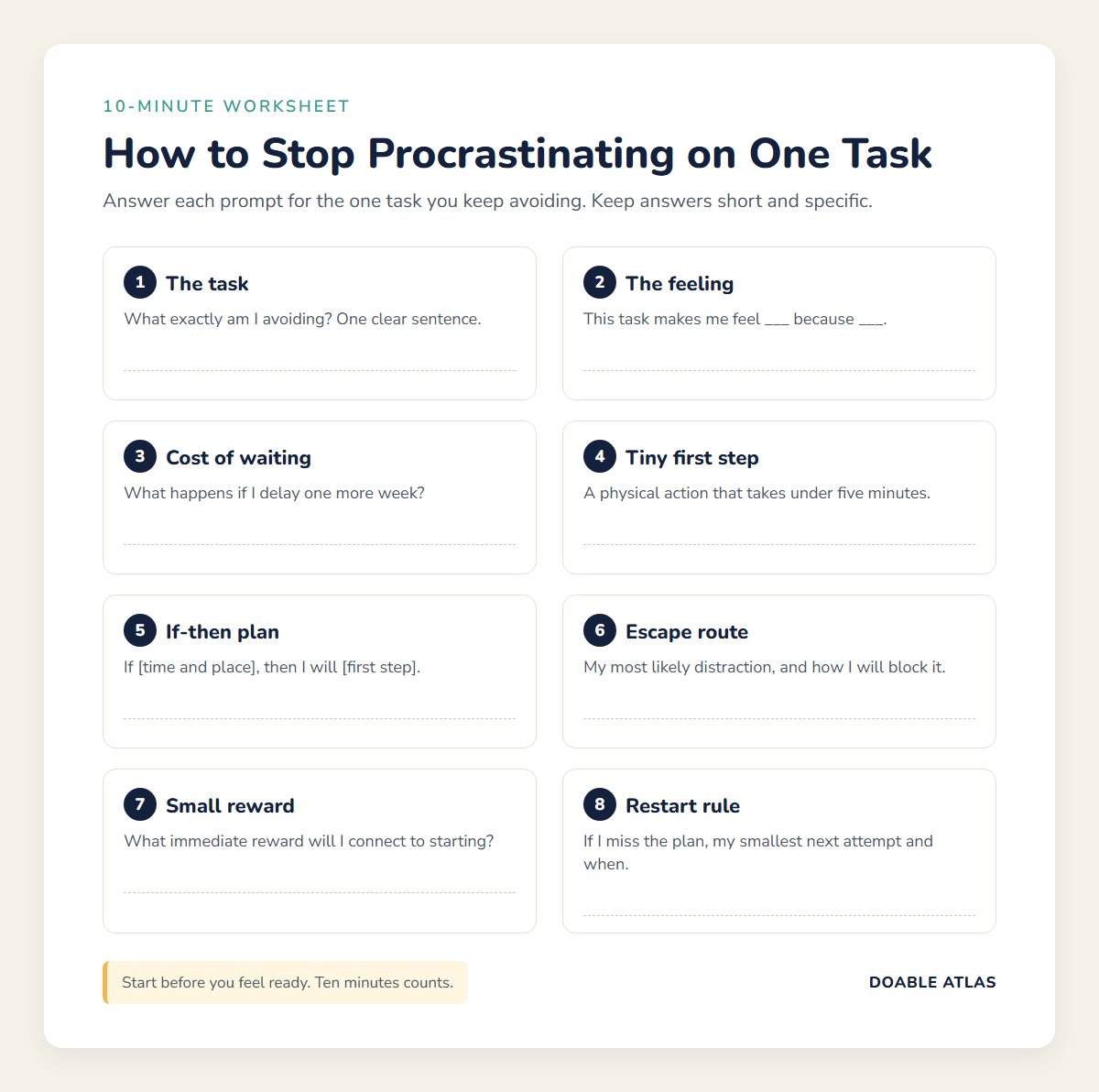
- The task: What exactly am I avoiding? Write one clear sentence.
- The feeling: What does this task make me feel, and why?
- The real cost of waiting: What happens if I delay another week? Be specific and calm, not dramatic.
- The tiny first step: What is a physical action that takes under five minutes?
- The if-then plan: If [time and place], then I will [tiny first step].
- The escape route: What is my most likely distraction, and how will I block it?
- The reward: What small, immediate reward will I connect to starting?
- The restart rule: If I miss the plan, what is the smallest next attempt and when?
Example: a delayed job application
Here is how a completed worksheet might look for someone who has been putting off an application for two weeks:
- Task: Submit the application for the operations coordinator role.
- Feeling: Anxious, because I worry my resume is not strong enough.
- Cost of waiting: The posting may close, and I will keep thinking about it every evening.
- Tiny first step: Open my resume and change the date of my current job.
- If-then plan: If I finish dinner on Wednesday, then I will sit at the desk and open my resume before turning on the TV.
- Escape route: My phone. It goes on the charger in the bedroom.
- Reward: I will make tea and use my favorite mug while I work.
- Restart rule: If Wednesday falls apart, I will do 10 minutes on Thursday before work.
Notice what is missing: there is no promise to finish the whole application in one sitting, and there is no harsh language. The plan is built to make the first move nearly automatic.
Common procrastination patterns and what to try
There is no single answer to how to stop procrastinating, because different kinds of delay respond to different fixes. Use this quick guide to match your pattern with a starting point.
“I will start once I feel motivated”
Motivation often follows action rather than coming before it. Waiting for the right mood can mean waiting indefinitely. Try the tiny first step and a 10-minute time box. Let motivation catch up with you.
“I work best under pressure”
Some people do produce focused work near deadlines, but the cost usually shows up as stress, lower sleep quality, or work that could have been better with more time. If this sounds familiar, create an earlier artificial deadline with a real consequence, such as promising a draft to a colleague by Thursday.
“I do not know where to begin”
This is usually a planning gap, not a motivation gap. Spend your first session only on listing the steps, in any order. Then pick the easiest step, not the most important one, to build momentum.
“I keep busy with other tasks instead”
Productive procrastination feels responsible, which makes it hard to notice. Decide each morning on the single task that matters most, and do a short session on it before anything else. A weekly reset can help you choose that task in advance so you are not deciding under pressure.
“I start, but stop as soon as it gets hard”
When you hit a difficult point, write down the exact question you are stuck on before you stand up. Coming back to a clear question is much easier than coming back to a vague sense of difficulty.
Building an environment that makes starting easier
Individual techniques help, but your surroundings can quietly support or undermine them. Figuring out how to stop procrastinating is much easier when your environment is not working against you.A few changes can make starting easier every day, not only when you remember a tactic.
- Prepare the night before: Leave the document open, the notebook on the desk, or the gym bag by the door. Starting is easier when the first step is already set up. Our evening reset routine includes a simple way to do this.
- Use a consistent place: If possible, link one location with focused work. Over time, sitting there becomes a cue to begin.
- Protect your best hours: Many people have a time of day when they think more clearly. Put avoided tasks there instead of saving them for the end of the day.
- Keep a visible short list: Three priorities for the day are easier to act on than a list of thirty items.
When procrastination may be a sign of something more
Most procrastination is ordinary and responds well to the strategies above. Sometimes, however, chronic delay is connected to other conditions. Persistent difficulty starting tasks, sustaining attention, and finishing work across many areas of life can be associated with ADHD. Losing interest in nearly everything, low energy, and hopelessness can be signs of depression. Intense worry that makes many tasks feel threatening can be related to anxiety.
This article cannot diagnose anything, and many people procrastinate without having any of these conditions. But if procrastination is seriously affecting your work, relationships, finances, or health, and self-help strategies are not making a difference, consider talking with a doctor or licensed mental health professional. The National Institute of Mental Health offers reliable background information on ADHD and other topics if you want to learn more first.
Frequently asked questions
Is procrastination a sign of laziness?
Usually not. Laziness suggests an unwillingness to make effort. Many people who procrastinate care a great deal about the task and spend a lot of energy worrying about it. Research points more toward difficulty managing uncomfortable feelings than toward a lack of effort.
How long does it take to stop procrastinating?
There is no fixed timeline, and the goal is not to eliminate procrastination completely. Most people notice a difference within a week or two of using one or two strategies consistently on real tasks. The skill improves with practice, especially the habit of starting with a tiny step.
Do productivity apps help with procrastination?
They can, but only when they support a clear plan. A timer, a simple task list, or a website blocker can reduce friction. Spending hours setting up a complex system can itself become a form of avoidance. Start with the simplest tool that solves your most frequent problem.
What is the fastest way to stop procrastinating right now?
Pick the task you are avoiding, define a first step that takes under five minutes, put your phone out of reach, and set a 10-minute timer. Start before you feel ready. When the timer ends, decide whether to continue.
Your next step
Learning how to stop procrastinating is less about becoming a different person and more about changing the moment of starting. Choose one task you have been avoiding. Write the feeling it creates, define a first step you can finish in five minutes, and make an if-then plan for when and where you will do it. Then do only that step.
If it goes well, repeat the same process tomorrow. If it does not, use your restart rule and try a smaller version. Progress built this way may look modest at first, but it is the kind that holds up during busy, imperfect weeks.