

The last days of December are a natural pause. Before you rush into new goals, it is worth looking back: what happened this year, what you learned, what you want to keep and what you are ready to leave behind. The easiest way to do that is with a short list of good questions.
This guide gives you 60 year in review questions organized by theme, a free one-page printable worksheet, a simple 45-minute reflection routine, and tips for doing a year in review with a partner, your family or your team. Pick the questions that speak to you, grab a notebook and give yourself an hour of honest, kind reflection.
Quick answer
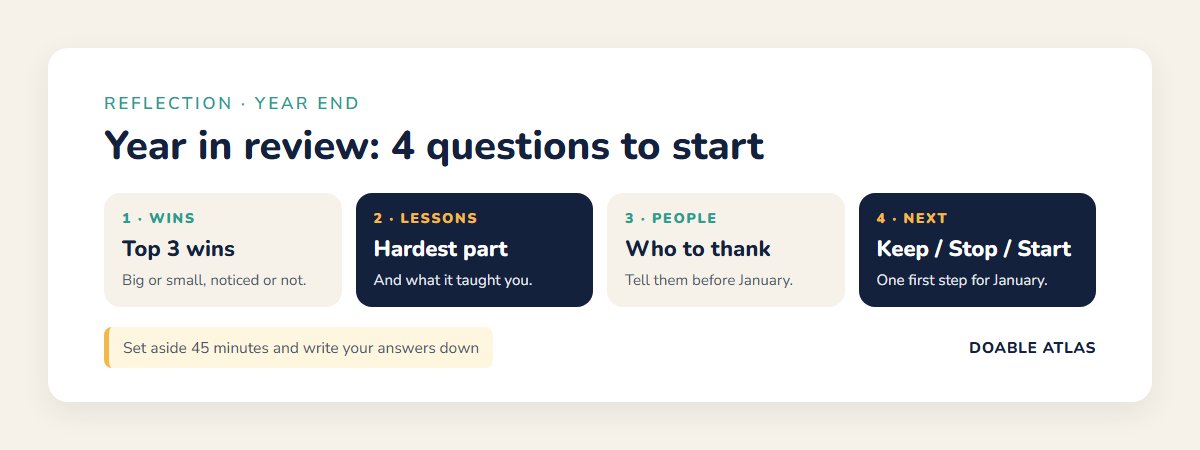
The best year in review questions cover highlights, challenges, lessons, health, money, relationships, work and the year ahead. Start with “What were my three biggest wins?” and “What was hardest, and what did it teach me?”, then finish with “What do I want to keep, stop and start next year?” Set aside 45 minutes, answer in writing, and choose one or two insights to carry into January.
In this guide
Why year in review questions are worth your time
Most of us remember a year through a few vivid moments and the last few weeks. Writing answers to year in review questions helps you see the whole picture: small wins you forgot, patterns that kept repeating, people who mattered and lessons you earned the hard way.
- You notice progress. Seeing what you actually accomplished is motivating, especially after a tough year.
- You learn from mistakes without dwelling on them, because a question turns regret into a lesson.
- You set better goals. Goals built on real reflection are more realistic than goals built on guilt. Our guide on how to set achievable goals shows the next step.
- You build gratitude. In a well-known study, people who wrote weekly about things they were grateful for reported feeling better about their lives than those who wrote about hassles or neutral events (Emmons & McCullough, 2003).
How to use these year in review questions
- Choose a quiet time. The week between Christmas and New Year’s Day is ideal, but any calm evening in December or January works.
- Gather memory aids. Scroll your phone’s photos month by month, glance at your calendar and check old notes. They will jog memories you would otherwise miss.
- Write, don’t just think. Writing slows your mind down and makes answers more honest and specific.
- Skip freely. You do not need to answer all 60 year in review questions. Choose 10 to 20 that feel useful.
- Be kind. Aim for curiosity, not judgment. “What did this teach me?” is more useful than “Why did I fail?”
60 year in review questions
Highlights and wins
- What were my three biggest wins this year?
- What am I most proud of, even if nobody else noticed?
- What was the best day of my year, and why?
- What new thing did I try for the first time?
- What small habit made a big difference?
- Which moment would I relive if I could?
- What compliment or kind word stayed with me?
- What did I finish that I had been putting off?
Challenges and lessons
- What was the hardest part of my year?
- What did that challenge teach me about myself?
- What mistake taught me the most?
- When did I feel most stressed, and what helped?
- What did I worry about that never happened?
- What would I do differently if I could replay the year?
- What did I learn to let go of?
- Where did I show resilience I didn’t know I had?
Health and energy
- How did I feel physically for most of the year?
- What gave me the most energy? What drained it?
- How were my sleep habits, and what affected them?
- What kind of movement did I actually enjoy?
- What did I do to take care of my mental health?
- What is one health habit I want to keep or start?
If sleep or energy keeps showing up in your answers, our evening reset routine is a gentle place to start.
Money
- Did my spending reflect what I value most?
- What was my best money decision this year?
- What purchase was not worth it?
- Which subscriptions or bills surprised me?
- How did I feel about money most of the time: calm, anxious, in control?
- What is one money habit I want to build next year?
Turn your answers into action with a simple budget spreadsheet or a quick subscription check using our guide to subscriptions vs one-time purchases.
Relationships
- Who supported me most this year?
- Who did I grow closer to? Who did I drift away from?
- Which conversations mattered most?
- Who do I want to thank, and have I told them?
- Where did I need to set a boundary, and did I?
- What relationship do I want to invest in next year?
For tricky conversations ahead, see how to have difficult conversations and how to set boundaries politely.
Work and learning
- What work am I most proud of this year?
- What skill did I improve or learn?
- When did I feel most focused and productive?
- What tasks drained me, and can I change them?
- What feedback helped me grow?
- What book, course or idea changed how I think?
- What do I want to learn next year?
- Where do I want my career or studies to be by next December?
Home and daily life
- Which part of my home made life easier? Which made it harder?
- What routine worked well this year?
- What clutter, physical or digital, weighed on me?
- How did I spend most of my free time?
- How much time did my phone take, and was it worth it?
- What simple change would make daily life smoother?
Our new year reset checklist turns these answers into a short, practical to-do list.
Joy and meaning
- When did I laugh the hardest?
- What made me feel truly like myself?
- What surprised me in a good way?
- What place, song, meal or book defined my year?
- What am I most grateful for right now?
- If my year were a movie, what would its title be?
Looking ahead
- What do I want to keep doing next year?
- What do I want to stop doing?
- What do I want to start?
- What one word do I want to guide my next year?
- What would make next year feel successful, in one sentence?
- What is the very first step I can take in January?
When you are ready to set goals, our guide to new year resolutions that actually stick shows how to turn these answers into habits.
Free printable: year in review worksheet
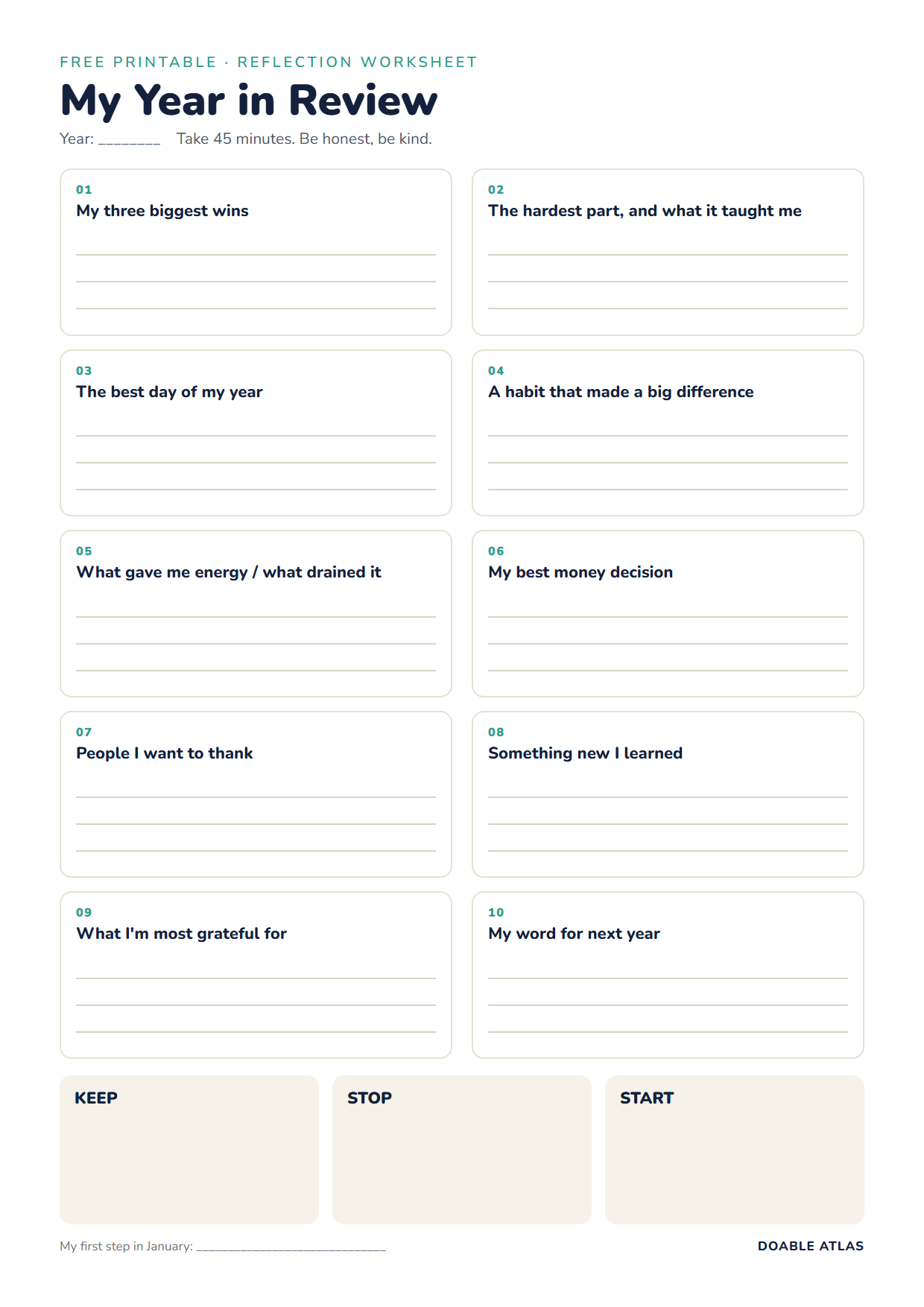
Prefer pen and paper? This one-page worksheet includes the 10 most useful year in review questions with space to write, plus a keep, stop and start box. Print it, fill it in with a cup of tea and keep it with next year’s planner.
Download the year in review worksheet printable
A 45-minute routine for your year in review questions
| Time | Step | What to do |
|---|---|---|
| 0–10 min | Remember | Scroll photos and your calendar month by month; jot down key moments |
| 10–25 min | Reflect | Answer 8–10 questions from highlights, challenges and lessons |
| 25–35 min | Look at life areas | Pick one or two questions each from health, money, relationships and work |
| 35–42 min | Keep, stop, start | List three things in each column for next year |
| 42–45 min | Choose | Circle one insight and write your first step for January |
Year in review questions after a hard year
Not every year deserves a celebration. If this year brought loss, illness, job trouble or burnout, the usual “biggest wins” questions can feel hollow. Try these gentler year in review questions instead:
- What helped me get through the hardest days?
- Who showed up for me, even in small ways?
- What did I survive that I once thought I couldn’t?
- What do I need more of next year: rest, support, space or structure?
- What is one small comfort I want to keep, like a walk, a call or a favorite meal?
- What would I tell a friend who went through the year I just had?
Go slowly, take breaks and stop whenever you need to. If the year left you feeling hopeless for weeks, please talk with a doctor, a counselor or someone you trust; in the US you can call or text 988 at any time.
Use your phone to remember the year
Your phone is a surprisingly good memory aid for year in review questions. Before you start writing, spend ten minutes with these:
- Photos: scroll month by month. Most photo apps also create automatic “year” or “memories” collections.
- Calendar: skim each month for trips, events, appointments and deadlines.
- Notes and messages: search for words like “excited”, “finally” or “thank you”.
- Screen time reports: check which apps took most of your time, then ask whether that matches what you value.
- Bank statements: your spending is a record of how you lived; look for patterns, not just totals.
If your photos are scattered, this is also a great moment to back them up. Our guides on how to back up your phone and how to organize digital files make it quick.
Turn your year in review into next year’s plan
Reflection is most valuable when it shapes what you do next. Once you have answered your year in review questions, take these four steps:
- Circle repeating themes. If “tired”, “rushed” or “money stress” appears several times, that is your starting point.
- Pick one to three focus areas. For example, sleep, savings and time with friends.
- Write one specific action for each. “Bed by 11 p.m. on weeknights” is easier to follow than “rest more”.
- Schedule a check-in. Put a 20-minute review on your calendar for the end of March to see how it is going.
Our guide on how to plan your week helps you turn those focus areas into a weekly rhythm.
Year in review questions for couples and families
Reflecting together can be surprisingly fun and bonding, and it often sparks stories nobody has told in months. Set a relaxed tone: this is a conversation, not a performance review. Make it a cozy tradition with snacks and old photos, and let everyone answer in turn:
- What was our favorite day together this year?
- What was the funniest thing that happened in our home?
- What did we get better at as a team?
- What was hard for us, and how did we get through it?
- What tradition do we want to keep or start?
- What adventure do we want to plan for next year?
For kids, keep questions simple: “What made you happiest this year?”, “What new thing did you learn?” and “What are you excited about next year?” Writing the answers in a family notebook each December creates a lovely record to read years later.
Year in review questions for work and teams
A short team retrospective at year end helps everyone see progress and plan smarter. Try these:
- What are we most proud of delivering this year?
- What helped us work well together?
- What slowed us down or caused frustration?
- What did we learn from our biggest challenge?
- What should we keep, stop and start next year?
- Who deserves a thank-you that they may not have heard?
Collect answers anonymously if people may hesitate to share openly, then discuss themes together. Our guide to healthy communication skills can help the conversation stay constructive.
Tips for answering year in review questions honestly
- Write by hand if you can. Many people find it slower and more reflective than typing.
- Look for patterns, not single events. Did the same stress show up in March, June and October?
- Balance the list. If you only see problems, return to the wins section. If you only see wins, ask what you avoided.
- Separate facts from stories. “I missed three workouts in May” is a fact; “I’m lazy” is a story. Our article on why people overthink explains this trap.
- End with gratitude. Finishing on what went right makes the next year feel more hopeful.
Year in review questions vs. journaling prompts
Year in review questions and everyday journaling prompts are close cousins, but they do different jobs. Daily prompts help you process what is happening right now. Year in review questions zoom out, so you can see trends that are invisible day to day: the friendship that slowly grew, the habit that quietly stuck, the stress that kept returning every quarter.
The two work beautifully together. If you journal during the year, even a few lines a week, your December review becomes much richer because you can reread real notes instead of relying on memory. If you have never journaled, your year in review questions are a perfect first step. Many people enjoy the process so much that they keep a small notebook for monthly mini reviews afterward. A simple monthly version needs only three year in review questions: what went well, what was hard and what will I try next month?
Common mistakes with year in review questions
- Trying to answer everything. Ten thoughtful answers beat 60 rushed ones.
- Turning reflection into self-criticism. Keep the tone curious and kind.
- Skipping the “so what?” Every review should end with one or two concrete changes.
- Comparing your year to others. Social media highlights are not a fair benchmark. See how to stop comparing yourself to others.
- Doing it once and forgetting it. Keep your answers and reread them next December.
Quick quiz: year in review questions
1. How many year in review questions should you answer?
Usually 10 to 20 is plenty. Choose the ones that feel most useful.
2. What simple framework turns reflection into action?
Keep, stop, start: list what to keep doing, what to stop and what to start next year.
3. What is a good memory aid before you start?
Scroll your phone photos and calendar month by month.
Year in review questions FAQ
When should I do a year in review?
Late December or the first week of January works well, but any quiet time is fine. Some people also do a short review every quarter.
How long does a year in review take?
About 45 minutes for a solid review using 10 to 20 questions. A deeper version can take a relaxed afternoon.
What are the best year in review questions to start with?
“What were my three biggest wins?”, “What was hardest and what did it teach me?” and “What do I want to keep, stop and start next year?”
Should I share my year in review?
That is up to you. Many people keep it private; others enjoy sharing highlights with a partner, friend or family to celebrate together.
The bottom line
A thoughtful year in review takes less than an hour and pays off all next year. Choose a handful of year in review questions, look back with curiosity and kindness, notice what worked and what didn’t, and finish with a clear keep, stop and start list. Print the worksheet, pour a warm drink and give yourself the gift of looking back before you leap forward.