

It is Monday, 9:40 a.m. You have answered fourteen emails, put out one small fire, and still have not touched the thing that actually matters this week. By Wednesday, the week feels like it is running you. By Friday, you are wondering where it went. Sound familiar? The fix is not working harder or waking up at 5 a.m. It is a simple, repeatable habit: spending about 30 minutes, once a week, deciding what the week is for.
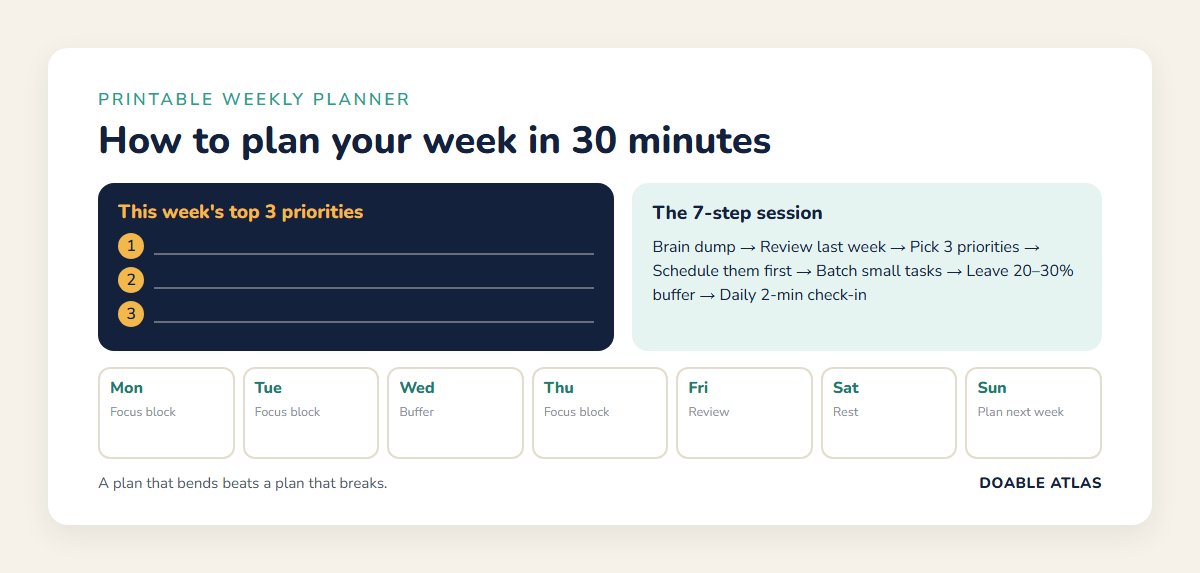
This guide shows you exactly how to plan your week in seven steps, with a sample weekly plan, ready-made templates for different lifestyles, and the research on why planning works so well. You will also find a printable one-page weekly planner you can save and use every Sunday.
Quick answer
To plan your week: (1) empty your head onto paper, (2) review last week and your calendar, (3) pick three priorities, (4) schedule them first as time blocks, (5) batch small tasks and errands, (6) add buffer time, and (7) end with a short daily check-in. The whole process takes about 30 minutes.
In this guide
Why weekly planning works better than daily to-do lists
Daily to-do lists are useful, but they have a blind spot: they only see one day at a time. Important projects rarely fit into one day, so they keep getting pushed to “tomorrow” while urgent but less important tasks take over. A weekly plan zooms out just far enough to see the big picture while staying close enough to act on.
Learning how to plan your week gives you three big advantages:
- Priorities get protected time. When your most important work has a slot on the calendar, it is far less likely to be crowded out.
- You see conflicts early. The dentist appointment, the school event, and the deadline all appear on one page before they collide.
- Your mind feels lighter. Unfinished tasks tend to nag at us. Making a concrete plan for them reduces that mental noise, as research below shows.
What the research says about planning
Three well-known findings explain why a weekly plan is so effective.
Plans quiet the mental noise
Psychologists E. J. Masicampo and Roy Baumeister found that unfinished goals tend to intrude on our thoughts and distract us. But simply making a specific plan for how and when to complete a goal reduced those intrusive thoughts, even before the task was done (Masicampo & Baumeister, 2011). In other words, a good plan lets your brain stop reminding you.
“When and where” plans boost follow-through
Peter Gollwitzer’s research on implementation intentions showed that people who decide in advance exactly when, where, and how they will act on a goal are much more likely to follow through than people who only set the goal (Gollwitzer, 1999). A weekly plan is essentially a set of implementation intentions for your most important work.
We consistently underestimate time
The planning fallacy describes our habit of underestimating how long tasks will take, even when we know similar tasks ran late before. In one study, students’ predictions of when they would finish their theses were far too optimistic: on average, they took longer than even their “worst case” estimates (Buehler, Griffin & Ross, 1994). This is why the steps below build in buffer time.
How to plan your week in 7 steps
Here is how to plan your week from start to finish. Choose a regular time, such as Sunday evening or Friday afternoon, and give yourself about 30 minutes with a notebook, planner, or calendar app.
Step 1: Do a brain dump (5 minutes)
Write down everything on your mind: work tasks, errands, calls to return, bills, birthdays, ideas, worries. Do not organize yet. The goal is to get it all out of your head and onto one page, where you can see it clearly. Most people are surprised by how much they were carrying around.
Step 2: Review last week and your calendar (5 minutes)
Look back before you look ahead. What got done? What slipped, and why? Then open your calendar for the coming week and note fixed commitments: meetings, appointments, school pickups, classes, social plans. These are the boundaries your plan has to fit around. If you already use a weekly reset checklist, this step slots in naturally.
Step 3: Choose your top three priorities (5 minutes)
From your brain dump, pick the three outcomes that would make this week a success. Not three tasks, three outcomes: “Submit the project proposal,” “Finish the budget review,” “Go to the gym three times.” Three is enough to make progress and few enough to protect. If you struggle to choose, ask, “If I could only finish one thing this week, which would make everything else easier?” For help picking realistic targets, see our guide on how to set achievable goals.
Step 4: Schedule your priorities first (5 minutes)
This is the heart of knowing how to plan your week. Block time on your calendar for each priority before anything else claims those hours. Put demanding work in the times when you have the most energy, often mornings for many people. Treat these blocks like appointments with your most important client: you. If this approach is new to you, our guide to time blocking for beginners walks through it step by step.
Step 5: Batch the small stuff (4 minutes)
Group similar small tasks so they do not fragment your days: one block for emails and messages, one for errands, one for admin and bills. Batching reduces the mental cost of switching between different kinds of tasks and keeps small jobs from leaking into your focus time.
Step 6: Add buffer time (3 minutes)
Because of the planning fallacy, assume things will take longer than you expect. Leave roughly 20 to 30 percent of your working time unplanned. Use it for overruns, surprises, and the tasks you forgot. A plan with no slack breaks the first time something unexpected happens, and something always does.
Step 7: Set a daily check-in (3 minutes)
Your weekly plan is a map, not a contract. Each morning or evening, take two minutes to look at the plan, adjust today’s tasks, and move anything that slipped. An evening reset routine is a great place for this check-in, because it lets you start the next day already knowing your first move.
A sample weekly plan
Here is an example of how to plan your week for someone with a full-time job, a gym goal, and a few household tasks. Notice how the three priorities get the best slots and how the week includes buffer time.
| Day | Morning focus block | Afternoon | Evening |
|---|---|---|---|
| Mon | Priority 1: draft proposal | Meetings, email batch | Gym |
| Tue | Priority 1: finish proposal | Admin and calls | Free |
| Wed | Priority 2: budget review | Buffer | Gym |
| Thu | Submit proposal | Meetings, email batch | Errands batch |
| Fri | Priority 2: finish review | Buffer + weekly review | Gym |
| Sat/Sun | Rest and fun | Groceries, meal prep | 30-minute weekly plan |
How to plan your week: templates for different lifestyles
There is no single right answer to how to plan your week. Here is how to adapt the steps to your situation.
For busy parents
- Start with the family calendar: school events, activities, appointments, and who drives where.
- Choose one personal priority alongside the family logistics, so your own goals do not disappear.
- Plan dinners for the week before you shop. A simple meal plan saves time, money, and wasted food. Our guide on how to keep food fresh longer helps groceries last until the end of the week.
- Hold a five-minute Sunday “family huddle” so everyone knows what is coming.
For students
- List every deadline for the next two weeks, not just this one, so nothing sneaks up on you.
- Break big assignments into weekly milestones: research, outline, draft, edit.
- Schedule study blocks right after classes, while the material is fresh.
- Protect sleep. All-nighters undo much of the benefit of planning.
For remote workers and freelancers
- Set clear start and end times for each day. Without an office, work expands to fill every hour.
- Batch client communication into one or two windows a day.
- Plan one block each week for admin: invoices, taxes, and tracking income. A simple budget spreadsheet makes this fast.
- Schedule movement and social contact, which remote work can easily crowd out.
For anyone who hates rigid schedules
- Skip the hour-by-hour calendar. Instead, give each day a theme, such as “Monday: deep work, Tuesday: meetings, Wednesday: errands.”
- Keep the three priorities, but let yourself choose when to do them each day.
- Use a simple “today, this week, later” list instead of time blocks.
How to plan your week when everything feels urgent
Some weeks, every task arrives labeled “ASAP.” That is exactly when knowing how to plan your week matters most, because without a filter, the loudest request wins instead of the most important one. A simple tool called the Eisenhower matrix, named after U.S. President Dwight D. Eisenhower, helps you sort tasks into four boxes:
- Urgent and important: real deadlines and genuine emergencies. Do these first, and schedule them early in the week.
- Important but not urgent: planning, learning, health, relationships, and long-term projects. This is where your top three priorities usually live. Block time for them, or they will never happen.
- Urgent but not important: many interruptions, some meetings, and other people’s last-minute requests. Batch them, delegate them, or keep them short.
- Neither urgent nor important: mindless scrolling and busywork. Drop them or save them for downtime.
Run your brain dump through these four boxes during Step 3. You will often find that only a handful of tasks are truly urgent and important, and that the “important but not urgent” box holds the work that will make next month easier.
A 10-minute weekly review: questions to ask
The review in Step 2 is where weekly planning gets smarter over time. Here are the questions that make it most useful. Answer them quickly, in a few words each.
- What were my three priorities last week, and did I finish them?
- What took longer than I expected, and by how much?
- What interrupted me most often?
- When did I have the most energy? The least?
- What did I say yes to that I should have declined?
- What went well that I want to repeat?
- What is one change I will make this week?
Over a few weeks, your answers reveal patterns. Maybe Tuesday afternoons always disappear into meetings, or writing tasks always take twice as long as planned. Each insight makes your next plan more realistic. This review is the difference between simply knowing how to plan your week and getting better at it every single week.
Paper planner or digital app?
Both work. The best tool is the one you will actually open every day. Here is a quick comparison to help you decide how to plan your week:
- Paper planner: fewer distractions, easier to see the whole week at a glance, and many people remember things better when they write them by hand. Downside: no reminders, and it is harder to move things around.
- Digital calendar: reminders, easy rescheduling, sharing with family or coworkers, and access on your phone. Downside: notifications and other apps can pull you off track.
- Hybrid: plan the week on paper on Sunday, then copy fixed appointments and priority blocks into your digital calendar for reminders. Many people find this gives them the best of both.
Common weekly planning mistakes
When people try to learn how to plan your week effectively, these are the mistakes that most often derail them:
- Planning every minute. A fully packed schedule leaves no room for reality. Keep buffer time.
- Too many priorities. If everything is a priority, nothing is. Stick to three.
- Ignoring energy levels. Scheduling your hardest work at your lowest-energy time sets you up to procrastinate. See our guide on how to stop procrastinating if this is a pattern.
- Skipping the review. Without looking back, you repeat the same planning errors every week.
- Treating the plan as a test. Moving tasks is not failure. Adjusting is the whole point of a daily check-in.
- Forgetting rest. A week with no downtime is not productive; it is a fast track to burnout.
Make it a habit
The real power of learning how to plan your week comes from repetition. The first few sessions may take longer than 30 minutes. After a month, most people find it quick and even relaxing.
- Same time, same place. Attach the session to something you already do, such as Sunday evening tea.
- Use the same template every week. Fewer decisions make the habit easier to keep.
- Make it pleasant. Favorite music, a good pen, a quiet corner. Small rewards help habits stick.
- Track your streak. Mark each completed planning session on a calendar. Seeing the streak grow is motivating.
For more on turning routines like this into automatic habits, read our guide on how to build better habits, and pair your weekly plan with a morning routine for productivity to start each day strong.
Your Sunday planning checklist
Copy this short checklist into your planner or phone and run through it every week:
- ☐ Brain dump finished: nothing important left only in my head
- ☐ Last week reviewed with the seven questions above
- ☐ Fixed appointments and deadlines added to the calendar
- ☐ Top three priorities written down as outcomes
- ☐ Priority blocks scheduled in high-energy time slots
- ☐ Email, errands and admin grouped into batches
- ☐ At least 20 percent of the week left as buffer
- ☐ Meals and grocery list planned for the busiest days
- ☐ Rest, exercise and time with people I care about on the calendar
- ☐ First task for Monday morning decided
When every box is ticked, close the planner and enjoy the rest of your weekend. The week ahead already has a shape.
Frequently asked questions
What is the best day to plan your week?
Sunday evening and Friday afternoon are the most popular choices. Friday works well if you want to start the weekend with a clear head; Sunday works well if you prefer planning with fresh energy just before the week begins. Choose the one you can stick to consistently.
How long does it take to learn how to plan your week?
About 30 minutes is a good target. Your first few sessions may take longer while you set up a template. With practice, many people finish in 20 minutes.
How many priorities should a weekly plan have?
Three is a practical number. It is enough to make meaningful progress and few enough to protect with scheduled time. Everything else goes into batches or onto a “later” list.
What should I do when my weekly plan falls apart?
Do not throw it away. Use your daily check-in to move tasks, use buffer time for the overflow, and ask what caused the disruption. Then build that lesson into next week’s plan. A plan that bends is better than one that breaks.
Is weekly planning better than daily planning?
They work best together. Knowing how to plan your week gives you direction and protects your priorities; a short daily check-in turns that plan into today’s specific actions.
Your next step
You now know how to plan your week in a way that is realistic, flexible, and built around what matters most. Do not wait for a perfect Sunday. Put a 30-minute planning session on your calendar for this weekend, grab the printable planner above, and pick just three priorities.
One planning session will not change your life. But a planning session every week, repeated for a few months, quietly changes how your weeks feel: less reactive, more intentional, and far more likely to include the things you actually care about.