

You sit through a terrible movie because you paid for the ticket. You keep pouring money into a car that breaks down every month because you have already spent so much on repairs. You stay in a course, a project, or even a relationship long after it stopped working, because walking away would mean all that time was “wasted.” These are classic sunk cost fallacy examples, and almost everyone falls for them.
This guide explains what the sunk cost fallacy is, walks through real-life examples from money, work, relationships, and everyday decisions, looks at the psychology behind it, and gives you a simple four-question check to make clearer decisions. You will also learn when sticking with something is actually the smart choice.
In this guide
What is the sunk cost fallacy?
A sunk cost is any cost you have already paid and cannot get back: money spent, time invested, effort made. The sunk cost fallacy is the tendency to keep investing in something because of what you have already put in, rather than because of what you expect to get out of it in the future.
In economic terms, sunk costs should be irrelevant to future decisions. The money is gone whether you continue or stop. The only question that matters is: from this point forward, which option gives me the best outcome? But human minds do not naturally think that way. We feel the weight of past investment, and it pulls us toward continuing.
The bias is sometimes called the Concorde fallacy, after the supersonic passenger jet developed by the British and French governments. The project continued for years despite growing evidence that it would never be commercially profitable, partly because so much had already been spent.
15 sunk cost fallacy examples from everyday life
The sunk cost fallacy shows up in big life choices and tiny daily ones. As you read these sunk cost fallacy examples, notice how many feel familiar.
Money and shopping
- The bad movie. You realize 30 minutes in that a film is dull, but you stay to “get your money’s worth.” The ticket is spent either way. Staying only costs you another 90 minutes.
- The all-you-can-eat buffet. You keep eating past the point of comfort because you paid a fixed price. Feeling unwell does not recover the money.
- The unused gym membership. You keep paying monthly because you already paid the sign-up fee and “might go next month.” The past fee says nothing about whether the membership is worth it going forward.
- The money-pit car. After $3,000 in repairs, you authorize another $1,500 because “I’ve already put so much into it.” The right comparison is the cost of future repairs versus the cost of a replacement, not the money already spent.
- Non-refundable tickets. You drive through a snowstorm to a concert you no longer feel like attending because the ticket was expensive. The risk and discomfort are real; the ticket price is already gone.
Work and career
- The failing project. A team keeps funding a product that customers clearly do not want because “we’ve invested two years.” Many businesses have lost far more by continuing than they would have by stopping.
- The wrong degree. A student who discovers they dislike their major continues anyway because they have already completed two years. Sometimes finishing makes sense, but past tuition alone is not a good reason.
- The job you have outgrown. Someone stays in a role they find draining because they spent years building seniority there. Experience is valuable, but it travels with you.
- The software nobody uses. A company keeps paying for an expensive system because of the setup costs, even though a simpler tool would work better.
Relationships and time
- The relationship that has run its course. “We’ve been together seven years” can be a reason to work on a relationship, but on its own it is not a reason to stay in one that makes both people unhappy.
- The friendship that only takes. You keep investing energy in a one-sided friendship because of shared history.
- The book you hate. You force yourself to finish a 600-page novel you are not enjoying because you are already halfway through. You could be reading something you love.
- The TV series that went downhill. You keep watching a show you no longer enjoy because you have already watched five seasons.
Home and hobbies
- The renovation that keeps growing. A homeowner keeps upgrading a project that has gone far over budget because stopping would mean the earlier spending was “for nothing.”
- The hobby gear. You keep a closet full of expensive equipment for a hobby you no longer enjoy, and feel guilty starting something new, because of what you spent.
In every one of these sunk cost fallacy examples, the past cost is already gone. The only thing still in your control is the future.
A famous experiment: the theater tickets
One of the best-known studies of this bias was published in 1985 by psychologists Hal Arkes and Catherine Blumer. They worked with a university theater that sold season tickets. Buyers were randomly given either the normal ticket price or a discount. All of them had the same plays available, so the only difference was how much they had paid.
The result: people who paid full price attended more plays during the first half of the season than those who received discounts. Having paid more made people feel more obliged to “use” what they had bought, even though the price they paid did not change how much they would enjoy the plays. The effect faded later in the season, suggesting the sting of the sunk cost fades with time (Arkes & Blumer, 1985).
Why we fall for the sunk cost fallacy
The sunk cost fallacy is not a sign of poor intelligence. It grows from several deep and normal human tendencies.
We hate losses
Psychologists Daniel Kahneman and Amos Tversky showed that losses tend to feel more painful than equivalent gains feel good, a pattern known as loss aversion. Walking away from an investment forces us to admit a loss. Continuing lets us postpone that pain, even if it makes the eventual loss bigger.
We do not want to be wasteful
Many of us were raised to finish what we start and not waste food, money, or effort. Those are generally good values. But when “not wasting” means spending even more on something that is not working, the instinct backfires.
We want to be consistent
Changing course can feel like admitting we were wrong. People tend to justify their past decisions, especially decisions they made publicly or defended to others. Researchers describe a related pattern called escalation of commitment, where people increase their investment in a failing course of action to justify earlier choices.
Uncertainty and hope
“Maybe it will turn around” is a powerful thought. Sometimes it is true. But hope can also keep us from looking honestly at the evidence. If you notice yourself replaying the decision over and over, our guide to why people overthink has tips for breaking that loop.
Sunk cost or smart persistence?
Not every decision to keep going is a fallacy. Persistence is often the right choice. The difference lies in why you continue:
| Sunk cost thinking | Smart persistence |
|---|---|
| “I’ve already spent too much to quit.” | “The remaining cost is worth the expected benefit.” |
| Focuses on the past | Focuses on the future |
| Ignores new evidence | Updates the plan when evidence changes |
| Driven by guilt or fear of waste | Driven by goals and values |
| Hard to explain to a neutral friend | Easy to explain with forward-looking reasons |
For example, finishing the last semester of a degree you have mixed feelings about may be smart persistence, because the credential still has future value and the remaining cost is small. Spending three more years on a degree you know you do not want, only because you have already started, is more likely sunk cost thinking.
Your past investment can also be relevant indirectly. Skills you have built, relationships you have formed, and knowledge you have gained are not sunk. They are assets you carry forward. The fallacy is only in counting the unrecoverable cost as a reason to continue.
How to avoid the sunk cost fallacy: a 4-question check
When you are deciding whether to continue something, run through these four questions. They work for small choices, like leaving a bad movie, and big ones, like changing careers.
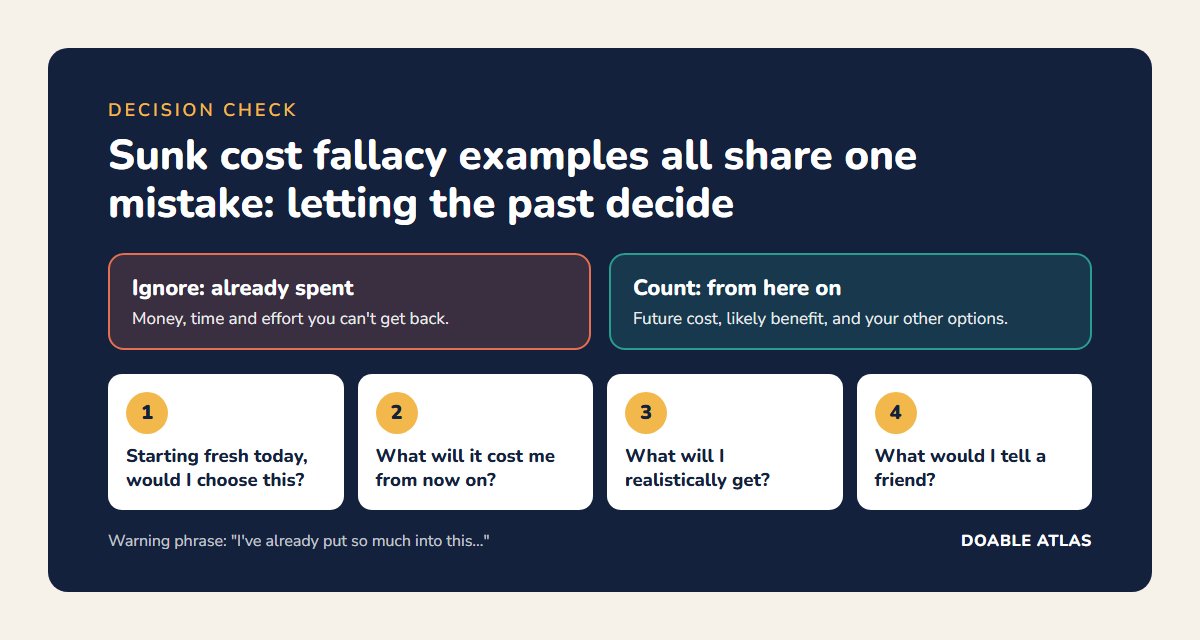
- If I were starting fresh today, would I choose this? Imagine you had invested nothing so far. Would you sign up, buy, or begin, knowing what you know now?
- What will it cost me from here on? Count only future money, time, energy, and opportunity, not what is already spent.
- What will I realistically get from here on? Be honest about the likely benefits, not the hoped-for best case.
- What would I tell a friend? Advice for someone else is often clearer, because you are not carrying their emotional investment.
If your answers point to stopping, it is often the right call, even if it stings.
More practical ways to protect yourself
- Set stop rules in advance. Before starting a project, decide what would make you quit: a budget limit, a deadline, or a specific result you must see by a certain date. Decisions made before you are emotionally invested are usually clearer.
- Schedule check-ins. Review ongoing commitments, such as subscriptions, projects, and memberships, every few months. Our subscription vs one time purchase guide includes a quick audit.
- Reframe the loss. Instead of “I wasted $500,” try “I paid $500 to learn this isn’t right for me.” The lesson is real value.
- Separate the decision-maker. In organizations, asking someone who was not involved in the original decision to review a project reduces the pull of past commitments.
- Talk it through. A trusted friend can spot sunk cost reasoning faster than you can. If the conversation feels hard, our guide on how to have difficult conversations can help.
- Notice the language. Phrases like “I’ve already put so much into this” or “I can’t let it go to waste” are warning signs. When you hear them, pause and run the four-question check.
A worked example: the car repair decision
Numbers make the sunk cost trap easier to see. Imagine your car needs a $1,500 repair. You have already spent $3,000 on repairs this year. The numbers below are illustrative, so swap in your own.
- Option A, repair: pay $1,500 now. Based on the car’s age, you expect about $2,000 more in repairs over the next two years.
- Option B, replace: sell the car for about $2,500 as-is and buy a reliable used car for $9,000, with low expected repair costs.
Sunk cost thinking says, “I’ve already put $3,000 into it, so I have to fix it.” But that $3,000 appears in neither option. It is gone either way. The honest comparison is about $3,500 in expected future costs for Option A, versus a net $6,500 for Option B in exchange for a newer, more reliable car with more years of life left.
Depending on your budget and how long each car would last, either option could be right. The point is that the decision should rest on future costs, reliability, and your needs, not on what you spent last year. Thinking in terms of future costs is also the core of good comparison shopping, which our guide on how to spot fake reviews touches on too.
Teaching kids about sunk costs
The sunk cost fallacy is a useful idea to share with children and teenagers, because it helps them make better choices about time and money early. A few simple ways to do it:
- Use their own examples. A board game nobody is enjoying, a toy they saved for that they no longer play with, or a club they joined but dislike.
- Ask the fresh-start question. “If you hadn’t started this yet, would you want to start it today?”
- Separate quitting from giving up. Explain that stopping something that does not work frees time for something that does, while still encouraging them to push through normal difficulty when the goal still matters to them.
- Model it yourself. Say out loud when you decide to stop something for forward-looking reasons. Kids learn decision habits by watching.
Learning to recognize sunk cost fallacy examples early can save years of misplaced effort later in life.
Sunk costs and the habits we keep
The same bias can keep old habits and routines alive. You might keep using a complicated productivity system because you spent a weekend setting it up, or stick with a morning routine that no longer fits your life because you have done it for a year. Letting go of systems that do not serve you is a skill. If you want to replace an unhelpful routine, see our step-by-step guide on how to break a bad habit.
Frequently asked questions
What is a simple example of the sunk cost fallacy?
Staying at a movie you are not enjoying because you paid for the ticket. The money is gone whether you stay or leave, so the only real question is whether the rest of the film is worth your time.
Why is it called the Concorde fallacy?
The name refers to the Concorde supersonic jet, whose development continued for years despite strong signs it would not be profitable, partly because of the huge sums already invested. It became a well-known example of sunk cost reasoning.
Is the sunk cost fallacy always bad?
Ignoring past costs is good decision-making in principle, but persistence itself is not bad. Continuing is reasonable when the future benefits outweigh the future costs. The fallacy is continuing only because of what has already been spent.
What are some sunk cost fallacy examples at work?
Common workplace sunk cost fallacy examples include continuing to fund a failing product, sticking with expensive software nobody likes because of setup costs, and keeping an underperforming strategy because leaders publicly backed it.
What is the difference between the sunk cost fallacy and loss aversion?
Loss aversion is the broader tendency to feel losses more strongly than equal gains. The sunk cost fallacy is one way loss aversion shows up in decisions: because quitting would lock in a loss, we keep investing to avoid feeling it. Many sunk cost fallacy examples, from the unused gym membership to the failing project, are driven by that underlying discomfort with admitting a loss.
How do I stop falling for the sunk cost fallacy?
Ask whether you would choose the same option if you were starting fresh today, count only future costs and benefits, set stop rules in advance, and get an outside view from someone who is not emotionally invested.
Your next step
The sunk cost fallacy examples in this article all share one pattern: letting yesterday’s spending make today’s decision. The fix is simple to say and harder to practice: look forward, not back.
Today, pick one commitment in your life that you keep “because you’ve already put so much in.” Run the four-question check on it. You might decide to keep going with fresh motivation, or you might give yourself permission to let it go. Either way, you will be deciding based on your future, not your past.