

Every January, millions of people promise to get fit, save money or finally get organized. By February, many of those promises have quietly faded. The problem is rarely willpower. Most new year resolutions fail because they are vague, too big, framed the wrong way or never turned into a daily routine.
This guide shows you how to make new year resolutions that actually stick. You will learn what research says about resolutions that last, how to rewrite a weak resolution into a strong one, 25 realistic resolution ideas across health, money, home, relationships and personal growth, and a simple 12-week system to keep going after the excitement wears off.
Quick answer
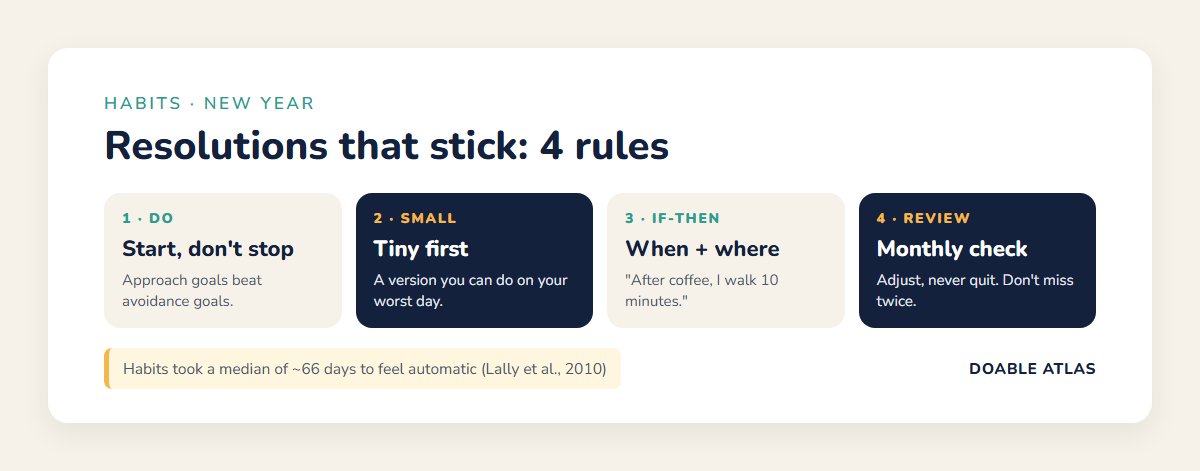
New year resolutions stick when they are specific, small enough to start this week, framed as something you will do (not something you will stop), tied to a clear “when and where” plan, tracked in a simple way and reviewed every month. Choose one to three resolutions, attach each to an existing routine, and plan in advance what you will do when you miss a day.
In this guide
Why most new year resolutions fail
Resolutions usually fail for predictable reasons, which is good news: predictable problems have practical fixes.
- They are too vague. “Get healthy” gives you nothing to do on a Tuesday night.
- They are too big. Going from zero to an hour of exercise a day is a shock to any schedule.
- They focus on stopping. “Stop snacking” leaves an empty gap instead of a new action.
- There is no plan for when and where. Intentions without a trigger rely on remembering.
- One slip feels like failure. Missing a day turns into quitting the whole goal.
- There are too many at once. Ten resolutions compete for the same limited time and energy.
Each of the steps below addresses one of these problems directly.
What research says about new year resolutions that last
Approach goals beat avoidance goals
In a large Swedish study of 1,066 people who made new year resolutions, participants with approach-oriented goals (doing something new) were more successful at one year than those with avoidance-oriented goals (stopping something): 58.9% versus 47.1%. Overall, 55% of those who responded at the one-year follow-up considered themselves successful (Oscarsson et al., PLOS ONE, 2020). In practice, “eat a vegetable with dinner” works better than “stop eating junk food”.
Habits take time, and missing a day is okay
A well-known study of habit formation found that the median time for a new daily behavior to feel automatic was about 66 days, with a very wide range from 18 to more than 200 days depending on the person and the habit. Missing a single day did not significantly hurt the process (Lally et al., European Journal of Social Psychology, 2010). Expect your resolution to feel effortful for weeks, not days, and do not quit after one slip.
If-then plans make action automatic
Psychologists call them implementation intentions: plans in the form “When X happens, I will do Y.” Research has repeatedly found that this kind of specific planning helps people follow through on goals. “When I finish my morning coffee, I will walk for 10 minutes” is far easier to act on than “I will walk more.”
How to make new year resolutions that actually stick: 9 steps
1. Choose one to three resolutions
Fewer resolutions get more attention. Pick the one change that would make the biggest difference to your year, and add one or two more only if they are small. Our guide on how to set achievable goals helps you choose.
2. Frame it as something you will do
Turn every “stop” into a “start”. Instead of “stop scrolling at night”, try “read 10 pages before bed”. Instead of “stop overspending”, try “check my budget every Sunday”.
3. Make it specific and measurable
Answer three questions: what exactly, how often and how much? “Walk 20 minutes, four days a week” is specific. “Exercise more” is not.
4. Start smaller than you think you should
Begin with a version so easy you could do it on your worst day: two minutes of stretching, one glass of water before coffee, five minutes of tidying. Once it is routine, increase it. Small starts build the consistency that big ambitions depend on.
5. Attach it to an existing routine
Link your new habit to something you already do every day, a technique often called habit stacking: “After I brush my teeth at night, I will write tomorrow’s top three tasks.” Our guide on how to build better habits explains this in detail.
6. Write an if-then plan
Decide when and where you will act, and what you will do when obstacles show up. “If it rains, I will walk on the treadmill at the gym” or “If I work late, I will do a 10-minute home workout instead.”
7. Make it easy to start and hard to skip
Lay out your workout clothes the night before, keep fruit on the counter, set up automatic savings transfers or put your phone in another room at bedtime. Change your environment so the good choice is the easy choice.
8. Track it simply
A paper calendar with an X for each day, a habit app or a note on your phone is enough. Seeing a streak builds motivation, and the record helps you notice patterns.
9. Review every month
On the first Sunday of each month, ask: what worked, what did not and what will I adjust? Changing the plan is not failure; it is how new year resolutions survive real life. Our weekly reset checklist makes a good companion routine.
Rewrite weak new year resolutions into strong ones
| Weak resolution | Resolution that sticks |
|---|---|
| Get fit | Walk 20 minutes after lunch on weekdays |
| Stop wasting money | Check my budget every Sunday at 7 p.m. and move $25 to savings |
| Be more organized | Clear my desk for 5 minutes before logging off each day |
| Spend less time on my phone | Charge my phone in the kitchen and read 10 pages before bed |
| Eat healthier | Add one vegetable to dinner five nights a week |
| Read more | Read for 15 minutes on my commute or at lunch |
25 new year resolutions that actually stick
Each idea below is specific, small enough to start this week and framed as an action. Choose the ones that fit your life, then adjust the numbers.
Health and energy
- Walk 20 minutes after lunch or dinner, four days a week.
- Drink a glass of water before your first coffee.
- Go to bed at the same time on weeknights, with an alarm 30 minutes earlier as a reminder.
- Stretch for five minutes while the kettle or coffee maker runs.
- Cook at home three more nights a week using simple, repeatable meals.
If sleep is your focus, our guides on how to wake up early and the evening reset routine are good places to start. These are general wellness ideas, not medical advice.
Money
- Move a fixed amount to savings automatically on every payday.
- Review your spending for 15 minutes every Sunday.
- Cancel one unused subscription each month.
- Plan meals before grocery shopping to cut waste. See how to save money on groceries.
- Use a 48-hour waiting rule before non-essential purchases over $50.
A simple budget spreadsheet makes money resolutions easier to track.
Home and organization
- Do a 10-minute tidy every evening before relaxing.
- Declutter one drawer or shelf every Saturday.
- Follow the one-in, one-out rule for clothes and gadgets.
- Plan your week every Sunday in 20 minutes. Our guide on how to plan your week shows how.
- Keep one surface, such as the kitchen counter, completely clear.
Digital life and focus
- Charge your phone outside the bedroom.
- Turn off notifications for everything except people.
- Check email at set times, two or three times a day. See how to manage email overload.
- Back up your phone on the first day of each month.
- Work in one 45-minute focus block each morning with your phone in another room.
Relationships and personal growth
- Call or message one friend or relative each week.
- Eat one meal a week with no phones at the table.
- Read 10 pages a day.
- Learn one new skill for 15 minutes, three times a week.
- Write down three good things that happened each Sunday night.
How to choose the right new year resolutions for you
The best new year resolutions come from honest reflection, not from a list of what everyone else is doing. Before you commit, spend 20 minutes with a notebook and answer these questions:
- What drained my energy most this year? A resolution that removes a daily frustration often pays off faster than a big dream.
- What gave me energy? Doing more of what already works is easier than inventing something new.
- What do I keep saying “someday” about? That is often your real priority.
- If I could change only one thing by next December, what would make the biggest difference? Start there.
- Why does this matter to me? Write one sentence. On hard days, your reason matters more than your plan.
If your answers point to a large, long-term goal, break it into a resolution for the first 12 weeks. “Run a half marathon” becomes “run three times a week, starting with 15 minutes”. The smaller step is the resolution; the big goal is the direction.
Simple tools to track new year resolutions
Tracking does not need to be complicated. Choose one method and stick with it:
- Paper calendar: mark an X on each day you complete your habit. The growing chain is surprisingly motivating.
- Habit tracker app: many free apps send reminders and show streaks. Our list of the best free productivity tools includes good options.
- Notes app checklist: a weekly list with one line per day is enough for most people.
- Calendar reminders: schedule the habit like an appointment so it shows up in your day.
- Monthly scorecard: on the last day of each month, write the number of days you completed each resolution and one lesson learned.
Keep the tracker visible: on the fridge, your desk or your phone’s home screen. Out of sight really does become out of mind.
Make your new year resolutions social
People are more likely to follow through when someone else is involved. Find a resolution buddy and agree on a quick weekly check-in by text. Join a walking group, a book club or an online community built around the same goal. Tell one supportive person exactly what you plan to do and when, and ask them to check in on you in February, when motivation usually dips. Shared new year resolutions, such as a family walk every Sunday or a friends’ savings challenge, also turn the habit into time together rather than another chore.
A 12-week plan to keep your new year resolutions
The first three months decide whether a resolution survives. Break them into phases:
| Weeks | Focus | What to do |
|---|---|---|
| 1–2 | Start tiny | Do the easiest version daily; track every day |
| 3–4 | Remove friction | Fix whatever made you skip: time, place, tools |
| 5–8 | Grow slowly | Increase by about 10–20% if the habit feels steady |
| 9–10 | Protect the streak | Plan for travel, illness and busy weeks with a minimum version |
| 11–12 | Review and reward | Look at your tracker, celebrate progress, set the next 12 weeks |
What to do when you slip
Everyone misses days. What matters is what happens next. Use the “never miss twice” rule: if you skip one day, make the next day non-negotiable, even if you only do the smallest version. Ask yourself what caused the slip and change one thing: a different time, an easier version or a reminder. Be kind to yourself; guilt drains the energy you need to start again.
If procrastination is the real obstacle, our guide on how to stop procrastinating has practical techniques, and how to break a bad habit helps when an old routine keeps pulling you back.
New year resolutions for different situations
For busy parents
Pick family-friendly resolutions you can do together, such as a Sunday walk, one phone-free dinner a week or a shared reading time before bed. Keep the bar low and the routine predictable.
For people who have failed before
Start with one tiny resolution and aim for 30 days in a row before adding anything. Success builds confidence faster than ambition.
For people working long hours
Choose resolutions that fit inside existing time: stretching during calls, walking meetings, prepared lunches or a 10-minute evening tidy. Time blocking helps; see time blocking for beginners.
For students
Good new year resolutions for students focus on routines that make the semester easier: a fixed study block each weekday, reviewing notes for 10 minutes after each class, a consistent sleep schedule and one weekly planning session. Small daily study habits beat last-minute cramming, and they free up weekends.
For retirees and people with more free time
More free time can make resolutions harder, because there is no natural structure. Build one into your week: a morning walk with a neighbor, a weekly class or volunteer shift, a regular call with family and a daily learning habit such as reading or a language app. Structure turns good intentions into a satisfying rhythm.
Common mistakes with new year resolutions
- Waiting for January 1. You can start today with a small version and use January as the official launch.
- Copying someone else’s resolution. Choose what matters to you, not what is trending.
- Going public too early with huge promises. Share your plan with one supportive person instead.
- Measuring only outcomes. Track actions you control, such as workouts done, not just pounds lost.
- Never reviewing the plan. A monthly check-in keeps resolutions realistic.
Quick quiz: new year resolutions
1. Which type of goal was more successful in the 2020 PLOS ONE study?
Approach-oriented goals (doing something new): 58.9% success versus 47.1% for avoidance goals.
2. Does missing one day ruin a new habit?
No. Research on habit formation found that missing a single day did not significantly affect the process. Just avoid missing twice in a row.
3. What is an if-then plan?
A plan that links a situation to an action, such as “When I finish dinner, I will walk for 15 minutes.”
New year resolutions FAQ
How many new year resolutions should I make?
One to three. Fewer resolutions get more of your time and attention, which makes success more likely.
What are the most realistic new year resolutions?
Small, specific actions you can start this week: a daily 10-minute walk, an automatic savings transfer, charging your phone outside the bedroom, reading 10 pages a day or a nightly 10-minute tidy.
How long does it take for a resolution to become a habit?
It varies widely. One study found a median of about 66 days, with a range from 18 to more than 200 days. Simple habits form faster than complex ones.
Is it too late to make new year resolutions in February?
No. Any day can be a fresh start. Use the same steps: choose one specific action, attach it to a routine and track it.
The bottom line
New year resolutions that actually stick are not about bigger promises or more willpower. They are about smaller, clearer actions: something you will do, at a specific time and place, tracked simply and reviewed monthly. Pick one resolution from this guide, write your if-then plan tonight and start with the smallest version tomorrow. Twelve weeks from now, you will be glad you did.