
A teenager falls from a breaking airliner into the Amazon rainforest and walks out alive. A ship’s steward survives 133 days alone on a raft in the Atlantic. An expedition crew stranded on Antarctic ice for more than a year all make it home. These incredible survival stories sound like movie plots, but they really happened, and the people who lived them left behind lessons that can help anyone stay calmer and safer in a crisis.
Below are seven of the most remarkable documented survival stories, with what happened, how they survived, and what is well documented versus debated or embellished. At the end, you will find the practical survival lessons that show up again and again, plus a simple checklist you can use before your next hike, trip, or storm season.
In this guide
7 incredible survival stories
1. Juliane Koepcke: the girl who fell from the sky (1971)
What happened: On December 24, 1971, LANSA Flight 508 broke apart in a violent thunderstorm over the Peruvian rainforest. Seventeen-year-old Juliane Koepcke, traveling with her mother, fell thousands of feet still strapped into her row of seats. She woke up on the forest floor with a broken collarbone, a deep cut on her arm, and one shoe. She was the only survivor of the 92 people on board.
How she survived: Juliane’s parents were biologists who ran a research station in the rainforest, and she had learned how the jungle worked. Remembering her father’s advice that following water downstream leads to people, she walked and waded along streams for about 11 days. When maggots infested her wound, she poured gasoline from a boat she found onto it to clean it. Eventually she reached a hut, where local loggers found her and got her to help.
Documented or debated? Her story is thoroughly documented, including in her own memoir and in a documentary by filmmaker Werner Herzog. Estimates of the height of her fall vary.
2. Shackleton’s Endurance crew: 28 men, nearly two years, everyone home (1914 to 1916)
What happened: Explorer Ernest Shackleton set out in 1914 to cross Antarctica on foot. His ship, the Endurance, became trapped in the pack ice of the Weddell Sea and was eventually crushed and sank in 1915. The 28 men camped on drifting ice for months, then took three lifeboats to remote Elephant Island.
How they survived: With no chance of rescue there, Shackleton and five companions sailed a small lifeboat, the James Caird, roughly 800 miles across some of the world’s roughest seas to South Georgia. Then three of them crossed the island’s unmapped, glacier-covered mountains on foot to reach a whaling station. Shackleton made several attempts before he finally rescued the men left on Elephant Island in August 1916. Every member of the Endurance crew survived.
Documented or debated? Very well documented through diaries and photographs. In 2022, researchers found the wreck of the Endurance deep in the Weddell Sea, remarkably well preserved. (A separate support team, the Ross Sea party, did lose three men.)
3. Poon Lim: 133 days alone on a raft (1942 to 1943)
What happened: In November 1942, during World War II, the British merchant ship SS Ben Lomond was torpedoed in the Atlantic. Poon Lim, a young steward from China, jumped overboard and found an empty life raft with a small supply of food and water.
How he survived: When supplies ran out, he caught rainwater in his life jacket’s canvas, fished using a hook made from a nail and a line from rope fibers, and even caught seabirds. Several ships passed without picking him up. After 133 days, he was rescued by Brazilian fishermen near the coast of Brazil, reportedly still able to walk.
Documented or debated? His survival and the length of his ordeal are widely documented. He was honored by the British government, and his story was used in later naval survival training. Some details of his methods come from his own accounts.
4. Apollo 13: “Houston, we’ve had a problem” (1970)
What happened: In April 1970, about two days into a mission to the Moon, an oxygen tank exploded aboard Apollo 13’s service module, crippling the spacecraft more than 200,000 miles from Earth. The Moon landing was canceled, and the three astronauts, Jim Lovell, Jack Swigert, and Fred Haise, faced a desperate trip home.
How they survived: The crew moved into the lunar module and used it as a lifeboat, even though it was designed to support two people for a much shorter time. Engineers on the ground worked around the clock to solve problem after problem, including a famous improvised adapter, built from materials on board, that let the crew use square carbon dioxide filters in a round socket. The crew splashed down safely in the Pacific on April 17, 1970 (NASA).
Documented or debated? Extensively documented by NASA. The famous line is often misquoted as “Houston, we have a problem.”
5. Mauro Prosperi: lost in the Sahara (1994)
What happened: Italian police officer and athlete Mauro Prosperi was competing in the Marathon des Sables, a multi-day race across the Sahara in Morocco, when a sandstorm hit. When it cleared, he was completely lost.
How he survived: With limited water, he rationed carefully, sheltered from the heat during the day, and found refuge in a small shrine, where he ate bats and drank their blood to stay hydrated. He walked for days until he found an oasis and was eventually helped by a nomadic family. By then he had wandered into Algeria, far off the race course, roughly nine days after getting lost.
Documented or debated? His survival is documented through interviews and media reports. Exact distances and the amount of weight he lost vary between accounts.
6. Aron Ralston: 127 hours in a canyon (2003)
What happened: In April 2003, hiker and climber Aron Ralston was exploring a remote slot canyon in Utah when a boulder shifted and pinned his right arm against the canyon wall. He had told no one exactly where he was going.
How he survived: After about five days trapped, with his water gone, Ralston freed himself by amputating his own forearm with a small multi-tool. He then rappelled down a cliff and hiked out until he met a family of hikers and was picked up by a rescue helicopter. His story became the book Between a Rock and a Hard Place and the film 127 Hours.
Documented or debated? Well documented, including through video he recorded while trapped. Ralston himself has emphasized one key lesson: always tell someone where you are going.
7. Hugh Glass: the frontiersman and the grizzly (1823)
What happened: In 1823, fur trapper Hugh Glass was badly mauled by a grizzly bear during an expedition in what is now South Dakota. Believing he would die, the two men assigned to stay with him left him behind, taking his rifle and gear.
How he survived: According to the accounts, Glass set his own broken leg, crawled and later walked for many weeks, and traveled a very long distance to reach Fort Kiowa on the Missouri River. His story inspired the film The Revenant.
Documented or debated? Glass was a real person, and the bear attack and abandonment are supported by records from the time. But many details, including the exact distance and his methods, come from later retellings that likely added drama. Treat this one as a true story wrapped in legend.
What these survivors have in common
Across these incredible survival stories, the settings could not be more different: rainforest, ice, ocean, space, desert, and canyon. Yet the same survival traits show up again and again:
- They stayed calm enough to think. Panic wastes energy and leads to poor decisions. Koepcke, Lovell’s crew, and Shackleton all focused on the next solvable problem.
- They used what they knew. Koepcke’s knowledge of the rainforest, Poon Lim’s improvised fishing, and NASA’s engineering skill all made the difference.
- They improvised with what they had. Canvas for rainwater, a nail for a hook, cardboard and tape for a filter adapter.
- They broke big problems into small steps. Survive today. Find water. Reach the next stream bend.
- They kept hope and purpose. Many survivors describe holding on to a reason to keep going, such as family, crewmates, or simply getting home.
- Some had a plan B, and some did not. Ralston’s story shows how much risk rises when nobody knows where you are.
Survival lessons you can actually use
The most useful thing about incredible survival stories is what they teach the rest of us. You will probably never fall from a plane or drift on a raft for months. But everyday emergencies, such as getting lost on a hike, being stranded by a storm, or losing power for days, are common. The lessons from these stories translate directly.
Use the STOP method when things go wrong
Wilderness safety programs often teach a simple acronym for the moment you realize you are lost or in trouble:
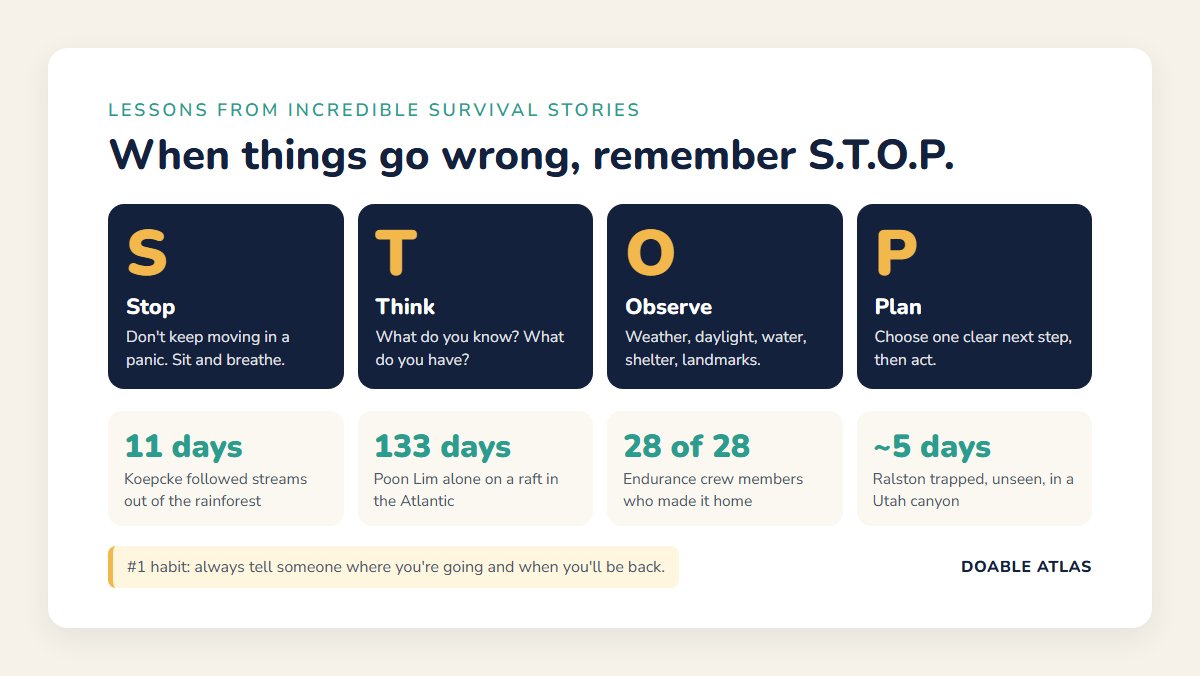
- Stop: do not keep moving in a panic. Sit down and breathe.
- Think: what do you know about where you are and what you have?
- Observe: look at your surroundings, the weather, daylight, water, and shelter.
- Plan: decide on one clear next step, such as staying put to be found or following a known trail.
Always tell someone your plan
Before a hike, paddle, or remote drive, tell a reliable person where you are going, your route, and when you expect to be back. Agree on a time when they should call for help if they have not heard from you. This single habit has prevented many tragedies.
Carry the basics
Even for a short day hike, bring water, a snack, a light layer, a headlamp, a whistle, a charged phone, and a simple first aid kit. At home, a well-stocked kit helps you ride out outages and storms. See our emergency kit checklist for home for a complete list.
Stay with the vehicle or the trail
If you are stranded in a car or lost near a trail, searchers usually find people faster when they stay in one visible place than when they wander. Make yourself easy to spot with bright clothing and sound signals.
Manage your mind
Fear is normal. Survivors often describe talking to themselves, setting tiny goals, and focusing on what they could control. The same techniques help in everyday stress. If anxious thoughts tend to spiral, our guide on why people overthink includes a 3-minute reset you can use anywhere.
Survival myths these stories help debunk
Movies and viral videos have spread plenty of bad survival advice. Several incredible survival stories, along with standard wilderness safety guidance, point the other way:
- Myth: keep moving when you are lost. Unless you know exactly where help is, as Koepcke did when she followed water downstream, wandering often makes you harder to find. Searchers generally recommend staying put near a trail or vehicle.
- Myth: drink seawater if you are desperate. Seawater’s salt makes dehydration worse. Poon Lim survived by collecting rainwater, not by drinking the ocean.
- Myth: eat snow for water. Eating large amounts of snow can lower your body temperature. In cold conditions, melting it first is the usual advice.
- Myth: survival is about toughness. Physical strength helps, but the survivors in these stories mostly credit clear thinking, preparation, and refusing to give up.
- Myth: it won’t happen to me. Ralston was an experienced outdoorsman. Experience reduces risk, but it does not remove it, which is why simple habits like sharing your plans matter for everyone.
How to read incredible survival stories critically
Because incredible survival stories are so dramatic, they attract exaggeration. Before you believe or share a viral survival tale, ask a few quick questions:
- Is there a named person, place, and date? Real cases, like the ones in this article, include specific, checkable details.
- Are there records from the time? Newspaper reports, official investigations, diaries, or photographs carry more weight than modern retellings.
- Who is telling the story? Survivors’ own accounts are valuable but can still blur details over decades.
- Do the numbers keep growing? Distances, days, and dangers that get bigger with each version are a warning sign.
Asking these questions does not make incredible survival stories less inspiring. It makes the real ones even more impressive, because you know they are true.
Why we love survival stories
Incredible survival stories are some of the most popular true stories ever told, from Shackleton’s diaries to modern documentaries. Part of their appeal is the drama. But they also give us something more lasting: proof that ordinary people can find extraordinary resilience, and practical wisdom about how to respond when life goes badly wrong.
They are also a good reminder to check the facts. Famous survival tales tend to grow with each retelling, as the story of Hugh Glass shows. If you enjoy separating the documented from the embellished, you may also like our articles on unbelievable coincidences that really happened and historical hoaxes people believed.
Frequently asked questions
What is the most incredible survival story ever?
There is no single answer, but Shackleton’s Endurance expedition, in which all 28 crew members survived nearly two years stranded in Antarctica, and Juliane Koepcke’s survival of a plane breakup and 11 days alone in the rainforest are among the most frequently cited.
Where can I find more incredible survival stories?
Good sources include survivors’ own memoirs, such as Juliane Koepcke’s book about her ordeal, Shackleton’s account South, and documentaries based on interviews and original records. Museum and historical society websites are also reliable places to read incredible survival stories with the facts checked.
Is the story of Hugh Glass true?
Partly. Hugh Glass was real, and records support that he was mauled by a bear and left behind. But many details popularized in books and films come from later retellings and are difficult to verify.
How long did Poon Lim survive at sea?
Poon Lim survived 133 days alone on a life raft in the Atlantic Ocean after his ship was torpedoed in 1942, one of the longest documented survivals of its kind.
What is the most important survival skill?
Many experts point to staying calm and thinking clearly. Practical habits, such as telling someone your plans and carrying basic supplies, prevent many emergencies from becoming life-threatening in the first place.
What can we learn from incredible survival stories?
That preparation, calm thinking, improvisation, and hope matter more than strength alone. Most survivors broke an overwhelming situation into small, manageable steps and kept going one step at a time.
Your next step
The incredible survival stories in this article are extreme, but the habits behind them are simple: prepare a little, tell someone your plans, stay calm, and take the next small step. Before your next outdoor trip, share your route with a friend and pack the basics. And this week, take ten minutes to check your home emergency supplies.
You will probably never need the survival skills of Shackleton or Koepcke. But a little preparation means that if something does go wrong, you will be ready to handle it with a clear head.