

Picture the Monopoly man. Top hat, white mustache, cane… and a monocle, right? Now picture the children’s books about a family of bears: the Berenstein Bears. If you are like millions of people, both memories feel completely certain. Both are also wrong. The Monopoly mascot has never worn a monocle, and the bears have always been the Berenstain Bears.
When large groups of strangers share the same false memory, it gets a name: the Mandela effect. Below you will find 15 of the most famous Mandela effect examples, a quick self-test to see which ones fooled you, and a clear explanation of what is really going on inside your memory. Spoiler: you have not slipped into a parallel universe. The real explanation is stranger, and far more useful.
Quick answer
The Mandela effect is a shared false memory: many people independently remember the same detail incorrectly. Classic Mandela effect examples include the Monopoly man’s “monocle,” the “Berenstein” Bears, and the movie line “Luke, I am your father.” Researchers explain it with how memory works: we store the gist, fill gaps with expectations, and borrow details from similar images.
In this guide
What is the Mandela effect?
The term was coined around 2009 by writer and paranormal researcher Fiona Broome. At a conference, she discovered that she and many other people shared a vivid memory of South African leader Nelson Mandela dying in prison in the 1980s, complete with news coverage and a funeral. In reality, Mandela was released in 1990, became South Africa’s first Black president in 1994, and died in 2013.
Broome started collecting similar cases online, and the idea spread. What makes Mandela effect examples so fascinating is not that people misremember things. Everyone does that. It is that so many unrelated people misremember the same thing in the same way, and feel equally sure about it.
Test yourself first
Before you read the answers, try this quick quiz. Pick the version you believe is correct, then open the answer.
Which one is real?
- The Monopoly man: with a monocle or without?
- Pikachu’s tail: black tip or all yellow?
- Fruit of the Loom logo: fruit with a cornucopia or without?
- Curious George: has a tail or no tail?
- The candy bar: Kit-Kat or KitKat?
- The cartoon series: Looney Toons or Looney Tunes?
Show the answers
1. Without. 2. All yellow (only the ears have black tips). 3. Without. 4. No tail. 5. KitKat. 6. Looney Tunes. If you got three or more “wrong,” congratulations: your memory works exactly like everyone else’s.
15 Mandela effect examples that fool almost everyone
Here are 15 of the best-known Mandela effect examples, grouped by type. For each one, you will see what people tend to remember and what is actually true.
1. Nelson Mandela’s death
What people remember: Mandela died in prison in the 1980s. Reality: he was freed in 1990, served as president from 1994 to 1999, and died in December 2013 at age 95. This is the case that gave the phenomenon its name. One likely ingredient: other anti-apartheid activists, such as Steve Biko, did die in custody, and their stories may have blended with Mandela’s in people’s memories.
2. The Berenstain Bears
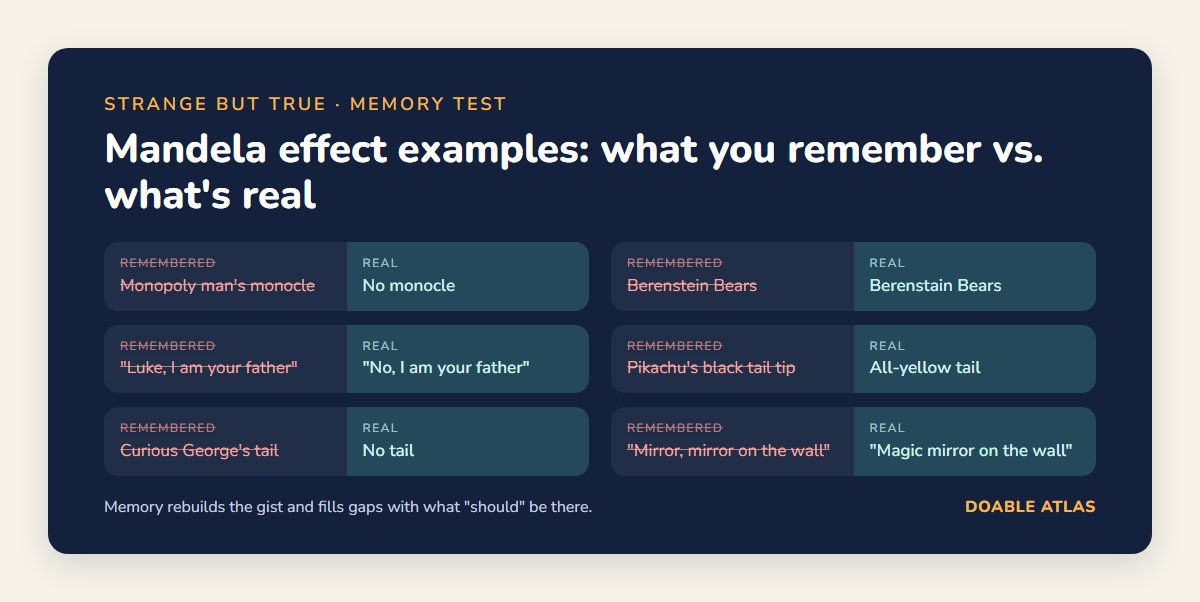
What people remember: “Berenstein” (or “Berenstien”). Reality: the books were created by Stan and Jan Berenstain, and the spelling has always ended in “-stain.” The “-stein” ending is far more common in English surnames, so the brain quietly “corrects” the unusual spelling to the familiar one.
3. The Monopoly man’s monocle
What people remember: a monocle. Reality: Mr. Monopoly (originally Rich Uncle Pennybags) has never worn one. He does, however, look a lot like another top-hatted mascot who does wear a monocle: Mr. Peanut. Our brains seem to merge the two “fancy gentleman” mascots into one.
4. “Luke, I am your father”
What people remember: Darth Vader saying “Luke, I am your father.” Reality: in The Empire Strikes Back (1980), the line is “No, I am your father.” The misquote is easier to understand out of context, so it is the version that spread through parodies and everyday speech.
5. Pikachu’s tail
What people remember: a black tip on Pikachu’s tail. Reality: the tail is yellow with a brown patch at the base. The black tips are on Pikachu’s ears, and the brain appears to extend that pattern to the tail.
6. C-3PO’s leg
What people remember: an all-gold droid. Reality: in the original Star Wars trilogy, C-3PO’s lower right leg is silver. It is right there on screen, but most viewers never notice it.
7. The Fruit of the Loom cornucopia
What people remember: a horn of plenty behind the fruit. Reality: the modern logo shows a cluster of fruit with no cornucopia. Fruit piles and cornucopias appear together so often in harvest imagery that the brain fills one in.
8. Curious George’s tail
What people remember: a monkey with a tail. Reality: George has no tail. Most monkeys do, so memory supplies one from general knowledge.
9. “Mirror, mirror on the wall”
What people remember: the Evil Queen saying “Mirror, mirror on the wall” in Disney’s Snow White (1937). Reality: in the Disney film she says “Magic mirror on the wall.” The “mirror, mirror” version is common in other retellings, which likely reinforced the mix-up.
10. Shazaam, the genie movie that never existed
What people remember: a 1990s movie called Shazaam starring comedian Sinbad as a genie. Reality: no such film exists, and Sinbad has said so himself. There was a 1996 genie movie called Kazaam starring basketball player Shaquille O’Neal, and in 1994 Sinbad hosted a TV marathon of classic Sinbad the Sailor films while dressed in a turban and Arabian Nights-style costume. Put together, they form a convincing fake memory of a film many people swear they rented.
11. KitKat’s missing hyphen
What people remember: “Kit-Kat.” Reality: the logo reads “KitKat,” with no hyphen. The two-part name looks like it should be hyphenated, so memory adds the punctuation.
12. Looney Tunes
What people remember: “Looney Toons,” because they are cartoons. Reality: the series has always been “Looney Tunes,” a pun on the musical “Merrie Melodies” shorts it was paired with.
13. “Play it again, Sam”
What people remember: Humphrey Bogart saying “Play it again, Sam” in Casablanca (1942). Reality: the exact line never appears. The famous request is closer to “Play it, Sam.” The misquote became so popular that Woody Allen used it as the title of a 1969 play.
14. “Beam me up, Scotty”
What people remember: Captain Kirk’s catchphrase in the original Star Trek. Reality: that exact phrase was never spoken in the original series. Similar commands were, and the short version was born in pop culture.
15. Henry VIII and the turkey leg
What people remember: a famous portrait of King Henry VIII holding a turkey leg. Reality: no such historical portrait is known. The image likely comes from films, cartoons, and costume parties that show the feasting king with a drumstick in hand.
Mandela effect examples at a glance
Here is a quick summary table you can save or share.
| Example | What many remember | What is real | Likely cause |
|---|---|---|---|
| Monopoly man | Monocle | No monocle | Merged with Mr. Peanut |
| Berenstain Bears | “-stein” | “-stain” | Familiar spelling wins |
| Darth Vader line | “Luke, I am…” | “No, I am…” | Context added for clarity |
| Pikachu | Black tail tip | Yellow tail | Pattern copied from ears |
| Curious George | Tail | No tail | “Monkeys have tails” |
| Snow White | “Mirror, mirror” | “Magic mirror” | Other versions of the tale |
| Shazaam | Sinbad genie film | Never existed | Blend of Kazaam and TV clips |
Why the Mandela effect happens
The internet has offered some wild explanations for Mandela effect examples, from parallel universes to glitches in a computer simulation. Memory researchers have a far simpler answer: human memory is not a video recording. It is a reconstruction, rebuilt each time we remember, and it follows predictable rules.
Memory stores the gist, not the details
Your brain is built for efficiency. It keeps the general idea (“old rich man with a top hat”) and throws away fine details it does not expect to need. When you later recall the image, the missing pieces get filled in with what seems right.
Schemas fill the gaps
Psychologists use the word schema for the mental templates we build from experience. A schema for “monkey” includes a tail. A schema for “fancy gentleman” includes a monocle. When memory has a gap, the schema plugs it, and the result feels just as real as an accurate memory.
Similar images blend together
Mr. Monopoly and Mr. Peanut. Kazaam and a Sinbad genie costume. When two memories share many features, details can migrate from one to the other. This is sometimes called source confusion: you remember a detail correctly, but attach it to the wrong source.
Words can rewrite what you saw
In a classic 1974 experiment, Elizabeth Loftus and John Palmer showed people a film of a car accident, then asked how fast the cars were going when they “smashed into” or “hit” each other. People who heard “smashed” gave higher speed estimates and were more likely to later report seeing broken glass, even though there was none (Loftus & Palmer, 1974). Small changes in wording, repeated in parodies and memes, can reshape shared memories the same way.
We can remember things that were never there
In another famous set of studies, people heard lists of related words such as bed, rest, awake, tired, dream. Later, many confidently “remembered” hearing the word sleep, which was never on the list (Roediger & McDermott, 1995). The brain is so good at spotting patterns that it can generate the missing piece and file it as a memory.
Repetition makes errors stick
Once a false version spreads, every repetition strengthens it. The misquoted Darth Vader line has been repeated in countless parodies, so many people have heard the wrong version far more often than the real one.
What the science says about visual Mandela effect examples
For years, Mandela effect examples were mostly an internet curiosity. Then, in 2022, researchers Deepasri Prasad and Wilma Bainbridge at the University of Chicago tested it directly. They showed people pairs of famous icons, the correct version and subtly altered ones, and asked which was real. For a handful of icons, including C-3PO, the Fruit of the Loom logo, Curious George, Mr. Monopoly, and Pikachu, people consistently chose the same wrong version, and they were often highly confident about it (Prasad & Bainbridge, 2022).
Interestingly, the researchers found that the false memories were not simply explained by how often people had seen the icons. This suggests that some images contain features that push many brains toward the same mistake, a kind of shared visual blind spot. The study turned well-known Mandela effect examples into measurable evidence that false memories can be both specific and widely shared.
Is the Mandela effect a sign of something wrong with your memory?
No. Falling for Mandela effect examples is a sign that your memory is working normally. A brain that stored every detail of every image you have ever seen would be slow and overloaded. Filling in details with educated guesses is usually efficient and good enough.
The downside is that confidence and accuracy are not the same thing. You can feel absolutely certain about a memory that is wrong. That matters far beyond cartoon logos. It is one reason eyewitness testimony can be unreliable, why family members often remember the same event differently, and why our minds tend to favor information that fits what we already believe. Our guide to confirmation bias examples explores that last point in depth.
How to protect yourself from false memories
You cannot switch off your brain’s gap-filling, but you can make it less likely to lead you astray when it matters.
- Check the source. Before you repeat a “fact” you remember, look it up in a reliable source. It takes seconds.
- Separate confidence from evidence. Ask yourself, “Do I remember this, or do I just feel sure?”
- Write important things down. Notes made at the time beat memories reconstructed later, especially for agreements, appointments, and decisions.
- Be careful with leading questions. When recalling an event with others, avoid suggesting details. Let each person describe it in their own words first.
- Stay curious, not defensive. When someone says your memory is wrong, treat it as an interesting puzzle rather than an attack.
These habits are also useful for evaluating viral claims online. If you enjoy this kind of detective work, try our guide on how to spot weak evidence in viral stories.
Why the Mandela effect is so much fun
Part of the appeal of Mandela effect examples is the jolt of discovering that something you were sure about is wrong. It is the same mix of surprise and delight people feel reading about unbelievable coincidences that really happened or historical hoaxes people believed. The difference is that this time, the mystery is inside your own head.
Try the quiz on friends and family. You will probably find that everyone falls for at least a few of these, and the conversations that follow, “No, I definitely remember the monocle!”, are half the fun.
Frequently asked questions
What is the most famous of all Mandela effect examples?
The case that gave the effect its name is the widespread false memory that Nelson Mandela died in prison in the 1980s. Among everyday examples, the Berenstain Bears spelling and the Monopoly man’s nonexistent monocle are probably the best known.
Is the Mandela effect proof of parallel universes?
No. There is no scientific evidence for that idea. Decades of memory research show that people routinely form false memories through gap-filling, blending similar images, and repetition, which fully explains the effect.
Why do so many people share the same false memory?
Because human brains work in similar ways. We share the same mental templates, see the same similar images, and hear the same misquotes repeated. Research from 2022 suggests some images contain features that lead many people to make the identical mistake.
Is the Mandela effect the same as a false memory?
It is a specific kind of false memory: one that is shared by many unrelated people and concerns the same detail. Individual false memories are extremely common; the Mandela effect is what happens when lots of people make the same one.
Can you train yourself to avoid the Mandela effect?
Not completely, because gap-filling is a basic feature of memory. But checking reliable sources, writing things down, and remembering that confidence is not proof will help you catch mistakes before they matter.
The takeaway
Mandela effect examples are a harmless, entertaining reminder of a serious truth: memory is a story your brain rebuilds every time you tell it. The monocle that was never there, the bears with the “wrong” name, and the movie that was never made all show the same pattern. Your brain fills gaps with what seems right, then hands you the result with total confidence.
So the next time you are absolutely certain about a small detail, take a second to check. And if you turn out to be wrong, you are in excellent company.