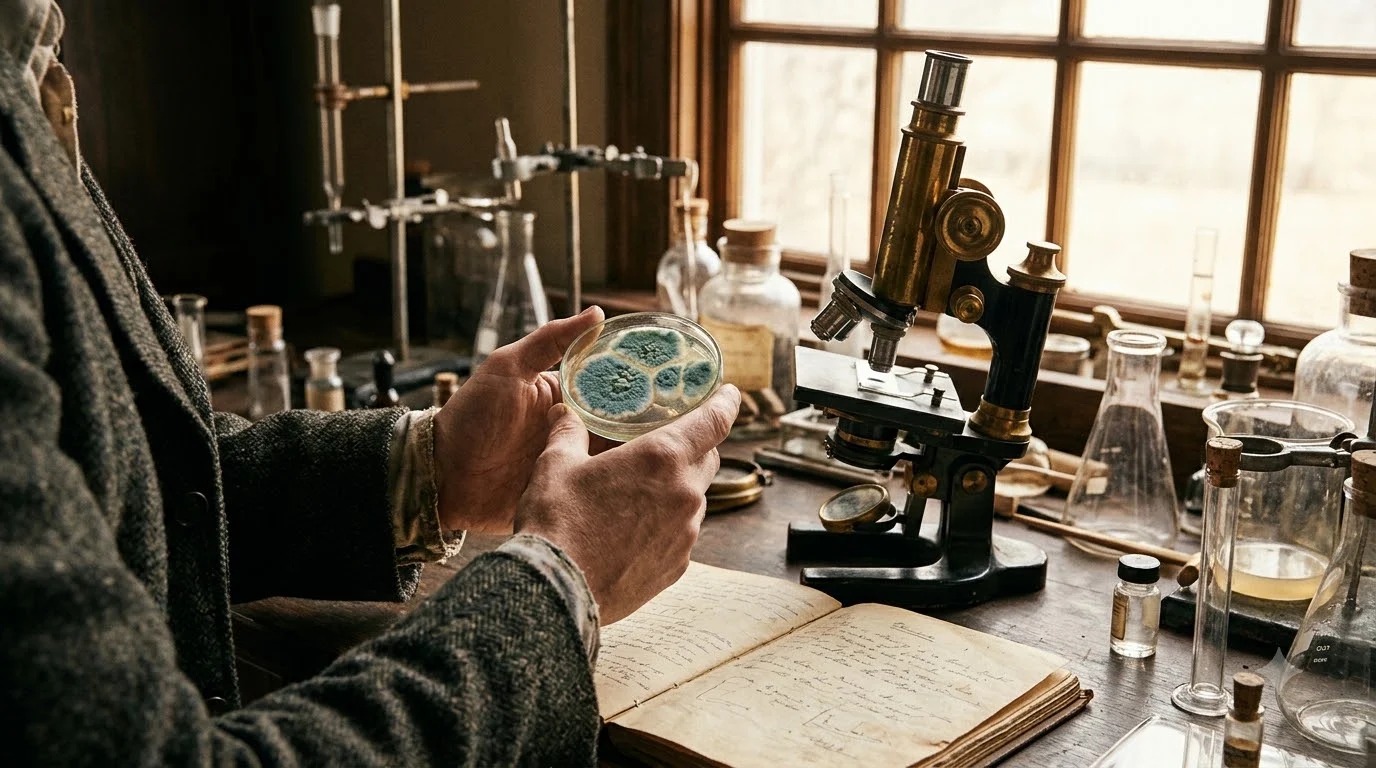
A moldy petri dish. A melted candy bar. A spring that tumbled off a shelf. Some of the most useful things in your home, your medicine cabinet and your car exist because someone noticed a mistake instead of throwing it away. The history of inventions discovered by accident is full of messy labs, lucky timing and curious people who asked, “Wait, why did that happen?”
This list covers 12 famous inventions discovered by accident, with a twist: each one gets a story check badge, because many popular “happy accident” tales have been polished over the years. You will see which stories hold up, which are partly embellished and which are mostly legend, plus the habits that turned each accident into something world-changing.
Quick answer
Famous inventions discovered by accident include penicillin, X-rays, the microwave oven, Post-it Notes, Velcro, Super Glue, the Slinky, the implantable pacemaker, saccharin, Teflon, safety glass and vulcanized rubber. In almost every case, the accident only mattered because a trained, curious person noticed it and spent years turning it into something useful.
In this article
How to read the story check badges
Popular stories about inventions discovered by accident tend to get simpler and more dramatic each time they are retold. To keep things honest, each entry below carries one of three labels:
- WELL DOCUMENTED The accidental discovery is supported by the inventor’s own records or reliable historical sources.
- PARTLY EMBELLISHED A real accident happened, but popular versions add or exaggerate details.
- MOSTLY LEGEND The famous story is doubtful or contradicted by evidence.
12 inventions discovered by accident
1. Penicillin (1928)
WELL DOCUMENTED
Scottish bacteriologist Alexander Fleming returned to his London laboratory after a summer break and noticed something odd on a culture plate of Staphylococcus bacteria. A mold had landed on it, and around the mold, the bacteria had died. Fleming identified the mold as Penicillium and called the active substance penicillin (American Chemical Society).
What popular versions often skip: turning that observation into a medicine took more than a decade. Howard Florey, Ernst Chain and their team at Oxford purified it and showed it worked in patients around 1940 and 1941, and mass production during World War II followed. Fleming, Florey and Chain shared the 1945 Nobel Prize in Physiology or Medicine (Nobel Prize). Of all inventions discovered by accident, this one has probably saved the most lives.
2. X-rays (1895)
WELL DOCUMENTED
German physicist Wilhelm Röntgen was experimenting with cathode-ray tubes in November 1895 when he noticed a fluorescent screen across the room glowing, even though the tube was covered. Some unknown kind of ray was passing through the cover. Within weeks he had made an image of the bones in his wife’s hand. He called the mystery rays “X” for unknown, and he received the first Nobel Prize in Physics in 1901 (Nobel Prize).
3. The microwave oven (1940s)
PARTLY EMBELLISHED
Percy Spencer, a self-taught engineer at the defense company Raytheon, worked with magnetrons, the tubes that generate microwaves for radar. As the story goes, he noticed a candy bar in his pocket had melted while he stood near an active magnetron. He then tested popcorn kernels and an egg, with messy results. Raytheon filed a patent and introduced its first commercial microwave oven, the large “Radarange,” in the late 1940s.
The core of the story is widely reported, but details such as the exact snack vary by retelling. What is certain is that it took years of engineering before microwave ovens shrank enough for American kitchens in the late 1960s and 1970s.
4. Post-it Notes (1968 to 1980)
WELL DOCUMENTED
In 1968, 3M scientist Spencer Silver was trying to create a super-strong adhesive. Instead, he made one that was weak, sticking lightly and peeling off cleanly. For years, nobody knew what to do with it. Then his colleague Art Fry, frustrated that paper bookmarks kept falling out of his church choir hymnal, realized the glue could make a bookmark that stayed put without damaging pages. After more development and testing, Post-it Notes launched nationally in 1980.
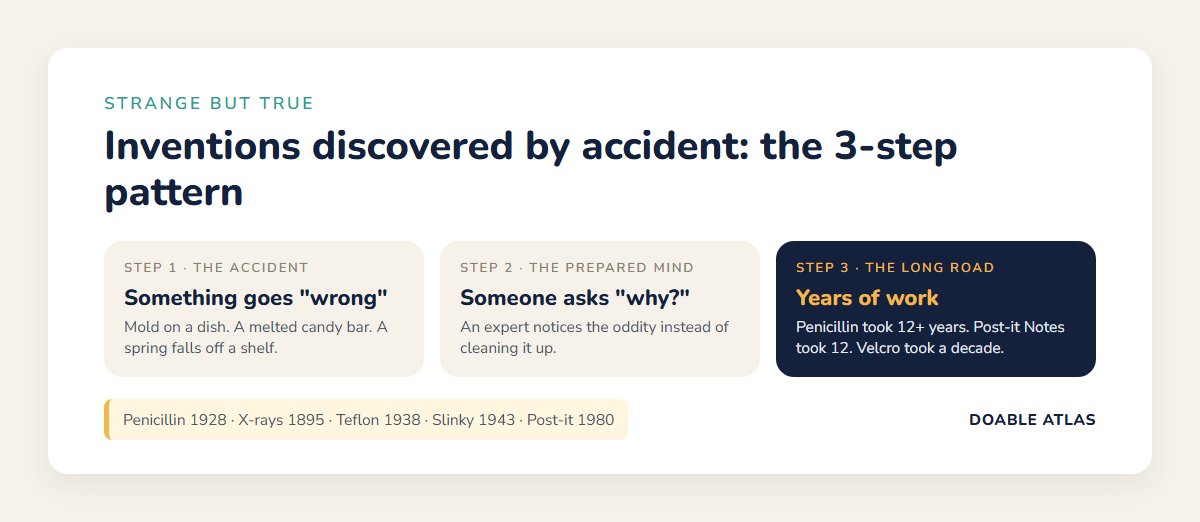
This is a great example of a pattern you will see again: the accident and the useful application were years and people apart.
5. Velcro (1940s and 1950s)
WELL DOCUMENTED
Swiss engineer George de Mestral went hiking with his dog and came home with both of them covered in burdock burrs. Instead of just picking them off, he looked at them under a microscope and saw tiny hooks that caught on loops in fabric and fur. It took him years to reproduce the effect with synthetic materials, and he patented his hook-and-loop fastener in the 1950s. It is now on everything from sneakers to spacesuits.
6. Super Glue (1942 and 1951)
WELL DOCUMENTED
Chemist Harry Coover was searching for a clear plastic for precision gun sights during World War II. He found that a group of chemicals called cyanoacrylates stuck to everything they touched, which made them useless for sights and annoying to work with. He set them aside. Years later, at Eastman Kodak, Coover and a colleague encountered the same compounds while working on heat-resistant materials, and this time recognized the value of a glue that bonds almost instantly. It went on sale in 1958.
7. The Slinky (1943)
WELL DOCUMENTED
Naval engineer Richard James was working on springs that could stabilize sensitive equipment on ships when one fell off a shelf and seemed to “walk” in a series of arcs. He and his wife, Betty James, who came up with the name, developed it into a toy. A holiday demonstration at Gimbels department store in Philadelphia in 1945 reportedly sold out its stock within about 90 minutes.
8. The implantable pacemaker (1956 to 1960)
WELL DOCUMENTED
American engineer Wilson Greatbatch was building a circuit to record heart rhythms when he reached for a resistor and installed one with the wrong value. The circuit began emitting steady electrical pulses, and Greatbatch recognized that the rhythm resembled a heartbeat. He went on to develop an implantable pacemaker, first implanted in a patient in 1960. Many inventors’ stories involve a happy accident; this one involves a mislabeled part.
9. Saccharin (1879)
WELL DOCUMENTED
Chemist Constantin Fahlberg was working with coal tar derivatives in Ira Remsen’s laboratory at Johns Hopkins University. At dinner, he noticed that his bread tasted unusually sweet and traced the sweetness to a compound on his hands from the lab. That compound became saccharin, the first commercially successful artificial sweetener. (A safety note from history: tasting unknown lab chemicals is a terrible idea, and modern labs have strict rules for a reason.)
10. Teflon (1938)
WELL DOCUMENTED
DuPont chemist Roy Plunkett was working on new refrigerant gases when a pressurized cylinder that should have released gas produced nothing. Instead of assuming it was empty, he and his assistant cut it open and found a slippery white powder inside. The gas had polymerized into polytetrafluoroethylene, later sold as Teflon, a material that resists heat and almost nothing sticks to it.
11. Safety glass (1903)
PARTLY EMBELLISHED
French chemist Édouard Bénédictus is said to have knocked a glass flask off a shelf. It cracked but held its shape, because a film of cellulose nitrate from an evaporated solution had coated the inside. Later, reading about car accidents in which drivers were injured by flying glass, he connected the two ideas and developed laminated glass. Laminated safety glass eventually became standard in car windshields. Details of the dropped-flask story vary, but Bénédictus did patent laminated glass in the early 1900s.
12. Vulcanized rubber (1839)
PARTLY EMBELLISHED
Early natural rubber turned sticky in summer heat and brittle in winter cold. American inventor Charles Goodyear spent years experimenting, often in debt. The famous version says he accidentally dropped a rubber and sulfur mixture on a hot stove and found that it charred into a tough, flexible material instead of melting. Historians note that Goodyear had been deliberately combining rubber and sulfur for some time, so the stove moment was more of a final clue than pure luck. The process, later called vulcanization, made rubber useful for tires, shoe soles and countless other products.
Inventions discovered by accident at a glance
Here is the whole list in one table, so you can compare the accident, the person who noticed it and the long road that followed.
| Invention | Accident noticed | The “accident” | Story check |
|---|---|---|---|
| Penicillin | 1928 | Mold killed bacteria on a culture plate | Well documented |
| X-rays | 1895 | A screen glowed near a covered tube | Well documented |
| Microwave oven | 1940s | Candy melted near a radar magnetron | Partly embellished |
| Post-it Notes | 1968 | A “failed” glue that was too weak | Well documented |
| Velcro | 1940s | Burrs stuck to a dog after a hike | Well documented |
| Super Glue | 1942 | A clear plastic that stuck to everything | Well documented |
| Slinky | 1943 | A spring fell and “walked” | Well documented |
| Pacemaker | 1956 | The wrong resistor in a circuit | Well documented |
| Saccharin | 1879 | Sweet residue on a chemist’s hands | Well documented |
| Teflon | 1938 | A gas cylinder that seemed empty | Well documented |
| Safety glass | 1903 | A coated flask cracked but held together | Partly embellished |
| Vulcanized rubber | 1839 | Rubber and sulfur meeting heat | Partly embellished |
Notice how many of these inventions discovered by accident came from people who were trying to make something else entirely: radar parts, gun sights, refrigerants, a stronger glue. The goal failed; the side effect succeeded.
Honorable mentions
A few more everyday products have similar origin stories. Corn flakes are linked to the Kellogg brothers, who reported that a batch of cooked wheat left standing turned into flakes when rolled, which led them to experiment with other grains. Play-Doh began life as a wallpaper cleaning compound before it was repurposed as a children’s modeling clay in the 1950s. That second story is less an accident than a clever pivot, but it shares the same lesson: a product that misses one market can be perfect for another.
Cars and sneakers carry a surprising amount of this history too. Rubber soles and tires rely on vulcanization, many windshields use laminated safety glass, and hook-and-loop straps appear on everything from running shoes to car seat covers. Every time you lace up or buckle up, you are using inventions discovered by accident.
Bonus: famous “accidents” that are mostly legend
Not every story about inventions discovered by accident survives a closer look.
If you enjoy separating good stories from good evidence, our guide to historical hoaxes people believed and the checklist for spotting weak evidence in viral stories use the same approach.
Why accidents lead to inventions: the prepared mind
The French scientist Louis Pasteur is often credited with the idea that chance favors the prepared mind. Looking across these inventions discovered by accident, the pattern is clear: the accident was never enough on its own.
- Expertise: Fleming knew bacteria well enough to recognize that a dead zone around mold was unusual. A beginner might have just cleaned the dish.
- Curiosity instead of frustration: Plunkett could have thrown out the “empty” cylinder. He cut it open.
- Patience: Post-it Notes took about 12 years from glue to store shelves. Velcro and penicillin took a decade or more.
- Connecting fields: Bénédictus linked a lab mishap to car crashes. Fry linked a failed glue to a hymnal.
- Teamwork: Florey and Chain made penicillin a medicine. Betty James named and marketed the Slinky.
Psychologists studying creativity often describe this as noticing anomalies: details that do not fit what you expected. People who pause on those details, instead of explaining them away, are more likely to discover something new. It is the opposite of confirmation bias, where we only see what we already believe.
How to use “happy accidents” in everyday life
You do not need a laboratory to benefit from the lessons behind inventions discovered by accident. Try these habits:
- Keep a “that’s weird” note. When something surprises you at work or home, write it down. Patterns appear over time.
- Ask why before you fix. When a recipe, a spreadsheet or a project goes wrong, spend a minute understanding why before starting over.
- Save your “failures.” Silver’s weak glue sat around for years before it found a purpose. A rejected idea today may solve a different problem next year.
- Talk across groups. Share odd results with people outside your field or department. They may see a use you missed.
- Run small experiments. Spencer did not stop at the melted candy bar. He tested popcorn on purpose. Turn a surprise into a quick test.
Quick quiz: accident or not?
Test yourself. Which of these were inventions discovered by accident?
1. The Slinky
Yes. A torsion spring fell off a shelf and “walked.”
2. Potato chips invented by George Crum
Mostly legend. Similar recipes existed decades earlier.
3. Teflon
Yes. A refrigerant gas cylinder that seemed empty held a slippery new polymer.
4. The implantable pacemaker
Yes, in part. A wrong resistor produced heartbeat-like pulses, and Greatbatch saw the potential.
Frequently asked questions
What is the most famous invention discovered by accident?
Penicillin is usually considered the most famous and important. Alexander Fleming noticed in 1928 that mold killed bacteria on a culture plate, and later work by Florey, Chain and others turned it into a life-saving antibiotic.
Were inventions discovered by accident really just luck?
Rarely. The accident provided a clue, but trained, curious people had to notice it, understand it and spend years developing it. Luck opened the door; skill and persistence walked through it.
What everyday items were discovered by accident?
Microwave ovens, Post-it Notes, Velcro, Super Glue, the Slinky, Teflon pans and laminated safety glass in car windshields all trace back to accidental discoveries.
Is the potato chip origin story true?
The popular story that chef George Crum invented chips in 1853 is doubtful. Recipes for thinly sliced fried potatoes appeared in cookbooks earlier in the 1800s.
What is serendipity in science?
Serendipity means finding something valuable while looking for something else. In science, it usually describes unexpected results that a prepared researcher recognizes as important.
The takeaway
The story of inventions discovered by accident is not really about luck. It is about attention. Moldy dishes, failed glues and wrong resistors happen every day. What made these moments historic was a person who paused, asked why and kept going for years.
The next time something goes wrong in a surprising way, try asking Fleming’s question before you clean up the mess: what is this actually showing me? Strange but true, your next small accident might be the start of a better idea.