

You sit down to work, and within minutes your attention drifts. A notification lights up your phone. You remember an email you meant to send. A browser tab you opened “for later” suddenly seems urgent. By lunchtime you have been busy all morning, yet the one thing that mattered barely moved.
If you are trying to figure out how to focus without getting distracted, the good news is that you are not fighting a personal flaw. Modern work and home environments are full of interruptions, and attention is a limited resource that responds strongly to its surroundings. That means focus is less about forcing yourself to concentrate and more about designing conditions where concentration is easier.
This guide explains what research says about distraction, then walks through ten practical habits you can start using today, along with a simple focus-session template and tips for specific situations such as working from home or studying.
In this guide
Why staying focused feels so hard
Distraction is not only about willpower. Several well-studied effects make it harder to stay on one task than most people expect.
Switching tasks has a hidden cost
Every time you switch between tasks, your brain has to stop one set of rules and load another. In laboratory experiments, researchers have found that switching between tasks takes extra time compared with repeating the same task, and that the cost grows when the tasks are more complex (Rubinstein, Meyer & Evans, 2001). The American Psychological Association summarizes this research by noting that multitasking can reduce efficiency because each switch carries a cost (APA).
Each individual switch may feel tiny. Across a day with dozens of switches, the lost time and mental energy add up.
Part of your attention stays behind
Organizational researcher Sophie Leroy described a related effect she called attention residue. When people moved from one task to another before finishing the first, part of their attention remained on the unfinished task, and their performance on the next task suffered (Leroy, 2009). This helps explain why “just quickly checking” your inbox can leave you scattered for much longer than the check itself.
Interruptions raise stress
In a study of interrupted office work, Gloria Mark and colleagues found that people who were interrupted often compensated by working faster, but they reported higher stress, frustration, and time pressure (Mark, Gudith & Klocke, 2008). In other words, you may still finish, but at a higher personal cost.
Your phone may pull at you even when it is silent
A widely discussed 2017 study suggested that simply having your smartphone nearby, even face down and silent, was associated with lower performance on some cognitive tasks (Ward et al., 2017). Later studies attempting to repeat this result have produced mixed findings, so it is best treated as a plausible effect rather than a settled fact. Still, the practical takeaway is low-cost: if your phone tempts you, putting it out of sight is an easy experiment.
How to focus without getting distracted: 10 effective habits
You do not need to adopt all ten at once. Choose two or three that address your biggest distractions, practice them for a week, and then add more.
1. Decide on one clear target before you start
Vague goals invite wandering. “Work on the proposal” leaves your brain constantly asking what to do next, and that uncertainty makes other tasks look attractive. Before each focus session, write one specific outcome:
- “Draft the introduction and the pricing section.”
- “Reconcile last month’s bank statement.”
- “Read chapter four and write three summary bullets.”
A clear target gives your attention somewhere to return when it drifts. It also gives you a satisfying finish line.
2. Work in time-boxed focus blocks
Long, open-ended stretches of work are hard to sustain. A focus block is a fixed period, often 25 to 50 minutes, followed by a short break. Knowing the block will end makes it easier to resist distractions, because you can tell yourself, “I’ll check that at the break.”
Start with whatever length feels manageable. If 25 minutes is difficult, begin with 15. Consistency matters more than duration. If you struggle simply getting started, our guide on how to stop procrastinating explains how to make the first few minutes easier.
3. Put your phone out of sight
For many people, the phone is the single biggest source of distraction. You do not need to give it up, only to add a little distance during focus blocks:
- Place it in another room, a drawer, or a bag.
- Turn on a focus or Do Not Disturb mode that allows calls from a few important contacts.
- Remove social media apps from your home screen so checking them takes deliberate effort.
The goal is to turn an automatic habit into a conscious choice. When reaching for your phone requires standing up, you have a moment to decide whether it is really necessary.
4. Batch notifications and messages
Constant notifications turn your day into a series of interruptions. Instead of responding in real time, check email and messages at set points, such as mid-morning, after lunch, and late afternoon.
Most messages can wait an hour or two without any harm. If your job requires faster responses, let colleagues know when you are in a focus block and how to reach you for something genuinely urgent. A short message such as “I’m heads-down until 11, call if it’s urgent” sets expectations without seeming unresponsive.
5. Close what you do not need
Every open tab, app, and window is a small invitation to switch. Before you begin, close everything unrelated to your target. If you are worried about forgetting something, add it to a list (see the next habit) and then close it.
If your digital workspace is consistently cluttered, a one-time cleanup can make a noticeable difference. Our digital declutter checklist walks through a focused 30-minute reset for files, notifications, downloads, and tabs.
6. Keep a distraction list
Many distractions are not external at all. They are thoughts: “I need to reply to Sam,” “Did I pay the electric bill?”, “What was that movie called?” Acting on each thought immediately pulls you off task, but ignoring it can make it nag at you.
Keep a notepad or a simple note next to you. When a thought appears, write it down in a few words and return to your work. Review the list during your next break. This small habit lets your brain release the thought because it knows the idea is safely captured.
7. Make your environment work for you
Your surroundings can quietly support or undermine focus. A few adjustments help many people:
- Use a consistent spot: Over time, sitting in the same place for focused work becomes a cue to concentrate.
- Reduce visual clutter: Keep only the materials for your current task within reach.
- Manage noise: Noise-canceling headphones, quiet instrumental music, or steady background sound can help. Experiment to see what works for you, because preferences vary widely.
- Check comfort: Hunger, thirst, poor lighting, and an uncomfortable chair all compete for attention.
8. Protect your best hours
Most people have times of day when they think more clearly. Some are sharpest early in the morning; others hit their stride in the late morning or evening. Pay attention to when your focus feels easiest for a week, then schedule your most demanding work in those windows.
Use lower-energy periods for routine tasks such as email, scheduling, and admin. Matching tasks to your energy is often more effective than trying to force concentration at your worst time.
9. Take real breaks
Breaks are not wasted time. They help you return to work with more attention. The key is to make them genuinely restful. Scrolling a feed during a break can leave you more scattered, because it fills your mind with new information.
Better break options include:
- A short walk, even around the room or building.
- Stretching or a few minutes of gentle movement.
- Getting a glass of water and looking out a window.
- A few slow breaths with your eyes closed.
10. End each session with a next step
Attention residue is strongest when you leave a task unfinished without a plan. Before you stop a focus block, spend one minute writing down exactly where you left off and the very next action. For example: “Next: finish the paragraph on pricing, then add the table.”
This makes it easier to let go when you switch to something else, and much easier to restart later. You will spend less time asking, “Where was I?”
A simple focus-session template
Here is how the habits above fit together into one repeatable routine. Use it for any task that needs your full attention. The summary card below is designed to be saved or printed and kept near your workspace.
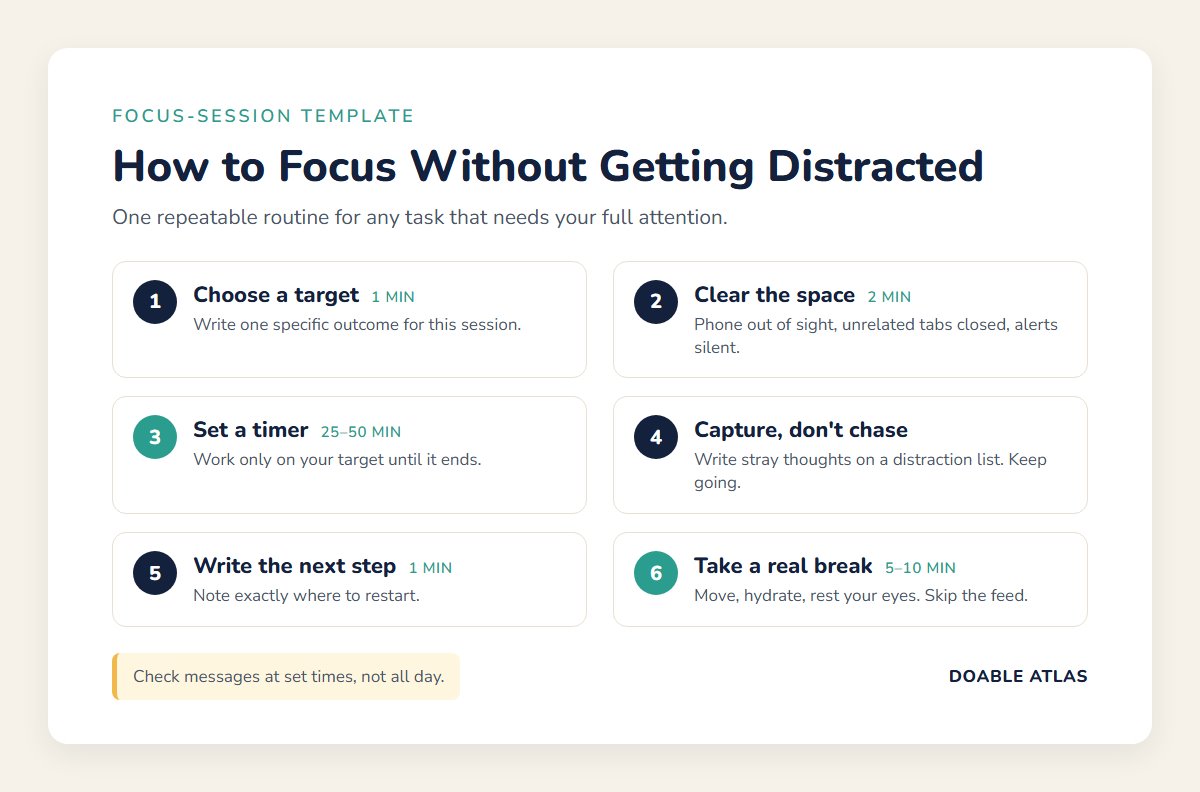
- Choose your target (1 minute): Write one specific outcome for this session.
- Clear the space (2 minutes): Put your phone away, close unrelated tabs, and set notifications to silent.
- Set a timer (25 to 50 minutes): Work only on your target until it ends.
- Capture, do not chase: Write stray thoughts on your distraction list and keep going.
- Write your next step (1 minute): Note exactly where to restart.
- Take a real break (5 to 10 minutes): Move, hydrate, and rest your eyes.
- Review your list: Handle quick items, schedule the rest, then start the next block.
Example: a focused morning
Imagine you need to finish a quarterly report while also keeping up with email.
- 8:45: Check email and messages for 15 minutes. Reply to anything quick and urgent.
- 9:00: Focus block one. Target: draft the summary section. Phone in a drawer, email closed.
- 9:45: Write the next step, take a 10-minute walk, review the distraction list.
- 10:00: Focus block two. Target: build the charts.
- 10:45: Check messages again for 15 minutes.
- 11:00: Focus block three. Target: finish and proofread the report.
Notice that email is not ignored. It simply has a defined place in the morning instead of interrupting every few minutes.
Staying focused in common situations
Working from home
Home offers comfort, but also chores, family members, and a refrigerator a few steps away. Set a clear start and end to your workday, use a dedicated work spot if possible, and agree on simple signals with others in your household, such as closed door or headphones on meaning “focus time.” Planning your week in advance helps too. Our weekly reset checklist shows how to choose priorities before the week begins.
Studying
Studying often requires sustained attention on challenging material. Keep your phone in another room, use focus blocks with specific goals such as “summarize section 3 in my own words,” and test yourself at the end of each block. Studying in short, focused sessions over several days is generally more effective than one long, distracted cram session.
Open offices
Shared spaces are noisy and full of visual movement. Headphones are a widely understood signal that you are concentrating. If your workplace allows it, book a quiet room for your most demanding tasks, or schedule them for times when the office is calmer.
Evenings and personal projects
After a long day, attention is often lower. Keep evening projects small and specific, and prepare everything you need in advance. Our evening reset routine includes simple steps that make the next morning easier to start, too.
When distraction may be a sign of something more
Everyone gets distracted, and the strategies above help most people noticeably. Sometimes, however, persistent trouble with attention can be related to other factors. Poor sleep, chronic stress, anxiety, depression, and ADHD can all affect concentration. Some medications and health conditions can too.
If difficulty focusing is affecting your work, relationships, or daily responsibilities, and practical changes are not helping, consider talking with a doctor or licensed mental health professional. They can help identify whether something else is contributing and what support may help.
Frequently asked questions
How long can a person stay focused?
There is no single number that applies to everyone. Focus depends on the task, your energy, your environment, and how interesting or difficult the work is. Many people find that focus blocks of 25 to 50 minutes with short breaks work well, but it is worth experimenting to find your own rhythm.
Is multitasking ever a good idea?
Doing two simple, automatic things at once, such as folding laundry while listening to a podcast, is usually fine. The problems appear when both tasks require thinking. Switching between demanding tasks tends to cost time and accuracy, so it is better to give each one your full attention in turn.
Does music help you focus?
It depends on the person and the task. Some people find instrumental music or steady background sound helps block out distractions, while others concentrate best in silence. Music with lyrics may be more distracting for reading and writing. Try different options and notice what helps you.
How do I stop checking my phone while working?
Make it less convenient. Put the phone in another room or a drawer during focus blocks, turn on a focus mode, and remove the most tempting apps from your home screen. Schedule specific times to check messages so you know you are not missing anything important.
Your next step
Learning how to focus without getting distracted is a skill you build through small, repeated changes, not a single burst of discipline. Pick one task you need to complete tomorrow. Write a specific target, put your phone out of sight, close unrelated tabs, and set a timer for 25 minutes. Keep a distraction list beside you, and when the timer ends, write down your next step before taking a short break.
Repeat this for a week and notice what changes. Most people find that a few well-designed focus blocks produce more meaningful progress than a whole day of scattered effort.