

Most people know how to set a goal. Fewer know how to set achievable goals: targets that stretch you without collapsing the first time life gets busy. If you have ever started January with a long list of resolutions and quietly abandoned most of them by February, the problem probably was not your character. It was the design of the goals themselves.
This guide walks through a practical, research-informed way to set goals you can actually reach. You will learn what makes a goal achievable, eight steps to build one, a short worksheet you can use in ten minutes, and how to adjust when things do not go to plan.
In this guide
What makes a goal achievable?
An achievable goal is not the same as an easy one. Easy goals rarely change anything. An achievable goal sits in a useful middle ground: it is challenging enough to matter, specific enough to act on, and realistic given your time, energy, and resources.
Psychologists Edwin Locke and Gary Latham spent decades studying goal setting. In a widely cited summary of that research, they reported that specific, challenging goals generally led to better performance than vague instructions such as “do your best,” especially when people were committed to the goal and received feedback on their progress (Locke & Latham, 2002). The same research also noted limits: very complex tasks and goals that people do not accept tend to weaken the effect.
In everyday terms, an achievable goal usually has four qualities:
- Clear: You can describe exactly what “done” looks like.
- Challenging but realistic: It requires effort, but it fits your actual life.
- Meaningful: You care about the result for your own reasons.
- Trackable: You can see progress along the way.
Why so many goals fail
Goals tend to stall for predictable reasons. They are too vague (“get healthier”), too big for the time available (“write a book this month”), too many at once, or disconnected from any specific action. Many also lack a plan for obstacles, so the first difficult week becomes the last week.
The steps below address each of these problems directly. Understanding how to set achievable goals is mostly about removing these common points of failure before you start.
How to set achievable goals in 8 steps
You can use these steps for personal, health, financial, learning, or career goals. Work through them on paper or in a note for the one goal that matters most to you right now.
1. Start with why the goal matters to you
Before you define what you want, take a minute to write down why you want it. A goal you chose because you think you should, or because someone else expects it, is much easier to abandon than one connected to something you value.
Ask yourself:
- What will be different in my life if I reach this goal?
- Why does that matter to me now, rather than someday?
- Would I still want this if nobody else ever knew about it?
Your answer becomes a reminder you can return to when motivation dips.
2. Make the goal specific and measurable
Turn a general wish into a concrete target. The test is simple: could a friend look at your goal and tell, without asking you, whether you achieved it?
- “Read more” becomes “Read 12 books by December 31.”
- “Save money” becomes “Save $1,500 for an emergency fund by June 30.”
- “Get fit” becomes “Walk 30 minutes, five days a week, for the next eight weeks.”
Specific goals give you a clear finish line and make progress easier to see.
3. Check whether it is realistic for your life right now
This is the step most people skip. A goal can be specific and still unachievable if it ignores your schedule, budget, health, or other responsibilities. Look honestly at your typical week and ask:
- How many hours do I genuinely have for this?
- What will I need to stop doing, or do less of, to make room?
- What resources, money, or help will I need?
If the honest answer is “not enough,” adjust the goal rather than hoping willpower will cover the gap. Saving $1,500 in six months might become $750 in six months, or $1,500 in a year. A smaller goal you complete builds more confidence than a larger one you abandon.
4. Set a deadline and break it into milestones
A deadline turns a goal from “someday” into a plan. Milestones turn a distant deadline into a series of near-term targets that feel manageable.
For example, a goal to save $1,500 in six months becomes $250 per month, or roughly $58 per week. A goal to read 12 books in a year becomes one book a month. Each milestone is small enough to start right away and gives you an early sign of whether you are on track.
5. Turn the goal into a weekly action
Outcome goals describe the result you want. Process goals describe what you will actually do. You control the process much more than the outcome, so achievable goals almost always include a clear weekly action.
- Outcome: “Run a 5K in March.” Process: “Run three times a week, following a beginner plan.”
- Outcome: “Get a new job by summer.” Process: “Send five tailored applications every week.”
- Outcome: “Learn basic Spanish.” Process: “Practice 15 minutes a day, six days a week.”
If you want help turning those actions into routines, our guide on how to build better habits explains how to attach new behaviors to cues you already have.
6. Plan for obstacles before they appear
Psychologist Gabriele Oettingen has studied an approach called mental contrasting: imagining the result you want, then deliberately thinking about the obstacles that could get in the way (Oettingen, 2012). She developed a simple four-part exercise from this research, often summarized as WOOP:
- Wish: What do you want to achieve?
- Outcome: What is the best result, and how will it feel?
- Obstacle: What inside you, such as a habit or feeling, is most likely to get in the way?
- Plan: What will you do when that obstacle shows up?
The plan works best in an if-then format. Research on these “implementation intentions” has found that specifying when, where, and how you will act tends to improve follow-through (Gollwitzer & Sheeran, 2006). For example: “If I feel too tired to run after work, then I will put on my shoes and walk for ten minutes instead.”
7. Track your progress where you can see it
Tracking turns effort into visible evidence. A meta-analysis of experimental studies found that prompting people to monitor their progress tended to improve goal attainment, and that the effect was larger when progress was physically recorded or shared with others (Harkin et al., 2016).
You do not need a complicated system. Choose one simple method:
- A paper calendar where you mark each completed action.
- A note on your phone with a running total.
- A weekly check-in with a friend who has a goal of their own.
Keep the tracking quick. If recording progress takes more effort than the action itself, it will not last.
8. Review and adjust every week
Achievable goals are not set once and forgotten. A short weekly review keeps them realistic as your life changes. Once a week, ask three questions:
- What did I complete this week?
- What got in the way?
- What will I change next week?
Adjusting a goal is not failure. Changing a deadline after an illness, or reducing a weekly target during a demanding month, keeps the goal alive. A weekly reset routine is a natural place to fit this review.
A 10-minute goal-setting worksheet
Use this worksheet to turn one wish into an achievable plan. The summary card below gives you the same prompts in a format you can save or print.
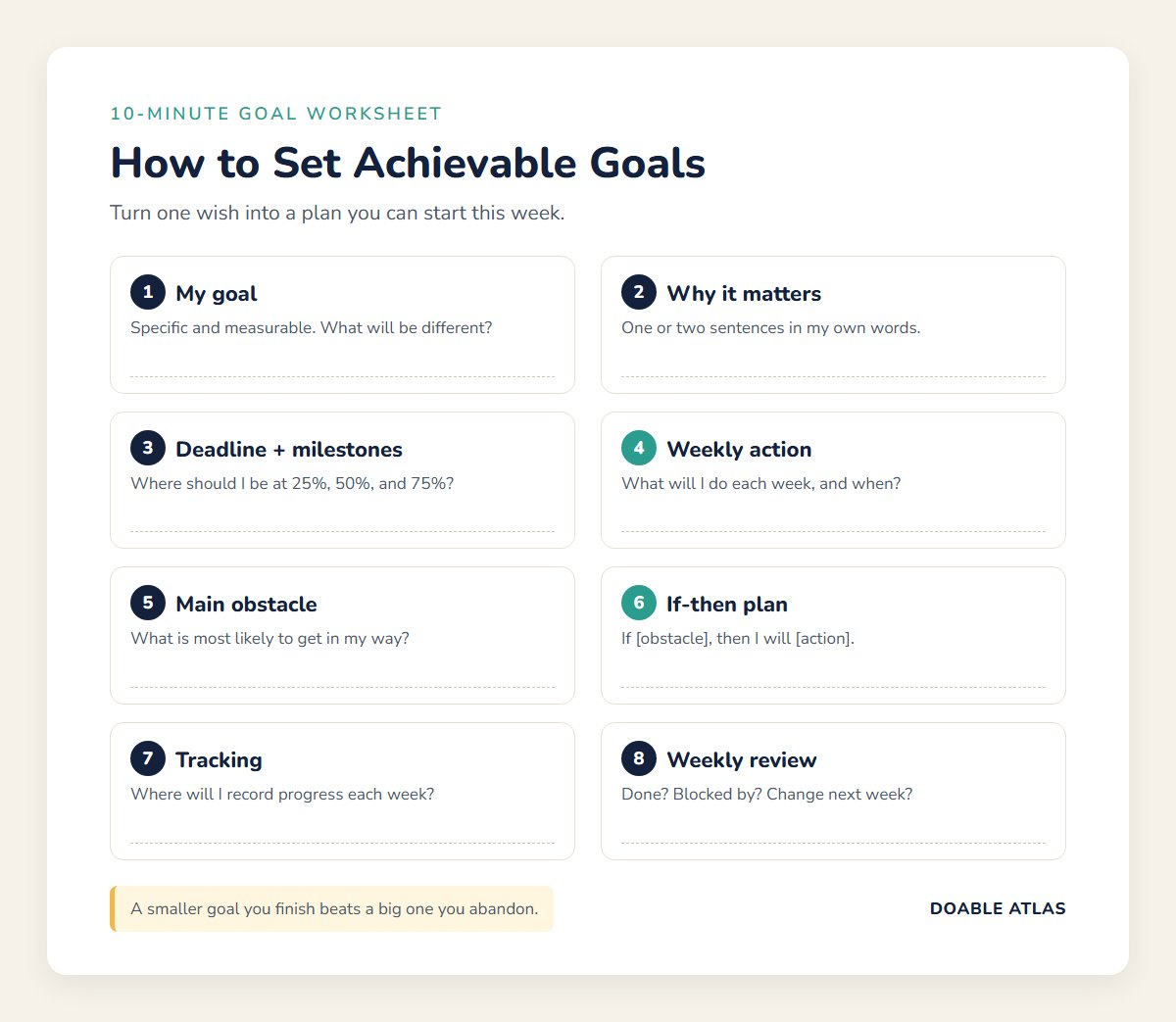
- My goal (specific and measurable): What exactly will be different, and how will I know?
- Why it matters: One or two sentences in my own words.
- Deadline: When will I reach it?
- Milestones: What will be true at the 25%, 50%, and 75% points?
- Weekly action: What will I do each week, and when?
- Main obstacle: What is most likely to get in my way?
- If-then plan: If [obstacle], then I will [action].
- Tracking method: Where will I record progress?
Example: an emergency fund goal
- Goal: Save $1,200 in an emergency fund by August 31.
- Why it matters: I want to stop worrying every time my car needs a repair.
- Deadline: August 31.
- Milestones: $300 by March 31, $600 by May 31, $900 by July 15.
- Weekly action: Transfer $50 to a separate savings account every Friday morning.
- Main obstacle: Spending extra on takeout when I am tired.
- If-then plan: If I want takeout on a weeknight, then I will make one of three simple backup meals I keep at home.
- Tracking method: A paper chart on the fridge, colored in after each transfer.
Notice how the example moves from a general wish to a weekly action you can start this Friday.
SMART goals: a helpful checklist, not a rule
You may have heard of SMART goals: Specific, Measurable, Achievable, Relevant, and Time-bound. The acronym is a useful checklist, and the steps above cover each part. It is not a magic formula, though. A goal can tick every SMART box and still fail if you do not care about it, have no weekly action, or never plan for obstacles.
Think of SMART as a quick quality check after you have done the deeper work of choosing what matters and how you will act.
SMART goal examples
- Health: “Walk 7,000 steps a day, at least five days a week, for the next six weeks, tracked with my phone.”
- Career: “Complete an online spreadsheet course by April 15 by studying 30 minutes every Tuesday and Thursday evening.”
- Learning: “Read 10 pages of a nonfiction book every night before bed through the end of the month.”
- Home: “Declutter one room per weekend until all five rooms are done by the end of next month.”
- Relationships: “Call one close friend or family member every Sunday afternoon for the next eight weeks.”
Common goal-setting mistakes to avoid
Setting too many goals at once
Every goal competes for the same limited time and attention. If you set eight goals in January, each one gets only a small share. Most people do better choosing one to three goals at a time and adding more once the first ones become routine.
Focusing only on the outcome
Outcomes depend partly on things you cannot control. A process you repeat every week depends mostly on you. Pairing every outcome with a weekly action keeps you focused on what you can do today.
Waiting for motivation
Motivation rises and falls. Achievable goals are designed to work on low-motivation days, too. That is why small weekly actions and if-then plans matter. If you often struggle to get started, our guide on how to stop procrastinating covers practical ways to make starting easier.
Treating a missed week as the end
Almost everyone misses a planned action at some point. The goal is not a perfect record but a quick return. Decide in advance that a missed week means a smaller next step, not giving up.
Never revisiting the goal
Life changes. A goal that made sense in January may need a new deadline by April. Regular reviews let you adjust before frustration builds.
How to stay focused on your goals
Even well-designed goals compete with daily distractions. Protect time for your weekly action by putting it on your calendar like an appointment. Keep your goal visible, for example on a sticky note near your desk or as your phone’s lock screen reminder. And when it is time to work on it, remove the easiest distractions first. Our guide on how to focus without getting distracted explains simple ways to make focused time easier.
Frequently asked questions
How many goals should I set at once?
For most people, one to three active goals is a manageable number. It is better to make steady progress on a few goals than to spread your time so thin that none of them move.
What is the difference between a goal and a habit?
A goal describes a result you want to reach, often with a finish line. A habit is a behavior you repeat, often automatically. Achievable goals usually depend on building one or two supporting habits, such as saving every Friday or walking after dinner.
How do I set goals when I feel overwhelmed?
Start smaller than you think you need to. Choose one area of life, set a short-term goal for the next two to four weeks, and pick a single weekly action. Early success builds confidence and energy for bigger goals later.
Should I share my goals with other people?
It can help, especially when it adds accountability or support. Research on progress monitoring suggests that reporting progress to others may strengthen its effect. Choose people who will encourage you rather than judge you, and share specific progress updates rather than only big announcements.
Your next step
Learning how to set achievable goals is less about ambition and more about design. Choose one goal that matters to you right now. Use the worksheet to make it specific and realistic, give it a deadline and milestones, choose one weekly action, and write an if-then plan for your most likely obstacle.
Then put the first weekly action on your calendar for this week. A clear plan you start today will take you further than a perfect plan you keep postponing.