
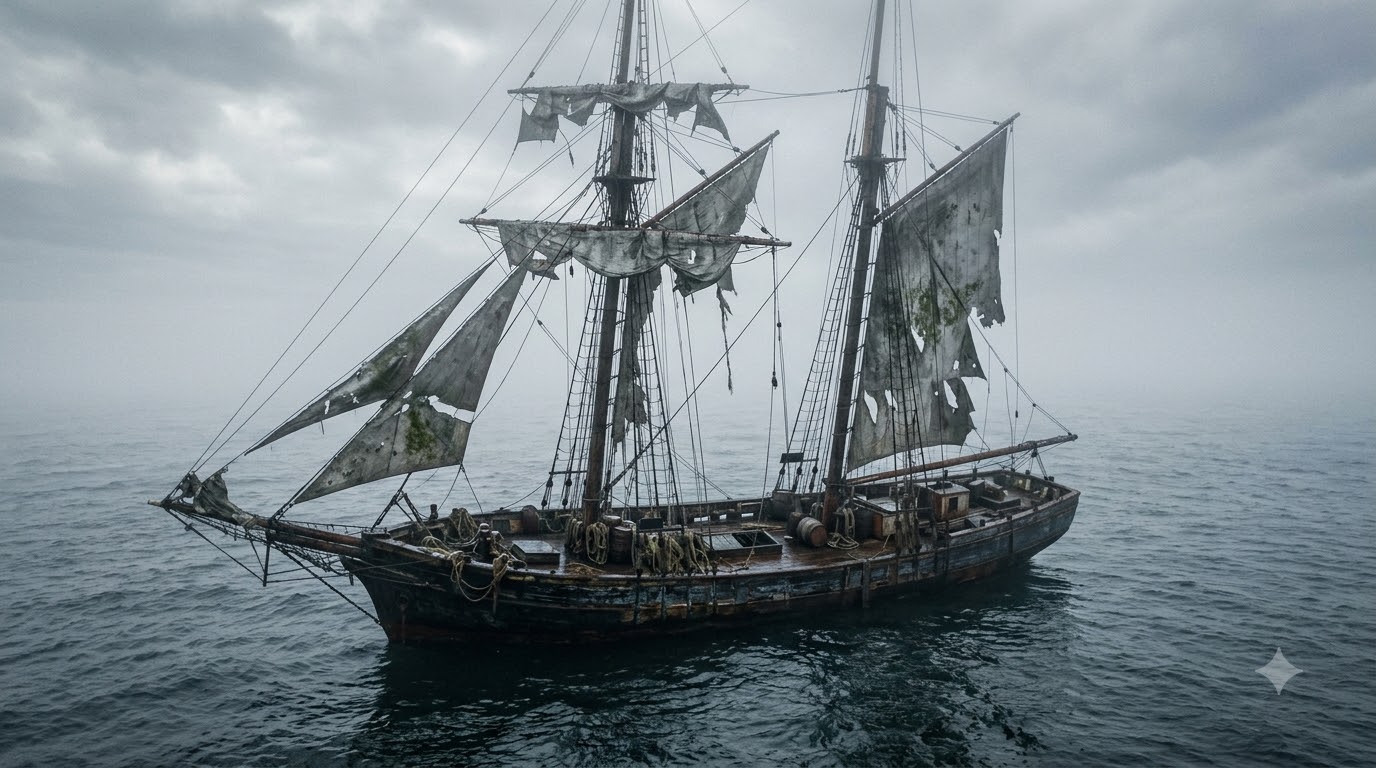
A ship drifts across the Atlantic with its sails set, its cargo intact, and not a single person on board. A Navy vessel carrying more than 300 people sails into calm waters and is never seen again. Three lighthouse keepers vanish from a remote Scottish island, leaving their dinner table set. The sea keeps its secrets well, and some of the most haunting puzzles in history happened on the water. These unsolved maritime mysteries have inspired legends, novels, and endless theories, but the real records are often stranger and more interesting than the myths.
This article explores seven famous cases. For each one, you will find what is documented, the leading explanations, and where popular retellings have drifted away from the facts. At the end, we look at why the ocean produces so many mysteries, and what the Bermuda Triangle has to do with it (spoiler: less than you might think).
In this guide
7 unsolved maritime mysteries
1. The Mary Celeste (1872)
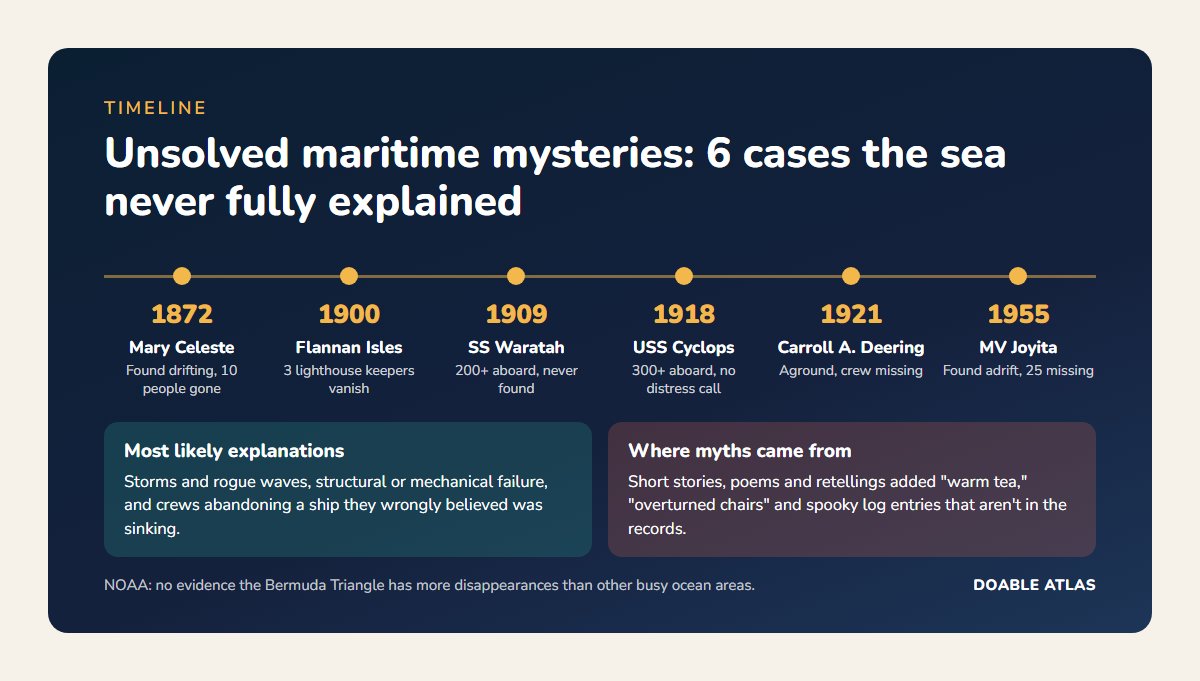
What happened: On December 4, 1872, the crew of the British ship Dei Gratia spotted a vessel drifting erratically in the Atlantic between the Azores and Portugal. It was the American merchant ship Mary Celeste, which had left New York about a month earlier carrying a cargo of commercial alcohol. When sailors boarded, they found the ship seaworthy, with plenty of food and water, but no one on board. The captain, Benjamin Briggs, his wife, their two-year-old daughter, and seven crew members were gone. The ship’s lifeboat was missing.
Leading explanations: Most researchers believe the people on board abandoned ship in the lifeboat, expecting to return, and were lost at sea. Why they left is debated. Theories include fear that the alcohol cargo was about to explode after fumes built up, a faulty pump or sounding rod that wrongly suggested the ship was flooding, or rough weather near land. A few barrels of the cargo were later found empty, which supports the idea of leaking fumes, though it does not prove it.
Myth vs. fact: Many dramatic details, such as warm cups of tea on the table, come from a fictional story written in 1884 by a young Arthur Conan Doyle, which mixed invention with the real case. The official records describe a ship that had been abandoned in some disorder, not a frozen moment in time.
2. USS Cyclops (1918)
What happened: In March 1918, the U.S. Navy cargo ship USS Cyclops left Barbados bound for Baltimore with more than 300 people on board and a heavy load of manganese ore. It never arrived. No distress call was received, and no wreckage was ever confirmed. The loss is often described as the largest single loss of life in U.S. Navy history not directly involving combat.
Leading explanations: Theories include a sudden storm, structural failure under the heavy cargo, and an engine problem the ship had reported before leaving. Because it disappeared during World War I, enemy action was also considered, but no German records supported that idea. The ship’s route passed through the area later nicknamed the Bermuda Triangle, which has helped keep the case famous.
3. SS Waratah (1909)
What happened: The Waratah, a new passenger and cargo steamer, left Durban, South Africa, in July 1909 bound for Cape Town with more than 200 people aboard. It was seen by another ship the next day, and then it was never seen again. Despite extensive searches over the following months, and modern expeditions decades later, no confirmed trace of the ship has been found.
Leading explanations: The coast of South Africa is known for powerful storms and freak waves. Some passengers who left the ship at Durban had reported concerns about how it rolled at sea, leading to theories that it was top-heavy and capsized in a storm. The wreck’s location remains unknown.
4. The Carroll A. Deering (1921)
What happened: On January 31, 1921, the five-masted schooner Carroll A. Deering was found run aground on Diamond Shoals, off Cape Hatteras, North Carolina. Its sails were set, but the crew had vanished, along with their personal belongings and the ship’s lifeboats. A lightship keeper had reported seeing the vessel days earlier and noticed that someone on board seemed unlike a typical officer.
Leading explanations: The U.S. government investigated theories ranging from mutiny to piracy to involvement with rum-runners during Prohibition. Bad weather and an attempt to abandon ship are also possible. No explanation was ever confirmed.
5. The Flannan Isles lighthouse keepers (1900)
What happened: In December 1900, a relief boat arrived at the lighthouse on the remote Flannan Isles, off the west coast of Scotland. The three keepers, James Ducat, Thomas Marshall, and Donald MacArthur, were nowhere to be found. The lighthouse was in order, but the light had not been seen from passing ships for days.
Leading explanations: The official investigation found storm damage at the island’s west landing and concluded that the keepers were most likely swept away by a large wave while securing equipment during bad weather. The case became famous partly because of a 1912 poem that added eerie details, such as an overturned chair, that do not appear in the official reports.
Myth vs. fact: Many retellings describe strange log entries about the keepers weeping and praying. Researchers have found no reliable evidence that these entries existed.
6. MV Joyita (1955)
What happened: In October 1955, the motor vessel Joyita left Samoa for the Tokelau Islands, a trip that should have taken about two days. It never arrived. More than a month later, the ship was found drifting far off course, partly flooded and listing, with no one aboard. All 25 passengers and crew were missing, along with the life rafts, and the logbook was gone.
Leading explanations: Investigators found a corroded pipe that could have flooded the engine compartment, and the ship’s construction meant it was very hard to sink. One theory is that people abandoned ship in the rafts believing it was sinking, while the vessel itself stayed afloat. Some evidence on board, including used medical supplies, suggested that at least one person had been injured. What happened to the people remains unknown.
7. The Ourang Medan (1940s): mystery or myth?
The story: According to accounts that circulated in the late 1940s and later, a Dutch freighter called the Ourang Medan sent a chilling distress call somewhere in Southeast Asian waters, reporting that the crew were dead. When rescuers boarded, they supposedly found everyone frozen in expressions of terror, before the ship caught fire and sank.
Myth vs. fact: Researchers have been unable to find the ship in official registries, and the original sources are vague and inconsistent. Many historians now consider the story a legend or a garbled retelling of a real incident. It is included here as a reminder that some “mysteries” may be mysteries mainly because the evidence was never there.
What these mysteries have in common
Look closely at these unsolved maritime mysteries and several patterns appear:
- Little or no evidence survived. On land, investigators usually find something. At sea, a vessel and everyone on it can disappear without a trace, leaving almost nothing to study.
- Weather and the sea are powerful. Sudden storms, rogue waves, and structural failure explain many disappearances, even if they cannot be proven in any single case.
- Abandoning ship is risky. Several ghost ships, including the Mary Celeste and the Joyita, were found afloat after people left them. Leaving a ship that seems to be sinking for a small boat or raft can be far more dangerous than staying aboard.
- Stories grow over time. Fiction, poems, and retellings add creepy details that were never in the original records.
What about the Bermuda Triangle?
Any list of unsolved maritime mysteries eventually leads to the Bermuda Triangle, the area of the western Atlantic roughly between Miami, Bermuda, and Puerto Rico. Popular books in the 1960s and 1970s claimed that ships and planes vanished there at unusual rates.
The evidence does not support that idea. The U.S. National Oceanic and Atmospheric Administration (NOAA) says there is no evidence that disappearances occur more frequently in the Bermuda Triangle than in any other large, well-traveled area of the ocean (NOAA). The region sees heavy shipping and air traffic, frequent storms, and the strong Gulf Stream current, all ordinary factors that can explain losses.
Cases like USS Cyclops are genuinely unsolved, but you do not need a supernatural triangle to explain them. As with many famous legends, the mystery comes more from the storytelling than the statistics.
How investigators study ocean mysteries today
Modern technology is slowly shedding light on unsolved maritime mysteries that once seemed hopeless:
- Deep-sea search: remotely operated vehicles and autonomous underwater drones can map and photograph the seafloor at great depths. In 2022, a team found Ernest Shackleton’s ship Endurance nearly 10,000 feet down in the Weddell Sea, more than a century after it sank. You can read about that expedition in our article on incredible survival stories.
- Weather reconstruction: historical weather records and computer models help researchers estimate the conditions a ship faced on its final voyage.
- Archive research: newly digitized records, letters, and newspapers often reveal details that early investigators missed, or show that dramatic details were added later.
- Tracking systems: today’s ships carry satellite tracking and emergency beacons, which make complete, unexplained disappearances much rarer than they once were.
How to separate sea legends from facts
Ocean mysteries are a magnet for exaggeration. When you read about unsolved maritime mysteries online, try these quick checks:
- Look for official records: naval reports, court inquiries, and lighthouse or harbor logs are more reliable than modern retellings.
- Find the earliest version: compare newspaper reports from the time with later books and videos. Notice what was added.
- Watch for fiction: several famous “facts” come from short stories and poems, as with the Mary Celeste and the Flannan Isles.
- Prefer simple explanations first: weather, human error, and mechanical failure are common. Extraordinary claims need extraordinary evidence.
For more practice spotting embellishments, see our guide to historical hoaxes people believed and our checklist for spotting weak evidence in viral stories.
The Flying Dutchman and other sea legends
Not every famous story of the sea began with a real ship. Some of the best-known tales behind unsolved maritime mysteries are pure folklore, passed between sailors for centuries:
- The Flying Dutchman: the legend of a ghost ship doomed to sail forever, never able to reach port. Sailors told stories of seeing it, often around the Cape of Good Hope, and believed the sighting was a bad omen. The tale has no single historical ship behind it, but it inspired an opera by Richard Wagner and countless later stories.
- Phantom lights: coastal communities around the world have stories of glowing ships seen at night. Natural explanations include unusual reflections, atmospheric mirages, and bioluminescent plankton.
- Mirages at sea: a type of mirage called a Fata Morgana can make distant ships appear to float above the horizon or stretch into strange shapes. Sailors who saw one long ago had no scientific explanation and understandably found it eerie.
Legends like these help explain why real unsolved maritime mysteries attract so many supernatural theories. Sailors lived in a world of danger, isolation, and limited communication, where an unexplained loss could easily take on a life of its own.
Lessons for anyone who goes to sea
The ghost-ship stories carry practical lessons that sailing instructors and rescue services still repeat today:
- Stay with the vessel if you can. A boat, even a damaged one, is much easier for rescuers to spot than a person or a small raft. “Step up into the life raft” is a common saying: only leave the boat when it is actually sinking.
- File a float plan. Tell someone ashore where you are going, your route, and when you expect to return, so they can raise the alarm.
- Carry emergency signaling equipment. Modern distress beacons, marine radios, and flares make it far less likely that a vessel will vanish without a trace.
- Respect the weather. Many historical losses involved storms that modern forecasts would have warned about.
The same idea applies on land: preparing before something goes wrong is far easier than improvising during a crisis. Our emergency kit checklist for home covers the basics.
Why ghost ships still fascinate us
Part of the appeal of unsolved maritime mysteries is the image itself: an empty deck, a set table, sails still full of wind. They tap into a deep fear of the unknown and the vastness of the ocean. But they also remind us how much of human history happened at sea, and how much courage it took to cross oceans before radios, satellites, and weather forecasts.
The real stories, with their uncertainties and competing theories, are often more rewarding than the legends. They invite us to think like detectives: weigh evidence, admit what we do not know, and resist the urge to fill every gap with the most dramatic explanation.
Frequently asked questions
Why are there so many unsolved maritime mysteries?
Ships often sank far from land, in deep water, with no witnesses and, before radio, no way to call for help. Evidence went down with the vessel. That is why unsolved maritime mysteries are far more common than similar mysteries on land, and why new wreck discoveries still make headlines.
What is the most famous unsolved mystery at sea?
The Mary Celeste, found drifting without its crew in 1872, is probably the most famous. It became the classic example of a “ghost ship,” partly thanks to fiction written about it.
Was the Mary Celeste ever explained?
Not definitively. Most researchers believe the people aboard abandoned ship in a lifeboat for reasons such as fear of exploding alcohol fumes or a false alarm about flooding, and were then lost at sea.
Is the Bermuda Triangle really dangerous?
According to NOAA, there is no evidence that disappearances happen more often there than in other busy areas of the ocean. Storms, heavy traffic, and strong currents explain most incidents.
Have any unsolved maritime mysteries been solved?
Some have been partly solved through wreck discoveries and archive research. Famous shipwrecks, including the Endurance, have been found in recent decades, and new technology continues to locate ships once thought lost forever.
What happened to the Flannan Isles lighthouse keepers?
The official investigation concluded they were most likely swept away by a large wave during a storm. Many spooky details in popular retellings come from later fiction rather than the original reports.
Your next step
The unsolved maritime mysteries in this article show how much the ocean can hide, and how easily legends grow in the gaps. Next time you come across a ghost-ship story, enjoy the chill, then check the date, the source, and the official record. You may find that the real story is even more fascinating than the myth.
Curious about more true stories with strange twists? Explore our collection of unbelievable coincidences that really happened.