

Most people who want to learn how to set boundaries politely are not trying to push anyone away. They want the opposite: to stay close to a friend, keep a good relationship with a coworker, or enjoy time with family without quietly resenting it. The problem is that the words feel risky. Say too little and nothing changes. Say too much and it sounds like an accusation.
A boundary does not have to be dramatic. At its best, it is a short, clear, friendly statement about what you will and will not do. This guide explains what boundaries are, why they feel so hard to say, and a simple seven-step method you can use in almost any relationship. You will also find 30 ready-to-adapt scripts for work, friends, family, partners, and digital life, plus advice for the moment someone pushes back.
In this guide
What a boundary is (and what it is not)
A boundary is a limit you set on your own time, energy, body, belongings, or attention, together with what you will do to protect it. The key word is your. A boundary describes your behavior. It does not try to control someone else’s.
Compare these two statements:
- “You need to stop calling me so late.” This is a demand about another person’s behavior.
- “I don’t answer calls after 9 p.m., so I’ll call you back in the morning.” This is a boundary. It describes what you will do.
The second version is calmer and easier to keep, because it does not depend on the other person agreeing. They can still call at 10 p.m. You simply follow through on what you said you would do.
Boundaries are not ultimatums or punishments
An ultimatum uses a threat to force a change: “If you do that again, we’re done.” A boundary explains a limit and the natural step you will take: “If the conversation turns into yelling, I’m going to take a break and come back to it later.” One aims to control; the other aims to protect. You can set boundaries with warmth, and the people who care about you will usually adjust.
Boundaries are not walls
Setting a limit does not mean shutting people out. Many boundaries actually make relationships closer, because they replace silent resentment with honest information. A friend who knows you cannot talk during work hours will stop wondering why you never reply at noon.
Why setting boundaries feels so uncomfortable
If saying a simple “no” makes your heart race, you are not alone. A few common reasons make boundaries feel harder than they should:
- Fear of disappointing people: Many of us learned early that being agreeable keeps relationships safe.
- Confusing kindness with compliance: It can feel unkind to refuse, even when agreeing costs you sleep, money, or peace of mind.
- Guilt after the fact: Even when the boundary is reasonable, you may replay the conversation and wonder whether you were rude.
- Lack of practice: If you rarely say no, you do not have ready words, so you freeze or over-explain.
The Mayo Clinic describes assertive communication as a way to express your needs directly while still respecting others, and notes that it can help reduce stress, especially for people who take on too much because they find it hard to decline requests (Mayo Clinic). That is exactly the skill a polite boundary uses: direct, but not harsh.
How to set boundaries politely in 7 simple steps
The steps below work for small boundaries (“I can’t stay late tonight”) and bigger ones (“I need us to stop discussing my weight”). You do not need to say every step out loud. Some happen before you open your mouth.
Step 1: Get clear on what you actually need
Vague discomfort is hard to communicate. Before the conversation, finish this sentence: “What I need is ___.” Try to make it specific and observable.
- Instead of “I need more respect at work,” try “I need meetings scheduled at least a day in advance.”
- Instead of “My sister is too much,” try “I need phone calls to be under 30 minutes on weeknights.”
A specific need is easier to say and easier for the other person to respect.
Step 2: Choose the right moment
Timing matters. Setting a boundary in the middle of an argument, in front of others, or when someone is rushing out the door makes it more likely to land badly. If you can, choose a calm, private moment. For ongoing issues, it is fine to say, “Do you have five minutes later today? There’s something small I’d like to talk about.”
If the boundary is needed right now, such as when someone is making a comment you do not want to hear, keep it short and save the longer conversation for later.
Step 3: Start with warmth or appreciation
A friendly opening signals that the relationship matters to you. It should be true, not a manipulation. A single sentence is enough:
- “I really like working with you, and I want to keep things running smoothly.”
- “I love seeing you, and I want our visits to feel good for both of us.”
Avoid long compliments followed by “but.” People quickly learn that praise is just a setup, and it can feel insincere.
Step 4: State the boundary clearly and briefly
This is the core. Use “I” language and describe what you will or will not do. One or two sentences is usually best.
- “I’m not able to take on extra projects this month.”
- “I don’t lend money to friends, even close ones.”
- “I’m not comfortable discussing my relationship at family dinners.”
Notice what is missing: lengthy justification. You can give a short reason if it helps, but over-explaining tends to invite debate. The more reasons you list, the more points the other person can argue with.
Step 5: Offer an alternative when you genuinely can
An alternative shows goodwill and keeps the relationship moving forward. It only works if you actually want to offer it.
- “I can’t help with the move on Saturday, but I could bring dinner on Sunday.”
- “I can’t review this today, but I can look at it first thing Thursday.”
If you do not want to offer anything, you do not have to. “No” is a complete answer. Offering an alternative you resent just creates a new problem.
Step 6: Expect a reaction and stay calm
People often react to a new boundary with surprise, disappointment, or mild irritation, especially if they benefited from the old arrangement. That reaction does not mean you were wrong. It means something changed.
Give them a moment. You can acknowledge the feeling without withdrawing the boundary: “I understand this is frustrating. It’s still what I need.” Listening carefully also helps. Our guide to active listening examples has simple phrases that show you heard someone without agreeing to give up your position.
Step 7: Follow through consistently
A boundary is only as strong as what you do afterward. If you say you do not answer work messages after 7 p.m. and then reply at 9 p.m., people will reasonably assume the limit is flexible. Follow-through does not need to be harsh. It just needs to be consistent.
Repeat the same calm message as often as needed. Many people find that after two or three consistent responses, others adjust without any further discussion.
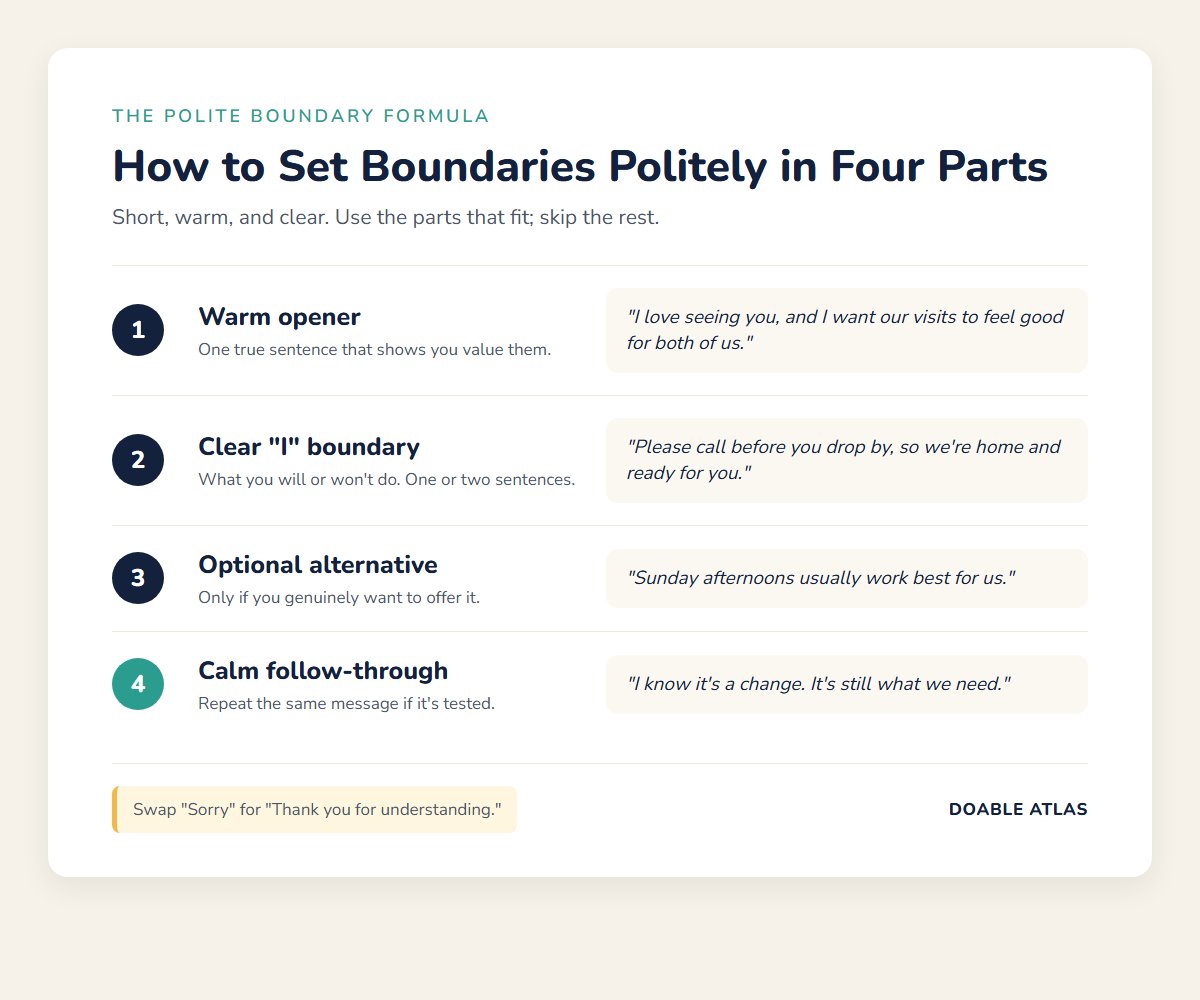
Put together, these steps form a simple formula you can use whenever you are unsure how to set boundaries politely. Save the summary below for quick reference.
30 polite boundary scripts you can use
Use these as starting points. Change the wording until it sounds like you. Saying a script that does not fit your voice will feel awkward for you and the listener.
At work
- “I’d like to help, but my plate is full this week. Can we look at this again on Monday?”
- “I’m not able to take this on without dropping something else. Which of my current tasks should move?”
- “I don’t check email after 6 p.m., so I’ll reply first thing tomorrow.”
- “I’d prefer to keep this conversation about the project. Can we come back to the timeline?”
- “I need at least a day’s notice for meetings. Could we schedule this for tomorrow afternoon?”
- “I’m going to step away for lunch. I’ll be back at 1:00.”
- “I’m not comfortable sharing my salary, but I’m happy to talk about the role.”
With friends
- “I love hanging out, but I’m saving money this month. Could we do something free, like a walk?”
- “I’m not up for a late night, but I’d love to meet for coffee this weekend.”
- “I don’t lend money, but I’m happy to help you look for other options.”
- “I’d rather not talk about my ex. Tell me what’s new with you.”
- “I need a little notice before people come over. Can you text me first next time?”
- “I can’t be on the phone for long tonight. Can I give you fifteen minutes now and call you properly on Saturday?”
- “I’m happy to listen, but I’m not able to give advice on this one.”
With family
- “I appreciate that you care, but I’m not discussing my weight. Let’s talk about something else.”
- “We’re going to spend this holiday at home this year. We’d love to visit the weekend after.”
- “I’m not comfortable with comments about my parenting in front of the kids. If you have concerns, let’s talk privately.”
- “We can stay for dinner, but we’ll head home by 8 so the kids can sleep.”
- “Please call before you drop by. We want to make sure we’re home and ready for you.”
- “I’ve made my decision about the job. I’d like your support even if you would have chosen differently.”
- “I love you, and I’m not going to keep arguing about this. Let’s change the subject.”
With a partner
- “I need about twenty minutes to decompress after work before we talk about plans.”
- “I want to have this conversation, but not when we’re both this upset. Can we come back to it after dinner?”
- “I’m not comfortable sharing my phone passwords, and that’s not about hiding anything.”
- “I need one evening a week to see my friends on my own.”
- “When we disagree, I need us to avoid name-calling. If it happens, I’ll take a short break.”
Online and on your phone
- “I don’t usually reply to messages during work hours, so expect an answer this evening.”
- “I’d rather not have photos of my kids posted online. Could you take that one down?”
- “I’m muting group chats in the evenings. If it’s urgent, please call.”
- “I don’t discuss politics on social media, but I’m happy to talk in person sometime.”
What to do when someone pushes back
Even a kind, well-timed boundary may meet resistance. Here are calm responses to common reactions.
“You’ve changed.”
“I have. I’m working on taking better care of my time. It doesn’t change how much I value you.” You do not need to apologize for growing.
“You’re being selfish.”
“I understand it might feel that way. Saying no to this helps me show up better for the things I can say yes to.” Avoid defending yourself point by point. That turns the boundary into a debate.
“But it’s just this once.”
“I know it feels small. My answer is still no this time.” Repeating the same calm message, sometimes called the broken-record technique, is one of the most effective ways to hold a boundary without escalating.
Silence, sulking, or the cold shoulder
Give the person space and do not chase them for approval. You can check in later: “I noticed things felt a bit tense after we talked. I still care about you, and I’m happy to talk if you want to.” Then let them come back in their own time.
Repeated violations
If someone regularly ignores a clearly stated boundary, the next step is a consequence that you control. For example: “I’ve asked you not to read my messages. If it happens again, I’ll start keeping my phone locked.” Consequences are not threats when they describe something you will genuinely do to protect yourself, and when you are willing to follow through.
How to set boundaries politely without over-apologizing
Many people soften a boundary so much that it disappears. Saying “I’m so sorry, I know this is terrible, I feel awful” before a simple request signals that you are doing something wrong. A single courtesy is enough.
Try swapping apologies for appreciation:
- Instead of “Sorry I can’t come,” try “Thank you for inviting me. I can’t make it this time.”
- Instead of “Sorry to bother you, but could you maybe…,” try “Could you please…”
- Instead of “Sorry, I just need some space,” try “Thanks for understanding that I need a quiet evening.”
You will notice that these versions sound more confident and, surprisingly, warmer. Gratitude points toward the relationship. Excessive apology points toward guilt.
Practicing boundaries when you are a people pleaser
If saying no feels almost impossible, start small. Set low-stakes boundaries first and build confidence before tackling harder conversations.
- Delay your yes: Instead of agreeing right away, say “Let me check my schedule and get back to you.” This gives you time to decide what you actually want.
- Practice with strangers: Politely declining an add-on at checkout or a survey at the door is good practice with very little emotional risk.
- Rehearse out loud: Say the script to a mirror or a trusted friend. The Mayo Clinic suggests practicing difficult conversations before they happen.
- Notice your body: A tight chest or sinking feeling when you agree to something is useful information about where you need a limit.
- Track the outcome: After you set a small boundary, write down what actually happened. Most of the time, the reaction is milder than you feared.
Learning to communicate needs clearly is a skill that improves every relationship. Our guide to healthy communication skills covers seven related habits that make difficult conversations easier, from lowering defensiveness to asking clarifying questions.
A quick boundary-planning worksheet
Before an important conversation, take five minutes to answer these questions:
- Situation: What keeps happening that I want to change?
- Need: What specifically do I need instead?
- Boundary sentence: How can I say this in one or two “I” sentences?
- Alternative: Is there something I genuinely want to offer instead?
- Likely reaction: How might they respond, and what will I say?
- Follow-through: What will I do if the boundary is crossed?
Example: the coworker who always asks for help
- Situation: A coworker asks me to finish parts of their reports most Fridays.
- Need: I need my Friday afternoons to finish my own work.
- Boundary sentence: “I’m not able to help with reports on Fridays anymore. I need that time for my own deadlines.”
- Alternative: “If you need a second pair of eyes, I could look at a draft on Wednesday mornings.”
- Likely reaction: Surprise. I will say, “I know this is a change. It’s what I need to keep up with my work.”
- Follow-through: If asked again on Friday, I will kindly repeat the same answer.
When a boundary problem is really a safety problem
Everything above assumes a relationship where both people are basically respectful, even if they sometimes clash. Some situations are different. If a partner, family member, or anyone else monitors your phone, controls your money, isolates you from friends, threatens you, or reacts to boundaries with intimidation or violence, the issue is not your wording. Polite scripts are not designed for abusive relationships, and trying harder to phrase things perfectly will not make an unsafe person safe.
If any of that sounds familiar, consider reaching out for confidential support. In the United States, the National Domestic Violence Hotline is available 24/7 at 1-800-799-7233, and also offers chat and text options. If you are in immediate danger, call 911.
Frequently asked questions
Is it rude to set boundaries?
No. A boundary stated calmly and kindly is not rude. It may disappoint someone, but disappointment is different from harm. In most healthy relationships, clear limits reduce tension over time because people no longer have to guess what you are comfortable with.
How do I set boundaries with someone who gets angry?
Keep your statement short, stay calm, and avoid arguing about whether your boundary is valid. If the conversation escalates, it is reasonable to pause: “I want to talk about this, but not while we’re both upset. Let’s try again tomorrow.” If anger turns into threats or intimidation, prioritize your safety and seek support.
Do I need to explain why I’m setting a boundary?
Not always. A brief reason can help people understand, especially at work or with close family. But you are not required to justify every limit. Long explanations often invite debate and make the boundary sound negotiable.
What if I feel guilty after setting a boundary?
Guilt is common, especially early on. It usually means you are doing something unfamiliar, not something wrong. Remind yourself why the boundary matters, and notice how the relationship actually responds over the following weeks. The guilt tends to fade as boundaries become normal.
Your next step
Knowing how to set boundaries politely is less about finding perfect words and more about practicing simple ones. Pick one small situation from the past week where you said yes but meant no. Write a one-sentence boundary using “I” language, choose one script from this guide to adapt, and say it the next time the situation comes up.
Start with a low-stakes boundary, notice how it goes, and build from there. Each clear, kind limit you set makes the next one easier, and makes your yes far more meaningful.