
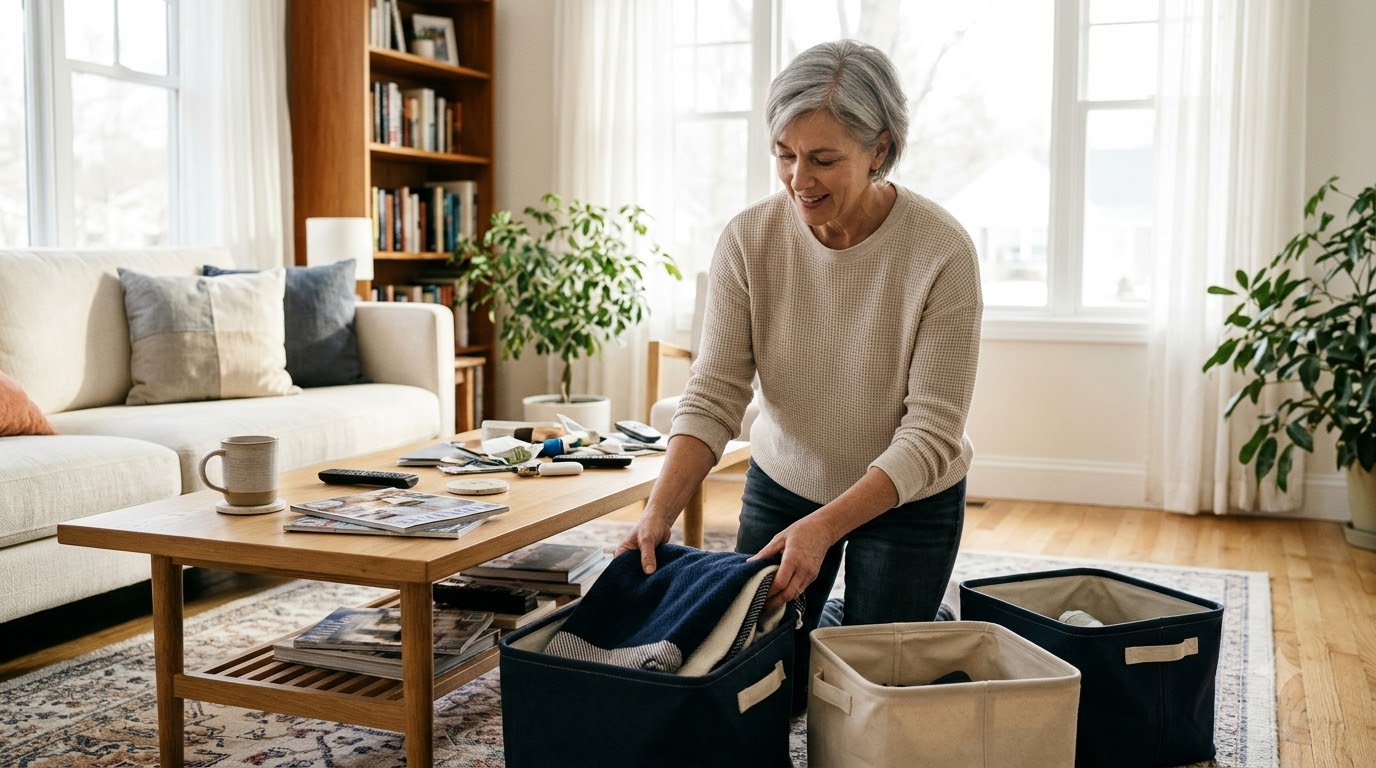
Guests are coming in two hours. Or maybe nobody is coming at all, and you are simply tired of stepping over piles every time you walk through the living room. Either way, you want results today, not a month-long organizing project. This guide shows you how to declutter your home fast without turning your weekend into a marathon or making decisions you will regret later.
You will find a quick explanation of why clutter feels so draining, a room-by-room speed plan, a 30-minute reset you can repeat any time, and simple rules that keep the clutter from creeping back.
In this guide
Why clutter feels so exhausting
Clutter is not only a visual problem. Researchers have found links between how people experience their homes and how they feel. In one study of dual-income couples, women who described their homes using more words related to clutter and unfinished projects showed a less healthy daily pattern of the stress hormone cortisol and reported a more depressed mood across the day (Saxbe & Repetti, 2010). Another study found that clutter was associated with lower satisfaction with home and with weaker psychological well-being, partly because it made spaces harder to use for their intended purpose (Roster, Ferrari & Jurkat, 2016).
These studies show associations, not proof that clutter causes stress for everyone. But they match a common experience: a cluttered room keeps asking for decisions. Every pile is a small, unfinished task. Clearing it gives you back both space and attention.
Before you start: the fast-declutter mindset
Speed decluttering works best when you stop aiming for perfect. Three ideas make the process faster:
- Progress over perfection: A clear surface you can see is worth more than a perfectly organized drawer nobody notices.
- Decide once: Pick up each item and make one decision. Putting things back in a “maybe” pile doubles the work.
- Work visible-first: Start with the surfaces and floors people see. Closets and junk drawers can wait.
Gather your supplies (5 minutes)
You need only a few things, and having them ready keeps you from wandering off mid-task:
- Four bins, boxes, or bags labeled Keep Elsewhere, Donate, Trash, and Recycle.
- A timer on your phone or a kitchen timer.
- A laundry basket for items that belong in other rooms.
- Trash bags and a cloth for quick wipe-downs.
- Music or a podcast if it helps you keep moving.
How to declutter your home fast: 7 steps
1. Set a timer and choose one zone
Decide how much time you have, then divide it. If you have one hour, you might give 20 minutes each to the living room, kitchen, and entryway. A timer creates urgency and prevents you from spending 45 minutes reading old birthday cards.
Choose the zone that bothers you most or that guests will see first. Working in one zone at a time keeps you from scattering mess across the house.
2. Start with obvious trash
Walk through the zone with a trash bag and remove everything that is clearly garbage: empty packaging, junk mail, receipts you do not need, dried-up pens, broken items you will not fix. This step requires almost no decisions, so it creates fast, visible progress and builds momentum.
3. Clear flat surfaces
Tables, counters, dressers, and desks are clutter magnets. Clear one surface completely, wipe it, and then put back only what truly belongs there. Everything else goes into one of your four bins or the laundry basket.
A completely clear surface instantly makes a room look calmer, even if other areas still need work.
4. Use the “belongs elsewhere” basket
A large share of household clutter is simply items in the wrong room: shoes in the kitchen, mugs in the bedroom, toys in the bathroom. Instead of walking each item back one at a time, drop it in the basket. When the timer ends, carry the basket through the house and return everything in one trip.
5. Make quick keep-or-go decisions
For anything that is not trash and not in the wrong room, ask two quick questions:
- Have I used this in the last year?
- Would I buy it again today?
If the answer to both is no, it probably belongs in the Donate bin. Seasonal items, important documents, and genuinely sentimental pieces are exceptions; set them aside rather than forcing a decision in the moment.
6. Clear the floor
After surfaces, focus on the floor. Bags, shoes, stacked boxes, and laundry piles make a room feel smaller and are easy to trip over. Clearing walkways is one of the fastest ways to make a home feel organized.
7. Take the bins out immediately
This is the step most people skip, and it is why clutter returns. Take trash and recycling outside right away. Put the donation bin in your car or by the front door with a specific drop-off day in mind. A donation bag that stays in the hallway for three weeks is just clutter in a different spot.
A room-by-room speed plan
If you are not sure where to start, use these quick priorities for each room. Each list is designed to fit roughly 15 to 20 minutes.
Entryway
- Put shoes on a rack or in a bin, keeping only those worn this week by the door.
- Clear mail and flyers; recycle junk mail immediately.
- Hang coats and bags, and move off-season items to storage.
Living room
- Clear the coffee table and side tables completely.
- Collect stray cups, wrappers, and remote controls.
- Fold throws, fluff pillows, and gather toys or hobby supplies into one basket.
Kitchen
- Clear the counters first; store small appliances you rarely use.
- Empty and load the dishwasher, or wash and dry dishes.
- Toss expired food from the fridge and pantry fronts.
Bedroom
- Make the bed; it is the largest visual surface in the room.
- Gather clothes from chairs and floors: clean clothes back to drawers, the rest to the hamper.
- Clear nightstands to just a lamp, a book, and a glass of water.
Bathroom
- Clear the counter and toss empty bottles and expired products.
- Put daily items in one small tray or basket.
- Replace towels and take out the trash.
The 30-minute home reset
When you need visible results quickly, this short routine covers the areas that make the biggest difference. The summary card below makes it easy to save or print.
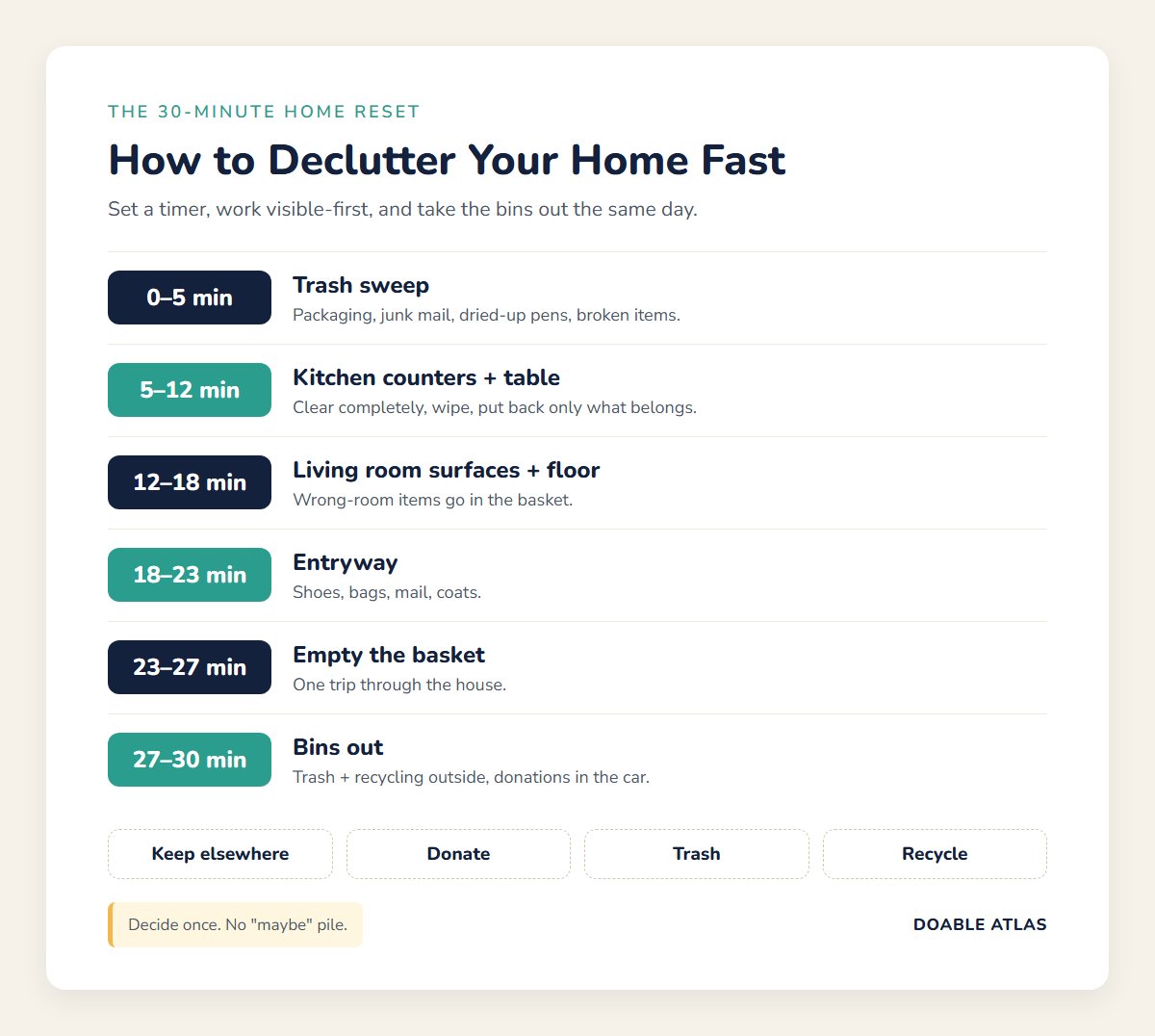
- Minutes 0–5: Trash sweep through the main living areas.
- Minutes 5–12: Clear and wipe the kitchen counters and dining table.
- Minutes 12–18: Living room surfaces and floor; fill the belongs-elsewhere basket.
- Minutes 18–23: Entryway shoes, bags, and mail.
- Minutes 23–27: Return everything in the basket to its room.
- Minutes 27–30: Take out trash and recycling; put donations in the car.
Repeat it weekly and your home will rarely slide back into chaos. It fits naturally into a weekly reset routine.
If you only have 10 minutes
Some days you will not have half an hour. A 10-minute session still makes a visible difference if you pick the right target. Try one of these:
- The one-surface rule: Choose the single surface that bothers you most, usually the kitchen counter or coffee table, and clear it completely.
- The 10-item sweep: Walk through one room and remove ten things that do not belong there, whether they go to trash, donation, or another room.
- The doorway test: Stand in the doorway of a room and fix only what you can see from there. This focuses you on what guests and family notice first.
- The bag challenge: Fill one grocery bag with donations from a single closet or drawer, then put it straight in the car.
Short sessions also make decluttering less intimidating. Many people find that once the timer starts, they keep going a little longer. If getting started is the hardest part, our guide on how to stop procrastinating explains why tiny first steps work so well.
Decluttering with kids, partners, or roommates
Shared homes add another layer, because not everything is yours to decide. A few approaches keep things fair and fast:
- Agree on shared zones first: Focus together on spaces everyone uses, such as the kitchen, living room, and entryway, and agree on what belongs there.
- Give each person a bin: Instead of deciding for others, place their items in a labeled bin and let them sort it by a set day.
- Make it a timed game for kids: A 10-minute race to clear the floor, with music on, often works better than a long cleanup lecture.
- Let kids choose donations: Giving children some say in which toys to donate builds cooperation and reduces conflict.
Talking about expectations calmly matters more than any system. If a conversation about clutter tends to turn tense, our guide on how to set boundaries politely has scripts that can help.
What to do with the things you remove
Decluttering quickly does not mean sending everything to a landfill. A few options keep usable items in circulation:
- Donate: Many thrift stores and charities accept clothing, housewares, books, and toys in good condition. Check their accepted-items list first.
- Give away locally: Neighborhood groups and free-item marketplaces often find takers for furniture and kids’ gear within days.
- Sell selectively: Only sell items worth the effort, such as furniture, electronics, or brand-name gear. Set a deadline; if it has not sold in two weeks, donate it.
- Recycle responsibly: Electronics, batteries, and paint often need special drop-off. Check your city or county’s recycling guidance.
- Shred sensitive papers: Bank statements and documents with personal information should be shredded rather than recycled whole.
Handling sentimental items without slowing down
Sentimental items are the fastest way to derail a speed declutter. Instead of deciding in the moment, create one “memory box.” Put sentimental items in it as you go and keep moving. Later, when you have time and energy, sort through that one box. You might keep a few favorites, photograph others, and let the rest go.
Giving sentimental items their own separate session protects both your progress and your feelings.
Keeping clutter from coming back
Fast decluttering works best when it is followed by a few small habits. These keep you from needing a big rescue session again:
- One in, one out: When a new item comes in, let a similar one go.
- A home for everything: Items without a designated spot tend to land on counters. If something has no home, decide where it lives or whether you need it.
- Daily 10-minute tidy: A short evening reset prevents small messes from piling up. Our evening reset routine shows a simple version.
- A landing zone: Keep one tray or basket by the door for keys, mail, and sunglasses.
- Handle mail daily: Recycle junk immediately and put bills in one specific folder.
Habits like these work best when they are tied to things you already do. If you want to make a new routine stick, see our guide on how to build better habits.
Common decluttering mistakes
Buying storage before decluttering
New bins and organizers can make clutter look tidier without reducing it. Declutter first, then buy only the storage you genuinely need for what remains.
Pulling everything out at once
Emptying an entire closet when you only have 20 minutes creates a bigger mess than you started with. Match the size of the task to the time you have.
Moving clutter instead of removing it
Shoving piles into a closet or the garage feels fast but just relocates the problem. Use the four-bin system so every item gets a real decision.
Decluttering other people’s things
Clearing a partner’s or roommate’s belongings without asking can cause conflict. Focus on your own items and shared spaces, and agree on guidelines together for the rest.
When clutter is more than a mess
For most people, clutter builds up during busy seasons and responds well to quick sessions like these. For some, though, letting go of possessions causes intense distress, and accumulation makes parts of the home unsafe or unusable. That can be a sign of hoarding disorder, a recognized mental health condition. If that sounds familiar for you or someone you love, a doctor or licensed mental health professional can help, and approaches that respect the person’s feelings tend to work better than forced cleanouts.
Frequently asked questions
How long does it take to declutter a house?
It depends on the size of the home and how much has built up. A quick reset of the main living areas can take 30 to 60 minutes. A full house, including closets, garages, and storage, often takes several weekends spread over a month or more.
Where should I start decluttering if I feel overwhelmed?
Start with the space you see most often, such as the kitchen counter or the coffee table, and give yourself just 15 minutes. Quick, visible progress makes it easier to continue.
What should I get rid of first?
Start with obvious trash, duplicates, expired products, and items that are broken. These need almost no thought and create fast results.
How do I stay motivated while decluttering?
Use short timed sessions, start with high-visibility areas, and take a quick before-and-after photo. Seeing the difference is often the best motivation to keep going.
Your next step
Knowing how to declutter your home fast comes down to a few simple moves: set a timer, start with trash and surfaces, use a belongs-elsewhere basket, and take the bins out right away. Choose one zone in your home right now, set a timer for 20 minutes, and see how much calmer it looks when the timer ends.
Then put a 30-minute reset on your calendar for the same time next week. A little regular attention keeps your home feeling like a place to rest, not another task on your list.