

You open your phone for a minute and close it twenty minutes later feeling slightly worse about your job, your home, your body, or your progress in life. Nothing bad actually happened. You simply watched other people’s best moments and quietly measured yourself against them. If that feels familiar, you are not shallow or ungrateful. You are human. Learning how to stop comparing yourself to others is not about switching off a normal part of your brain. It is about noticing when comparison is hurting you and redirecting it toward something more useful.
This guide on how to stop comparing yourself to others explains why we compare, when comparison helps and when it harms, and then gives you a practical, step-by-step plan you can start today. You will also find a one-page comparison reset card you can save, and answers to the questions people ask most often.
In this guide
Why we compare ourselves to others
In 1954, psychologist Leon Festinger proposed what he called social comparison theory. His idea was simple: people have a basic drive to evaluate their own abilities and opinions, and when there is no objective standard available, they evaluate themselves by comparing with other people (Festinger, 1954). There is no official scale for being a “good enough” parent, a “successful” thirty-year-old, or an “attractive” person, so the brain reaches for the nearest available yardstick: everyone around us.
This drive made sense for most of human history. Knowing how you measured up within a small group helped you learn skills, find your place, and avoid falling behind. The problem is that the group used to be a few dozen people you actually knew. Today it is thousands of strangers, influencers, and old classmates, all presenting carefully selected highlights.
Comparison also happens automatically. You do not decide to compare. You see a friend’s promotion announcement and the thought “I should be further along by now” appears before you have chosen anything. That is why trying to simply “stop thinking about it” rarely works. Knowing how to stop comparing yourself to others starts with accepting that the first thought is not your fault. What you do with the second thought is where your power lies.
Upward and downward comparison
Researchers usually describe two directions of comparison:
- Upward comparison: comparing yourself with someone who seems better off, more skilled, or more successful. It can inspire you (“If she learned to code at forty, maybe I can too”) or crush you (“I will never be that good”).
- Downward comparison: comparing yourself with someone who seems worse off. It can bring short-term relief or gratitude, but it can also slide into judgment and does little for long-term growth.
Neither direction is purely good or bad. The outcome depends on what you compare, how often, and what story you tell yourself afterward. An upward comparison that ends with “What can I learn from how they did it?” is useful. The same comparison that ends with “I am behind and always will be” is harmful.
How social media makes comparison worse
Social media did not invent comparison, but it supercharged it. In one set of studies, people who used Facebook more often reported lower self-esteem, and this link was explained largely by greater exposure to upward social comparisons (Vogel et al., 2014). In another experiment, students who limited their social media use to about 30 minutes per day for three weeks reported significant reductions in loneliness and depression compared with a control group (Hunt et al., 2018).
Several features make online comparison especially painful:
- Highlight reels: people post the vacation, not the argument in the airport. You compare your full, messy life with everyone else’s edited best moments.
- Endless volume: there is always someone richer, fitter, or more productive, and the feed never runs out.
- Numbers everywhere: likes, followers, and views turn social standing into a scoreboard.
- Algorithms: feeds learn what grabs your attention, and envy is very good at grabbing attention.
That does not mean you must delete every account. It means that if you want to know how to stop comparing yourself to others, your feed is one of the first places to look.
How to stop comparing yourself to others in 9 steps
Here is a practical plan for how to stop comparing yourself to others. You do not need to do all nine steps at once. Start with two or three that feel doable, then add more over the next few weeks.
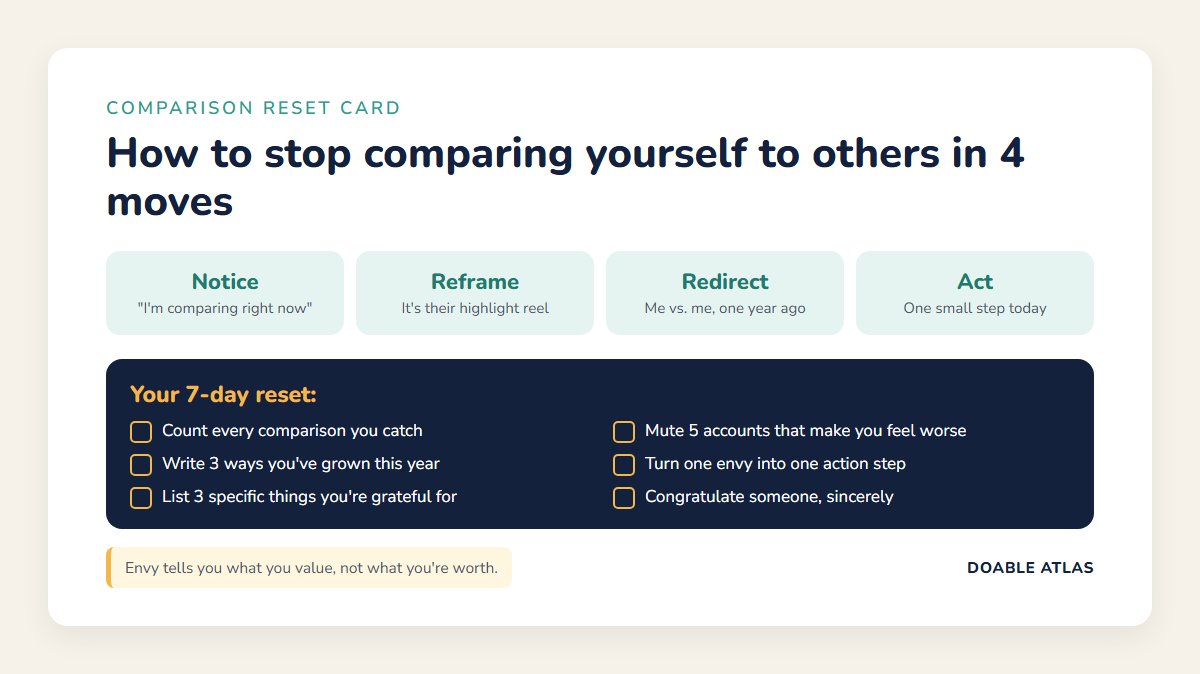
Step 1: Notice the moment it happens
Comparison runs on autopilot, so the first step is catching it. Pay attention to the physical signs: a tight chest, a sinking feeling, a sudden urge to check how you are doing against someone else. When you notice it, name it silently: “I am comparing right now.” That small label creates distance between you and the thought. You are no longer inside the comparison. You are observing it.
Step 2: Find your personal triggers
For three to five days, jot down when comparison hits hardest. Is it scrolling in bed? Group chats about salaries? A certain friend’s posts? Family gatherings? Most people discover a few predictable triggers rather than a constant flood. Once you know your triggers, you can plan for them instead of being ambushed. Mapping triggers is the quiet foundation of how to stop comparing yourself to others for good.
Step 3: Curate your feed on purpose
Go through the accounts you follow and ask one question about each: “Do I usually feel better or worse after seeing this?” Mute or unfollow the accounts that reliably leave you feeling inadequate. You do not need to announce it or feel guilty. Then add accounts that teach you something, make you laugh, or show real, unpolished life. If you want a structured way to do this, our digital declutter checklist walks through a full clean-up.
Step 4: Set limits on scrolling
The Hunt et al. experiment suggests that even modest limits can help. Try a daily time limit for social apps, move them off your home screen, or keep your phone out of the bedroom. Many people find that comparison is worst late at night, when they are tired and their defenses are low. Replacing bedtime scrolling with a book or a short evening reset routine removes one of the biggest triggers.
Step 5: Remember you are seeing a highlight reel
When a comparison appears, remind yourself what you are not seeing: the debt behind the new car, the hours of editing behind the photo, the anxiety behind the confident post, the years of failure behind the overnight success. You are comparing your behind-the-scenes footage with someone else’s trailer. That is not a fair test, so it is not a meaningful result.
Step 6: Compare yourself with your past self
One of the most effective ways to learn how to stop comparing yourself to others is to change the comparison target. Instead of asking “Am I doing as well as them?”, ask “Am I doing better than I was a year ago?” Look at concrete evidence: skills you have learned, problems you have handled, habits you have built. Many people are surprised by how much progress they have made once they stop measuring it against strangers.
Step 7: Turn envy into information
Envy is uncomfortable, but it is also useful data. It often points to something you want. If a friend’s career change makes you jealous, maybe you are craving more meaningful work. If someone’s fitness photos sting, maybe you miss feeling strong. Ask, “What exactly do I want here, and what is one small step toward it?” Then write that step down. Our guide on how to set achievable goals can help turn that insight into a realistic plan.
Step 8: Practice gratitude in a specific way
Gratitude works as a counterweight to comparison because it shifts attention from what you lack to what you have. In a well-known study, people who wrote down things they were grateful for each week reported feeling better about their lives overall than people who wrote about hassles or neutral events (Emmons & McCullough, 2003). Keep it specific. “I am grateful for my family” is easy to write and easy to forget. “I am grateful my brother called to check on me after my interview” lands with real feeling.
Step 9: Celebrate other people out loud
This one feels counterintuitive. When you notice comparison with someone you know, congratulate them sincerely. Send the message. Say the kind thing. Doing this repeatedly trains your brain to treat other people’s wins as good news rather than as evidence of your own failure. It also strengthens relationships, which are one of the strongest protectors against feeling inadequate.
Self-talk scripts that help
Comparison is often fueled by a harsh inner voice. Having a few ready-made phrases can interrupt that voice before it spirals. Try saying one of these to yourself when comparison strikes:
- “Their success does not take anything away from mine.”
- “I am seeing one chapter of their story, not the whole book.”
- “I am on my own timeline, and it is allowed to look different.”
- “What is one thing I can do today that past me would be proud of?”
- “Feeling envious tells me what I value, not what I am worth.”
These may feel awkward at first. That is normal. Like any new habit, kinder self-talk becomes more natural with repetition. If you notice that harsh self-talk also leads to endless rumination, our article on why people overthink explains how to break that loop.
Comparison in specific areas of life
Knowing how to stop comparing yourself to others looks a little different in each area of life. Comparison tends to show up in the same few places. Here is how the steps apply to the most common ones.
Career and money
Job titles and salaries invite comparison because they look like neutral numbers. But they leave out working hours, stress, debt, family support, and luck. If career comparison is a trigger, focus on your own direction: what skills you want to build this year and what kind of work feels meaningful to you. Tracking your own finances clearly, for example with a simple budget spreadsheet, also reduces anxiety, because you stop guessing whether you are “behind” and start working with real numbers.
Appearance and fitness
Images online are often filtered, edited, posed, and lit professionally. Comparing your reflection in a bathroom mirror with them is comparing a photograph with a painting. Shift attention toward what your body can do rather than how it looks: walking farther, sleeping better, lifting more, feeling more energetic. Those are goals you can actually influence.
Relationships and family life
Anniversary posts and family photos rarely show conflict, boredom, or loneliness. Every relationship has hard seasons. If comparison makes you doubt your own relationships, talk to the people involved instead of the feed. Good conversations do more for your relationship than any post. Our guide to healthy communication skills is a good place to start.
Productivity and personal growth
Ironically, self-improvement content can become another source of comparison. Someone wakes up at 5 a.m., meditates, journals, runs ten kilometers, and reads a book before breakfast. It is easy to feel lazy by comparison. Remember that routines are personal. A morning routine that works for you will look different from anyone else’s, and that is the point.
When comparison can actually help
Comparison is not always harmful. Used well, it can motivate and guide you. The key difference is whether comparison leads to action and learning or to shame and paralysis.
- Learning from role models: studying how someone reached a goal you share can give you a roadmap.
- Realistic benchmarks: knowing typical progress rates in a skill can stop you from expecting too much too soon.
- Inspiration: seeing someone similar to you succeed can make a goal feel possible.
A useful test is to check how you feel ten minutes after the comparison. If you feel energized and have a next step in mind, the comparison was helpful. If you feel smaller and stuck, it was not. Knowing how to stop comparing yourself to others in harmful ways does not mean never looking at other people. It means choosing comparisons that serve you.
A 7-day comparison reset
If you like structure, try this one-week plan. It is the simplest way to practice how to stop comparing yourself to others without overhauling your whole life. Each day takes ten minutes or less.
- Day 1: notice and name every comparison you catch. Just count them, without judgment.
- Day 2: list your top three comparison triggers from yesterday’s notes.
- Day 3: mute or unfollow at least five accounts that reliably make you feel worse.
- Day 4: write down three ways you have grown in the last year.
- Day 5: pick one envy feeling and turn it into a single small action step.
- Day 6: write three specific things you are grateful for.
- Day 7: congratulate someone sincerely, then review the week. Which steps helped most?
At the end of the week, keep the two or three steps that made the biggest difference and repeat them. That is your personal plan for how to stop comparing yourself to others over the long term.
Mistakes that keep the comparison trap going
- Trying to suppress the thought. Telling yourself “do not compare” often makes the thought stronger. Notice it, name it, and redirect it instead.
- Swapping one scoreboard for another. Comparing how “un-comparing” you are with others is still comparison. Keep the focus on your own progress.
- Relying only on willpower. Environmental changes, such as feed curation and screen limits, work better than trying to resist triggers you see every day.
- Using downward comparison as a crutch. Feeling better because others are struggling offers short relief and can damage empathy.
- Ignoring the deeper feeling. Constant comparison is sometimes linked to low self-esteem, loneliness, anxiety, or depression. Addressing those directly matters more than any trick.
When to get extra support
Sometimes learning how to stop comparing yourself to others on your own is not enough. For most people, comparison is an occasional annoyance. For some, it becomes a constant weight. Consider talking with a doctor, counselor, or therapist if:
- Comparison leaves you feeling hopeless or worthless most days.
- It is affecting your sleep, eating, work, or relationships.
- You are avoiding people or situations because you feel you do not measure up.
- You notice signs of depression or anxiety that last more than two weeks.
Approaches such as cognitive behavioral therapy and compassion-focused therapy specifically help people change self-critical thinking patterns. Asking for help is a strength, not a failure.
Frequently asked questions
Is it normal to compare yourself to others?
Yes. Social comparison is a basic human tendency that psychologists have studied since the 1950s. Everyone does it. The goal is not to never compare, but to recognize when comparison is unhelpful and to redirect it.
What is the fastest way to learn how to stop comparing yourself to others?
The quickest relief usually comes from removing triggers: muting accounts that make you feel worse and limiting scrolling, especially at night. Pair that with a simple habit of comparing yourself with your past self instead of with other people.
How do I stop comparing myself to others on social media?
Curate your feed, set daily time limits, keep apps off your home screen, and remind yourself that posts are edited highlights. Research suggests that even limiting social media to about 30 minutes a day can reduce loneliness and low mood.
Can comparison ever be good?
Yes, when it inspires action. Learning from someone who has achieved a goal you share can give you ideas and motivation. If comparison leaves you feeling stuck or ashamed, it is time to change your focus.
How long does it take to stop comparing yourself to others?
There is no fixed timeline. Many people notice a difference within a week or two of curating their feed and practicing new self-talk. Deeper change takes longer, because you are building new habits of thought. Be patient and consistent.
Your next step
Learning how to stop comparing yourself to others is less about willpower and more about attention. Notice the comparison, name it, and gently steer your focus back to your own path: your progress, your values, and the next small step you can take.
Start today with one action. Mute three accounts that make you feel worse, write down one way you have grown this year, or send a sincere congratulations to someone you have been quietly envying. Small shifts like these add up. Over time, you will find that other people’s success feels less like a threat and more like proof of what is possible, including for you.