

You promise yourself you will stop scrolling in bed, skip the afternoon snack run, or quit biting your nails. For a day or two it works. Then a stressful afternoon arrives and you are right back where you started. If that cycle sounds familiar, the problem is not your willpower. It is your strategy. Learning how to break a bad habit is less about forcing yourself to resist and more about understanding how habits work, then quietly redesigning the situations that trigger them.
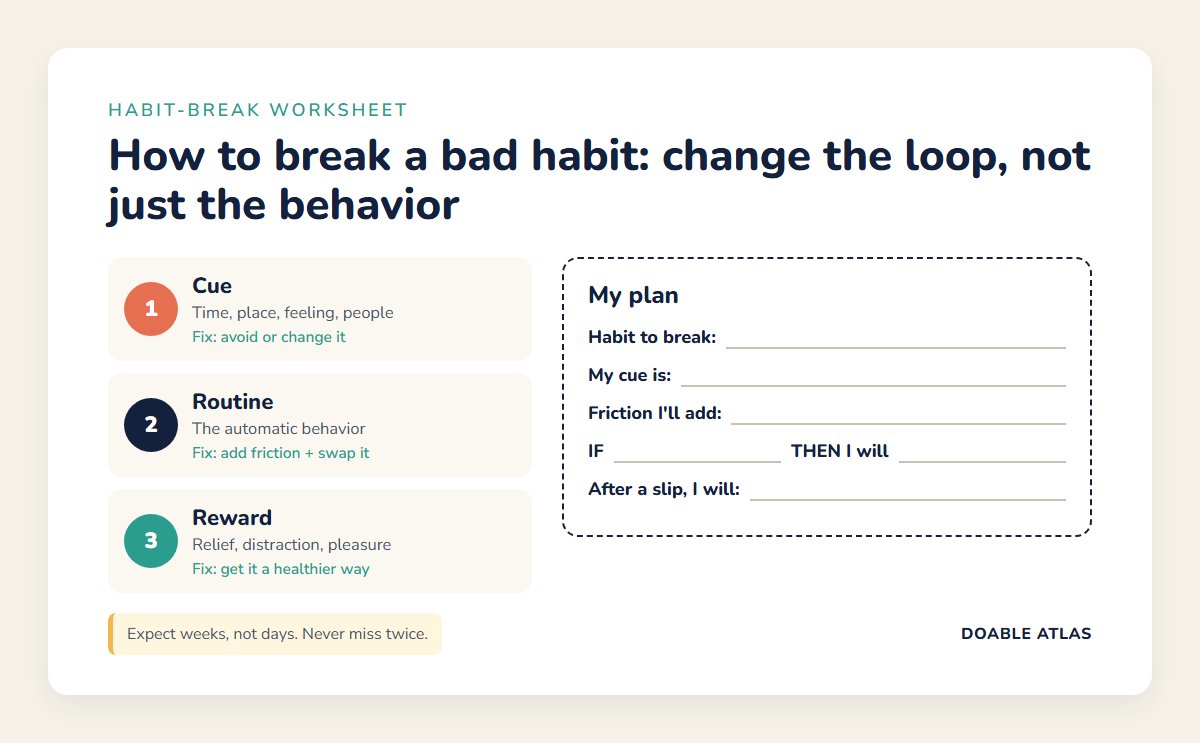
This guide explains what keeps bad habits running on autopilot, then walks you through a practical, step-by-step plan: spotting your triggers, adding friction, replacing the routine instead of deleting it, and handling slip-ups without giving up. You will also find a one-page habit-break worksheet you can save or print.
In this guide
Why bad habits are so hard to break
A habit is a behavior your brain has learned to run automatically in response to a familiar situation. That automation is useful. It frees your attention for other things, which is why you can brush your teeth while planning your day. The trouble is that your brain automates unhelpful behaviors just as efficiently as helpful ones.
Researchers who study habits describe them as context-driven. Over time, a cue in your environment, such as a time of day, a place, a feeling, or the people around you, becomes linked to a behavior and its payoff. Once that link is strong, the cue alone can trigger the behavior before you have consciously decided anything. Psychologist Wendy Wood, who has studied habits for decades, has found that a large share of our daily actions are performed out of habit, often while we are thinking about something else.
That explains three frustrating facts:
- Good intentions fade under stress. When you are tired or overwhelmed, your brain falls back on its automatic routines.
- Willpower is a weak tool against cues. You can resist once, but the cue keeps showing up, day after day.
- Simply stopping leaves a gap. The habit was meeting a need, such as comfort, stimulation, or a break. If nothing replaces it, the old behavior rushes back in.
The good news is that the same mechanics can work in your favor. Change the cues, the effort, and the payoff, and the habit loses its grip.
The habit loop: cue, routine, reward
A popular way to picture a habit is as a loop with three parts, a model popularized by journalist Charles Duhigg in The Power of Habit:
- Cue: the trigger. It might be a time (after lunch), a place (your couch), an emotion (boredom or anxiety), other people (friends who smoke), or a preceding action (opening your laptop).
- Routine: the behavior itself, such as checking social media, grabbing a sugary drink, or biting your nails.
- Reward: the payoff that makes your brain want to repeat the loop, such as relief, distraction, energy, or a small hit of pleasure.
When you understand your own loop, you stop fighting the behavior head-on and start working on the parts that drive it. Most successful approaches to breaking habits target the cue (avoid or change it), the routine (swap it), or the effort required (make it harder).
How to break a bad habit in 7 steps
Here is how to break a bad habit step by step. Work through these steps in order for one habit at a time. Trying to overhaul several habits at once usually means none of them change.
Step 1: Pick one habit and define it precisely
“Stop wasting time” is too vague to act on. “Stop scrolling social media in bed after 10 p.m.” is specific. Write down exactly what the behavior is, when it happens, and what you want instead. A precise target makes it easier to notice the habit and to measure progress.
Step 2: Track it for three to five days
Before changing anything, observe. Each time the habit happens, jot down a quick note: the time, where you were, what you were doing just before, how you felt, and who was around. Patterns appear fast. Many people discover that their habit is tied to one or two very specific cues, such as boredom at 3 p.m. or stress after a work call.
Tracking also creates awareness, and awareness alone often reduces the behavior a little, because it interrupts the autopilot.
Step 3: Identify the reward you are really after
Ask what need the habit is meeting. Are you hungry, or are you bored? Is scrolling relaxing you, or helping you avoid a hard task? A useful experiment is to try a different routine when the urge appears, such as a short walk, a glass of water, or a chat with a colleague, and notice whether the craving fades. If it does, you have found a substitute that delivers the same reward.
Step 4: Change or avoid the cue
The easiest habit to break is one you are never prompted to do. Look at your tracking notes and ask how you can remove or change the trigger:
- Charge your phone outside the bedroom if you scroll in bed.
- Do not keep sweets on the counter or in your desk drawer.
- Take a different route home that does not pass the drive-through.
- Log out of shopping apps and delete saved card details.
- Change your routine after work if that is when the habit starts.
Major life changes, such as moving house or starting a new job, are also good moments to drop old habits, because many familiar cues disappear at once.
Step 5: Add friction
Habits thrive on ease. When a behavior takes even a little more effort, people do it less often. That is why small amounts of friction work so well:
- Move distracting apps off your home screen, or into a folder on the last page.
- Use a website blocker during work hours.
- Buy snacks in single portions rather than family-size bags.
- Unplug the TV and put the remote in a drawer.
- Keep cigarettes, vapes, or alcohol out of the house.
Each extra step gives your conscious mind a chance to catch up with your automatic one and ask, “Do I actually want this?”
Step 6: Replace the routine with a better one
Instead of only saying “I will not do X,” decide what you will do when the cue appears. Psychologists call this kind of plan an implementation intention, a simple “if-then” statement linking a situation to a response. Research led by psychologist Peter Gollwitzer has found that if-then plans make people more likely to follow through on their goals.
- “If I get into bed, then I will read a paper book for ten minutes.”
- “If I feel the 3 p.m. slump, then I will walk around the block.”
- “If I notice I am biting my nails, then I will squeeze a stress ball.”
Choose a replacement that is easy, available, and delivers a similar reward. If your old habit gave you a break, your new one should too.
Step 7: Plan for slip-ups
You will slip. Everyone does. What matters is what happens next. A helpful rule is “never miss twice”: a single lapse is a normal part of change, but two in a row can start a new pattern. Decide in advance what you will do after a slip, such as reviewing what triggered it and adjusting your plan, rather than treating it as proof that you have failed.
How long does it take to break a bad habit?
You may have heard that it takes 21 days to change a habit. That number is a myth. A frequently cited 2009 study from University College London, led by Phillippa Lally, followed people forming new daily habits and found that it took a median of about 66 days for a behavior to become automatic, with a very wide range of roughly 18 to 254 days depending on the person and the behavior (UCL).
The study looked at forming new habits rather than breaking old ones, but the lesson applies to both: change usually takes weeks to months, not days. The same research found that missing a single day did not seriously derail progress. Consistency over time mattered more than perfection.
So if you are wondering how to break a bad habit quickly, the honest answer is that speed matters less than consistency. Set your expectations accordingly. Think in terms of a two- to three-month project, and celebrate the days that go well instead of counting only the days that do not.
Strategies for common bad habits
The steps above show how to break a bad habit of almost any kind, but here is how they look in practice for a few of the most common ones.
Phone scrolling
- Cue: boredom, waiting, bedtime, the phone within reach.
- Friction: turn off non-essential notifications, set app time limits, keep the phone in another room at night.
- Replacement: a paper book by the bed, a podcast while waiting, a short stretch break.
For a deeper plan, see our guide on how to focus without getting distracted.
Mindless snacking
- Cue: afternoon energy dips, stress, snacks in sight.
- Friction: keep treats out of view or out of the house, portion snacks in advance.
- Replacement: water, a piece of fruit, or a quick walk. Check whether you are actually hungry or simply need a break.
Procrastination
- Cue: a task that feels big, vague, or unpleasant.
- Friction: block distracting sites during focus time.
- Replacement: commit to just two minutes on the task. Starting is usually the hardest part.
Our article on how to stop procrastinating covers this habit in detail.
Nail biting and other nervous habits
- Cue: stress, boredom, concentration.
- Friction: keep nails short, wear a bandage on the most-bitten finger, or try a bitter-tasting nail polish.
- Replacement: give your hands a job, such as a stress ball or fidget object. Therapists use a structured version of this approach called habit reversal training.
Impulse spending
- Cue: marketing emails, late-night browsing, “limited time” offers.
- Friction: unsubscribe from store emails, remove saved payment details, use a 48-hour waiting rule for non-essentials.
- Replacement: add items to a wish list instead of the cart and review it weekly.
If subscriptions are part of the problem, our guide to subscription vs one time purchase includes a 20-minute audit.
Mistakes that keep bad habits alive
When people struggle with how to break a bad habit, it is usually because of one of these common mistakes:
- Relying on motivation alone. Motivation rises and falls. Systems, such as changing your environment, keep working on low-energy days.
- Changing too much at once. Pick one habit. When it feels easier, move on to the next.
- Leaving a gap. If you remove a habit without a replacement, the old routine tends to return.
- All-or-nothing thinking. One slip does not erase weeks of progress. Treat it as data, not failure.
- Ignoring the emotion behind the habit. Many habits are ways of coping with stress, loneliness, or anxiety. Addressing the underlying feeling makes change much easier.
- Keeping it a secret. Telling a friend, or finding someone working on the same goal, adds support and gentle accountability.
A sample 30-day plan
If you like structure, here is a simple month-long plan that shows how to break a bad habit without trying to change everything overnight:
- Days 1 to 3: track the habit without judging it. Note every cue, feeling, and reward.
- Days 4 to 7: change or remove your most common cue, and add one piece of friction.
- Days 8 to 14: write one if-then plan and follow it every time the urge appears. Mark each success on a calendar.
- Days 15 to 21: review your notes. Which situations still trip you up? Adjust the plan for those moments.
- Days 22 to 30: keep going, add a small reward for each week completed, and tell a friend how it is going.
At the end of the month, the habit may not be completely gone, but it should feel noticeably weaker. Keep the plan running for another month or two, and it will keep getting easier.
Build the new habit you want
Breaking a bad habit and building a good one are two sides of the same coin. Every time you choose your replacement routine, you are strengthening a new habit. A few techniques help it stick:
- Make it easy: keep the book by the bed, the water bottle on your desk, the running shoes by the door.
- Stack it: attach the new behavior to something you already do every day, such as “after I pour my morning coffee, I will write my top priority.”
- Make it satisfying: track your streak on a calendar, or pair the habit with something you enjoy.
- Start tiny: two minutes of reading is better than a 30-minute plan you never start.
Our step-by-step guide on how to build better habits goes deeper on these techniques, and how to set achievable goals helps you choose targets you can actually hit.
When to get extra help
Some habits are harder to change alone. Consider talking with a doctor, therapist, or specialist service if:
- The habit involves alcohol, nicotine, drugs, or gambling and you have struggled to cut back.
- It is causing physical harm, such as skin picking or hair pulling that leaves damage.
- It is tied to persistent stress, anxiety, or low mood.
- It is affecting your work, finances, or relationships.
Effective, evidence-based support exists, including behavioral therapies and, for some habits, medical treatment. In the United States, the free SAMHSA National Helpline (1-800-662-4357) offers confidential information and referrals for substance use concerns.
Frequently asked questions
What is the fastest way to break a bad habit?
There is no instant fix, but the quickest results usually come from changing your environment: remove or avoid the cue and add friction so the habit takes more effort. Pair that with a specific replacement routine for when the urge appears.
Is it true that it takes 21 days to break a habit?
No. The 21-day figure is a popular myth. Research on habit formation found that new habits took a median of about 66 days to become automatic, with a wide range between people. Expect change to take weeks to months.
Why do I keep going back to my bad habits?
Usually because the cue is still present, the habit is still easy, and it still delivers a reward you have not replaced. Stress and tiredness also make automatic behaviors more likely. Adjust your environment and plan a replacement for high-risk moments.
Should I quit a bad habit cold turkey or gradually?
It depends on the habit and the person. Some people do well quitting at once, while others prefer cutting back step by step. For substances such as alcohol, talk to a doctor first, because stopping suddenly can sometimes be unsafe.
How do I know how to break a bad habit that is linked to stress?
Start by finding a healthier way to get the same relief, such as a short walk, slow breathing, or talking to someone. Then reduce the stress itself where you can. If stress or anxiety feels overwhelming, a professional can help.
Your next step
Knowing how to break a bad habit comes down to a simple idea: stop fighting the behavior and start redesigning the loop around it. Pick one habit today. Track it for three days, find the cue, add one bit of friction, and write a single if-then plan for your replacement routine.
Then be patient. Habits took months or years to build, and they will take a little time to fade. Every time you follow your new plan, you are wiring in the habit you actually want.