A famous writer predicts he will die when a comet returns, and he does. Two founding fathers die on the same historic day. A young woman survives three disasters at sea. Some stories sound too neat to be real, yet they are well documented. This article collects seven unbelievable coincidences that really happened, explains what we know and what is still debated, and then looks at the surprising math and psychology behind why coincidences feel so meaningful.
For each story, we have separated the documented facts from the parts that rest mainly on someone’s personal account. That distinction matters, because coincidence stories grow in the retelling. The real versions are remarkable enough.
In this guide
7 unbelievable coincidences that really happened
1. Mark Twain arrived and left with Halley’s Comet
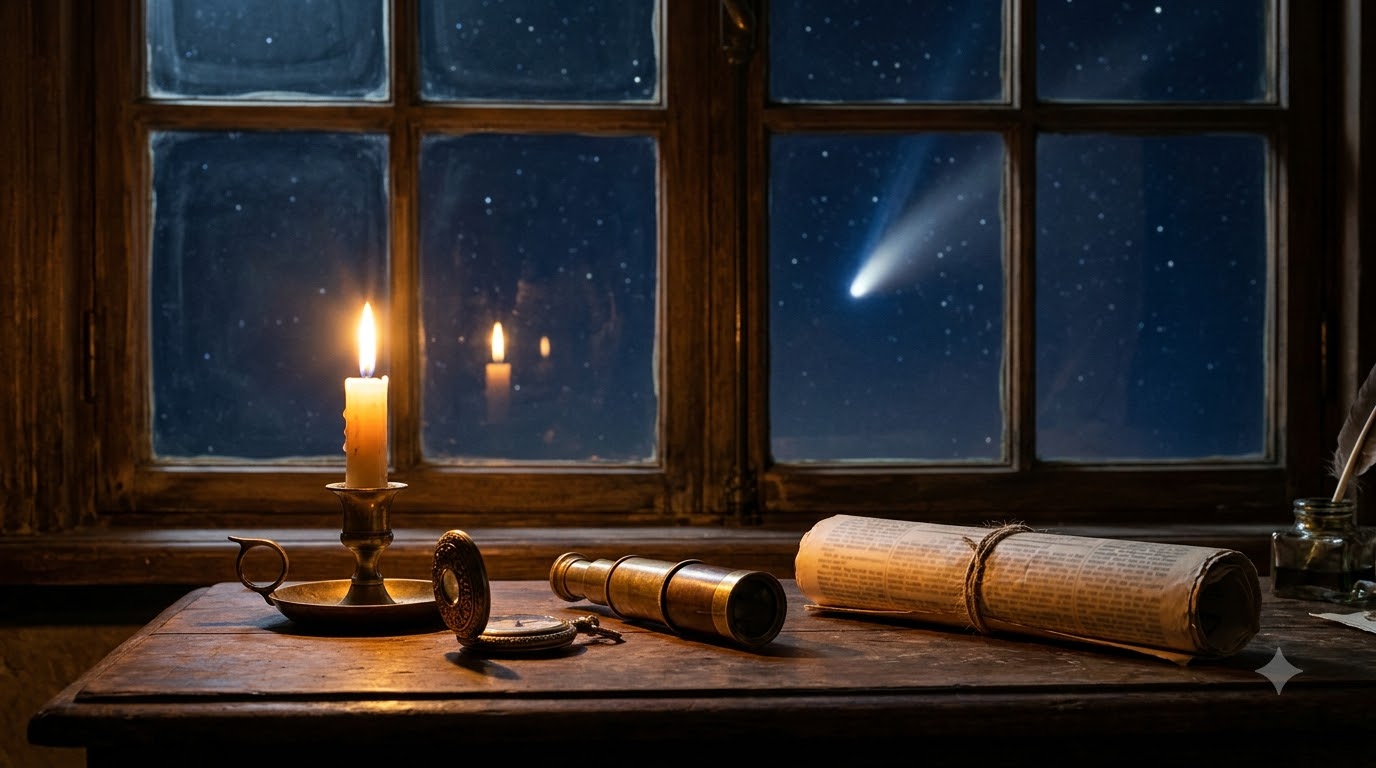
The story: Samuel Clemens, better known as Mark Twain, was born on November 30, 1835, about two weeks after Halley’s Comet made its closest approach to the Sun. The comet returns roughly every 75 to 76 years. In 1909, Twain reportedly wrote: “I came in with Halley’s Comet in 1835. It is coming again next year, and I expect to go out with it.”
What happened next: Twain died of a heart attack on April 21, 1910, one day after the comet’s next closest approach to the Sun. The prediction, made with his usual dark humor, came true almost to the day.
Documented or debated? His birth and death dates and the comet’s timing are well documented. The quote comes from his biographer, Albert Bigelow Paine, so the exact wording relies on that source, but it is widely accepted.
2. Two founding fathers died on the Fourth of July, 1826
The story: John Adams and Thomas Jefferson were collaborators on the Declaration of Independence, then bitter political rivals, then, late in life, warm correspondents. Both men died on July 4, 1826, the 50th anniversary of the adoption of the Declaration (Monticello).
The twist: Jefferson died first, around midday at Monticello in Virginia. Adams died a few hours later in Massachusetts. His last words are traditionally reported as “Thomas Jefferson survives,” though he could not have known his friend had already died. Five years later, on July 4, 1831, a third early president, James Monroe, also died.
Documented or debated? The dates are certain. Adams’s exact last words come from those present and are sometimes reported slightly differently.
3. Violet Jessop survived three disasters at sea
The story: Violet Jessop worked as a stewardess and nurse on ocean liners in the early 1900s. In 1911, she was aboard the RMS Olympic when it collided with the British warship HMS Hawke. The Olympic was damaged but made it back to port.
What happened next: In April 1912, Jessop was a stewardess on the Olympic‘s sister ship, the RMS Titanic. She survived its sinking by escaping in a lifeboat. Then during World War I, she served as a nurse aboard the third sister ship, HMHS Britannic, which sank in 1916 after striking a mine in the Aegean Sea. She survived that too, and later returned to work at sea.
Documented or debated? Her presence on all three ships is well documented. Some popular versions add colorful details from her memoir that are harder to verify, but the core story stands.
4. Robert Todd Lincoln and the presidential assassinations
The story: Robert Todd Lincoln, the eldest son of Abraham Lincoln, has one of history’s strangest track records. When his father was shot at Ford’s Theatre in April 1865, Robert rushed to the house across the street where the president had been carried, and he was at his bedside when he died.
What happened next: In 1881, as Secretary of War, Robert was at a Washington, D.C., train station to meet President James Garfield when Garfield was shot there. In 1901, he was in Buffalo, New York, at the Pan-American Exposition when President William McKinley was shot at the same event. He reportedly began refusing presidential invitations afterward.
The extra twist: Years earlier, during the Civil War, Robert slipped from a crowded train platform in Jersey City and was pulled to safety by a stranger: the famous actor Edwin Booth. Edwin’s brother, John Wilkes Booth, later assassinated Abraham Lincoln.
Documented or debated? Robert’s presence near all three shootings is documented. The Edwin Booth rescue is supported by Robert’s own later account in a letter, though the exact date is uncertain.
5. Anthony Hopkins and the lost book on a bench
The story: In the early 1970s, actor Anthony Hopkins was cast in a film adaptation of George Feifer’s novel The Girl from Petrovka. He went looking for a copy in London but could not find one in the bookshops he tried. Waiting for a train afterward, he noticed a book left on a bench. It was The Girl from Petrovka.
What happened next: Later, while filming, Hopkins met the author. Feifer mentioned that he had lent his own annotated copy to a friend, who had lost it in London. According to the story, the copy Hopkins found had Feifer’s notes in the margins. It was the lost book.
Documented or debated? This story comes mainly from Hopkins and Feifer themselves and has been retold in interviews and books about coincidence. There is no independent record of the book on the bench, so it is best treated as a well-known personal account rather than a verified fact.
6. The balloon and the two Laura Buxtons
The story: In 2001, a 10-year-old girl named Laura Buxton in Staffordshire, England, released a balloon with a label carrying her name and address and a request for whoever found it to write back.
What happened next: The balloon traveled roughly 140 miles and came down in Wiltshire, where it ended up with another girl of about the same age who was also named Laura Buxton. The two girls met, discovered more small similarities, and became friends. Their story was widely reported and later discussed by psychologist Richard Wiseman, among others.
Documented or debated? The core story was reported by the media at the time. Later retellings noted a detail that makes it a little less magical: the balloon was found by a neighbor, who passed it to the second Laura. That does not undo the coincidence of the shared name, but it shows how stories get polished over time.
7. The father and son of the Hoover Dam
The story: On December 20, 1922, a surveyor named J.G. Tierney drowned in the Colorado River while helping scout locations for what would become the Hoover Dam. His death is often described as the first associated with the project.
What happened next: Exactly 13 years later, on December 20, 1935, his son Patrick Tierney died after falling from an intake tower at the dam. His death is often cited as the last of the construction-era fatalities.
Documented or debated? Both deaths and dates appear in accounts of the dam’s history. Calling them precisely the “first” and “last” deaths depends on how fatalities are counted, so treat those labels as approximate.
What these coincidences have in common
Look closely at these unbelievable coincidences that really happened and a few patterns appear:
- A meaningful date or name: Anniversaries, birthdays, and shared names make a coincidence feel designed rather than random.
- A small, closed world: Jessop worked on a single line’s sister ships, and Robert Lincoln moved in a small circle of national politics. Being in a narrow world raises the odds of repeated encounters.
- Selective storytelling: We remember the hits and forget the misses. Nobody tells stories about the thousands of people whose predictions about comets did not come true.
- Polishing over time: Details tend to become neater with every retelling, which is why checking the original account matters.
Why coincidences happen more than we think
Even unbelievable coincidences that really happened feel like they defy the odds. Often, they do not. Statisticians have a few ideas that explain why surprising matches turn up all the time.
The law of truly large numbers
In 1989, Stanford statisticians Persi Diaconis and Frederick Mosteller described what they called the law of truly large numbers: with a large enough number of opportunities, any outrageous thing is likely to happen. A one-in-a-million event happening to you seems astonishing. But in a country of hundreds of millions of people, events like that should happen to hundreds of people every day.
The birthday problem
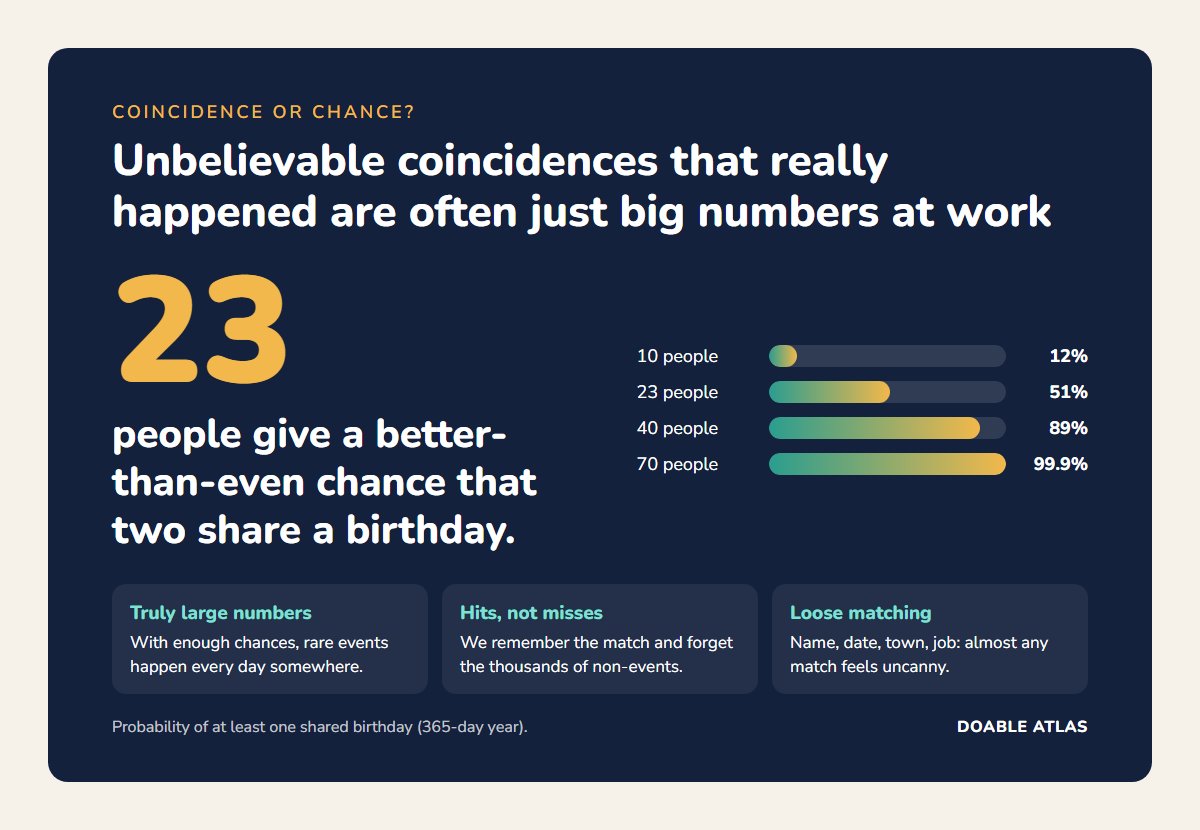
Here is a classic example. How many people do you need in a room for there to be a better-than-even chance that two of them share a birthday? Most people guess around 180. The real answer is just 23. With 70 people, the probability rises above 99 percent. The trick is that we are not asking whether someone shares your birthday, but whether any two people match, and the number of possible pairs grows very quickly.
Try the birthday math yourself
You do not need advanced math to see why the birthday problem works. The trick is to calculate the chance that nobody shares a birthday, then subtract it from 100 percent. Assume a 365-day year and that birthdays are spread evenly:
- The first person can have any birthday: 365 out of 365 days.
- The second person must avoid that one day: 364 out of 365.
- The third person must avoid two days: 363 out of 365.
- Keep going, multiplying each fraction, until you reach the number of people in the room.
For 23 people, multiplying all those fractions gives a result of about 0.493, meaning a 49.3 percent chance that every birthday is different. Subtract that from 1 and you get roughly a 50.7 percent chance that at least two people share a birthday. A spreadsheet can do this in seconds: put 365 down to 343 in a column, divide each by 365, and multiply the column together.
The lesson goes beyond birthdays. Whenever you are asking “Could any two things match?” rather than “Will this specific thing match?”, the number of possible combinations explodes, and the odds of a surprising match climb fast. Next time you meet a stranger who shares your birthday, hometown, or unusual middle name, you will know why it is less rare than it feels, and why it is still fun.
The “small world” effect
Another reason coincidences pile up is that social networks are more connected than they seem. Research on so-called small-world networks, popularized by the phrase “six degrees of separation,” suggests that most people are linked to strangers through surprisingly short chains of acquaintances. That is why running into a friend of a friend on vacation, or discovering a new colleague grew up on your street, happens more often than intuition predicts. Each of us has hundreds of acquaintances, and each of them has hundreds more.
We notice hits and forget misses
Your brain is a pattern-detection machine. When you think of a friend and they call a minute later, it feels uncanny. You do not count the hundreds of times you thought of someone and they did not call. Psychologists describe related tendencies as confirmation bias, the habit of noticing what fits our expectations, and apophenia, the tendency to see meaningful connections in random information.
Loose matching
Coincidences also feel more common because we accept many kinds of matches. Same birthday, same name, same hometown, same school, same unusual job: any of them would feel like a coincidence. When you count all the possible ways two things could match, the chance that something matches becomes surprisingly high.
How to tell a real coincidence story from an embellished one
Coincidence stories spread quickly online, and many are exaggerated or invented. Before you share one, run through these quick checks:
- Look for dates and names: Real stories usually include specific, checkable details.
- Find the earliest source: Is there a newspaper report, letter, or official record from the time, or only a modern retelling?
- Watch for “too perfect” details: Exact matching numbers, identical lists of similarities, and neat endings are often added later.
- Separate fact from personal account: A story told by the person involved can be sincere and still be impossible to verify.
- Check a reliable reference: Museums, historical societies, and reputable encyclopedias often address famous stories directly.
The same habits help with every kind of viral claim. If you enjoy this kind of detective work, see our article on historical hoaxes people believed, which shows how even experts were fooled by stories that seemed too good to doubt.
Why we love coincidence stories
Even when we understand the statistics, coincidences still give us a little thrill. That is not a failure of logic. Stories like these remind us that life can be surprising, that small decisions can lead to unexpected places, and that the world is more connected than it looks.
Coincidences can also be useful. Noticing a meaningful match might prompt you to reach out to an old friend, look into an opportunity, or reflect on a pattern in your own life. The key is to enjoy the wonder while keeping a clear view of the evidence, just as you would when spotting fake reviews or evaluating any remarkable claim.
Frequently asked questions
What are some unbelievable coincidences that really happened?
Well-documented examples include Mark Twain dying the day after Halley’s Comet returned, John Adams and Thomas Jefferson dying on the same Fourth of July, and Violet Jessop surviving incidents on all three Olympic-class sister ships.
What is the most famous coincidence in history?
There is no official ranking, but the deaths of John Adams and Thomas Jefferson on July 4, 1826, the 50th anniversary of the Declaration of Independence, are among the most frequently cited, partly because the facts are so well documented.
Did Mark Twain really predict his death?
He predicted, partly as a joke, that he would “go out with” Halley’s Comet, which had appeared shortly before his birth. He died in April 1910, one day after the comet’s closest approach to the Sun. The quote is recorded by his biographer.
Are coincidences statistically likely?
Many are. Because there are so many people, events, and possible ways for things to match, surprising coincidences are expected to happen regularly somewhere. The birthday problem, where just 23 people give a better-than-even chance of a shared birthday, is a classic example.
Was Violet Jessop really on the Titanic?
Yes. Violet Jessop was a stewardess on the Titanic in 1912 and survived. She was also aboard the Olympic during its 1911 collision and served as a nurse on the Britannic when it sank in 1916.
Why do coincidences feel meaningful?
Our brains are built to detect patterns and remember striking events, while we tend to forget the many times nothing unusual happened. That selective memory makes coincidences feel rarer and more meaningful than they statistically are.
Your next step
The unbelievable coincidences that really happened in this article show that real life can be stranger than fiction, and that the truth is often more interesting than the embellished version. Next time a jaw-dropping coincidence story crosses your feed, enjoy it, then take two minutes to check the dates, find the earliest source, and ask how many other chances there were for something similar to happen.
Curiosity and careful thinking make a great team. Together, they let you enjoy the wonder of the world without being fooled by it.