

Your alarm goes off at 6:00. You hit snooze, then again, then a third time, and by 6:27 you are rushing, groggy and already behind. If you have ever promised yourself that tomorrow you will finally become a morning person, you are in good company. The good news: learning how to wake up early is less about willpower and more about working with your body clock instead of fighting it.
This guide shows you how to wake up early in a way that actually sticks. You will get the science behind morning grogginess, a 14-day plan that moves your wake time gradually, a list of evening and morning habits that make the shift easier, and fixes for the most common setbacks. No 4:30 a.m. hustle culture, just practical steps that work for real schedules.
Quick answer
How to wake up early: move your bedtime and wake time earlier by about 15 minutes every few days, get bright light soon after waking, dim screens and lights in the last hour before bed, keep the same wake time on weekends, and protect at least seven hours of sleep. Your body clock adjusts gradually, so a slow, consistent shift beats a sudden jump.
In this guide
Why waking up early feels so hard
Before you change anything, it helps to understand what you are up against. Three forces make early mornings feel brutal.
Your body clock runs on its own schedule
Your brain keeps a roughly 24-hour internal rhythm, called the circadian rhythm, that controls when you feel sleepy and alert. Light is its main timekeeper. Bright light in the morning nudges the clock earlier; bright light late at night pushes it later. If your evenings are full of screens and overhead lights, your clock may be set for a later wake-up than your alarm.
A well-known study showed how strongly light matters. Researchers sent volunteers camping for a week with only natural light, no electric lights or screens. Their internal clocks shifted about two hours earlier, and the gap between night owls and early birds largely shrank (Wright et al., 2013). You do not need to go camping, but you can borrow the principle.
Sleep inertia: the fog after waking
That heavy, confused feeling during the first minutes after your alarm has a name: sleep inertia. It is a normal transition state between sleep and wakefulness, and it is usually strongest when you are short on sleep or woken from deep sleep. Research reviews describe it as lasting from a few minutes to around half an hour, sometimes longer (Tassi & Muzet, 2000). Knowing this helps: the fog is temporary, and how you feel at 6:01 is not how you will feel at 6:30.
Not enough total sleep
Many people trying to figure out how to wake up early simply set an earlier alarm without going to bed earlier. That cuts sleep, and short sleep makes every morning harder. Sleep experts recommend that adults get seven or more hours per night on a regular basis (Watson et al., 2015; see also the CDC sleep resources). An early wake time only works if your bedtime moves with it.
How to wake up early: the core principle
The single most important rule of how to wake up early is this: move gradually and stay consistent. Your body clock can shift, but it shifts slowly. Jumping from a 7:30 wake-up to 5:30 overnight usually leads to two or three miserable days, a weekend of sleeping in, and a return to square one.
Instead, think in small steps of about 15 minutes, held for a few days each, with your bedtime moving at the same pace. Light, meals and activity at consistent times reinforce the new schedule. Within a couple of weeks, the earlier time starts to feel normal instead of forced.
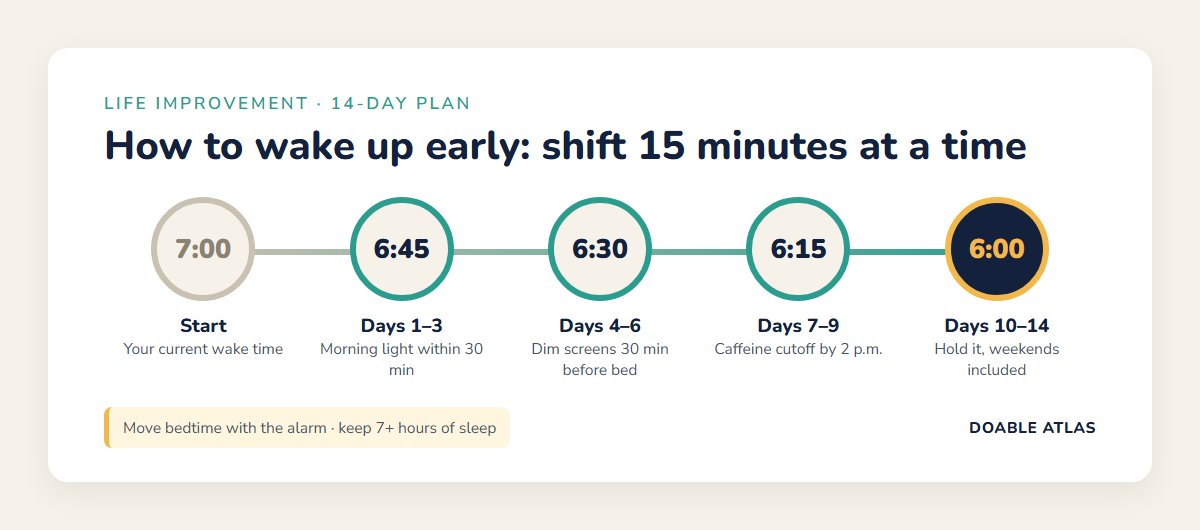
The 14-day wake-up shift plan
Here is a concrete plan for anyone who wants to wake up one hour earlier. Adjust the times to your own starting point: if you currently wake at 7:00 and want 6:00, subtract the same amounts from your own schedule.
| Days | Wake time | Lights-out | Focus for these days |
|---|---|---|---|
| 1 to 3 | 7:00 → 6:45 | 11:00 → 10:45 p.m. | Get outside light within 30 minutes of waking. |
| 4 to 6 | 6:30 | 10:30 p.m. | Start a 30-minute screen-dim window before bed. |
| 7 to 9 | 6:15 | 10:15 p.m. | Move caffeine cutoff to early afternoon. |
| 10 to 12 | 6:00 | 10:00 p.m. | Plan one small morning reward you look forward to. |
| 13 to 14 | 6:00 (weekend too) | 10:00 p.m. | Hold steady. Keep weekend wake-ups within an hour. |
If a step feels rough, stay on it for a few extra days before moving on. The goal is not speed. The goal is a wake time your body accepts without a fight.
Evening habits that make early mornings easier
Most of the work of how to wake up early actually happens the night before. These habits help your body get sleepy at the right time.
1. Dim the lights and screens
Bright light in the evening tells your brain it is still daytime. In one controlled study, people who read on a light-emitting tablet before bed took longer to fall asleep, had delayed body-clock timing and felt less alert the next morning than when they read a printed book (Chang et al., 2015). Try switching to lamps instead of overhead lights for the last hour and putting your phone on a charger outside the bedroom.
2. Set a “start winding down” alarm
People rarely miss their morning alarm because they forgot it. They miss bedtime because nothing reminds them. Set a second alarm about 45 minutes before lights-out. When it rings, start your wind-down: dishes done, tomorrow’s clothes out, lights low. Our evening reset routine gives you a ready-made sequence.
3. Watch the caffeine clock
Caffeine lingers longer than many people realize. A sleep-lab study found that caffeine taken even six hours before bed noticeably reduced sleep (Drake et al., 2013). If lights-out is 10:00 p.m., a practical cutoff is early afternoon.
4. Keep big meals and alcohol earlier
Heavy late dinners and nightcaps can make sleep lighter and more broken, which makes the morning alarm harsher. Aim to finish your main meal a few hours before bed and keep alcohol modest and early if you drink.
5. Write tomorrow’s first step down
A racing mind keeps you up. Spend two minutes writing your top task for tomorrow and the first small action you will take. Research on planning shows that specific “when and where” plans make follow-through more likely, and offloading tasks to paper can also quiet the mental to-do list. If your thoughts tend to loop at night, our guide on why people overthink has more tools.
Morning habits: what to do the minute your alarm rings
The first ten minutes decide whether your early wake-up becomes a good morning or a nap on the couch. Use this sequence.
- Put the alarm across the room. Standing up to turn it off breaks the snooze reflex.
- Feet on the floor, lights on. Do not negotiate with yourself in bed. Sit up, stand up, turn on a bright light.
- Drink a glass of water. Keep it ready on the nightstand or next to the alarm.
- Get daylight. Open the curtains, step onto the porch, or walk to the mailbox. Morning light is the strongest signal for keeping your new schedule.
- Move for two minutes. A few stretches, a walk around the block, or a short set of squats helps clear the fog of sleep inertia.
- Start your reward. Coffee on the porch, a podcast, ten pages of a book. Give your brain a reason to like early mornings.
For ideas on how to use your new time well, see our morning routine for productivity.
Should you stop hitting snooze?
Snooze feels kind in the moment, but it usually gives you fragmented, low-quality sleep in short chunks, and you may wake up repeatedly into the grogginess of sleep inertia. For most people trying to learn how to wake up early, one firm alarm set for the real wake time works better than three alarms set 10 minutes apart.
If you truly need a buffer, try a single “transition alarm”: a gentle sound 10 minutes before your real alarm, with lights on a timer or a sunrise-style lamp. Then get up at the main alarm with no further snoozing.
Are you a night owl? How to wake up early anyway
People naturally differ in their body-clock timing, often called chronotype. Some feel sharp at dawn; others hit their stride at night. These tendencies are partly biological, and they also shift with age: teenagers and young adults tend to run later, while many older adults drift earlier.
If you are a strong night owl, learning how to wake up early is still possible, but expect it to take longer and to require extra attention to light. A few adjustments help:
- Use smaller steps: 10 minutes every three or four days instead of 15.
- Be strict about evening light: owls are especially sensitive to late-night screens.
- Get outside early: 10 to 20 minutes of daylight soon after waking, even on cloudy days.
- Protect weekends: sleeping in by three hours on Saturday resets much of your progress.
- Decide if earlier is truly needed: if your life allows a later schedule, a consistent 7:30 wake time may serve you better than a forced 5:30.
Quick self-check: what is blocking your early mornings?
Answer these five questions to find your biggest obstacle. Each “yes” points to the fix to start with.
- Do you usually sleep fewer than seven hours on work nights? Fix: move bedtime first, not the alarm.
- Is your phone the last thing you look at before sleep? Fix: screen-dim window and charge the phone outside the bedroom.
- Do you sleep in more than two hours on weekends? Fix: keep weekend wake-ups within about an hour.
- Do you drink coffee, tea or energy drinks after 2 p.m.? Fix: move the cutoff earlier.
- Do you hit snooze more than once most days? Fix: alarm across the room plus one firm wake time.
Most people find one or two clear culprits. Fix those first, then return to the 14-day plan.
Common mistakes when trying to wake up early
Changing everything at once
New wake time, new workout, cold showers and a meditation habit all starting on Monday is a recipe for burnout. Change the wake time first. Add other habits once it feels stable. Our guide to building better habits explains why small changes stick better.
Waking early but not sleeping early
This is the most common reason the plan fails. If you wake an hour earlier, bedtime must move an hour earlier too.
Using the extra time for your phone
If the first 30 minutes of your new morning go to social media, the early wake-up can feel pointless. Decide the night before what your first activity will be.
All-or-nothing thinking
Missed a day? That does not cancel the plan. Get up at your target time the next morning and continue. Consistency over weeks matters more than perfection over days.
What to do with your new early morning
An early start is only worth it if you use the time for something that matters to you. A few ideas, depending on what your days need most:
- Focus block: 30 to 60 minutes on your most important task before messages arrive. Pair it with time blocking.
- Movement: a walk, a run, a bike ride or a short workout while the streets are quiet.
- Calm start: coffee without hurry, journaling, reading or simply sitting outside.
- Household reset: lunches packed, a load of laundry started, the day’s plan reviewed.
- Connection: breakfast with family before everyone scatters.
Pick one. Trying to cram five goals into your first early morning will make it feel like work again.
Sample early schedules for real lives
How to wake up early looks different depending on who you are. Here are three realistic examples to adapt.
The commuter (target 6:00 a.m.)
Wind-down alarm at 9:15 p.m., phone on the kitchen charger at 9:30, lights-out at 10:00. Wake at 6:00, water and daylight on the porch by 6:10, a 20-minute walk or stretch, breakfast and out the door by 7:15 without rushing. The 30 minutes that used to vanish into snoozing become a calm buffer for traffic.
The parent (target 5:45 a.m.)
Kids in bed by 8:00, kitchen reset and lunches prepped by 9:00, adult wind-down until lights-out at 9:45. Wake at 5:45 for 30 to 45 minutes of quiet before the house wakes up: coffee, a short workout or a few pages of a book. Parents often say this protected time is the main reason early mornings are worth it.
The shift-flexible worker (target 7:00 a.m.)
Not everyone needs dawn. If your job starts at 9:30, a steady 7:00 wake time with lights-out at 11:00 may be the right goal. The same rules apply: consistent times, morning light, evening dimming. Early is relative; consistent is what counts.
Whichever profile fits, write your target wake time and bedtime on a sticky note by the bathroom mirror for the first two weeks. Seeing the plan every evening makes it far easier to follow.
When to talk to a doctor
Many sleep problems are habits and schedules. Some are not. Talk to a healthcare provider if:
- You regularly struggle to fall asleep or stay asleep for weeks at a time, even with good habits.
- You feel very sleepy during the day despite getting seven or more hours in bed.
- Someone notices loud snoring, gasping or pauses in your breathing during sleep.
- You fall asleep unintentionally while driving, working or in conversation.
- Low mood, anxiety or medications seem to be affecting your sleep.
Conditions such as insomnia, sleep apnea and circadian rhythm disorders are common and treatable. This article is general information, not medical advice.
Frequently asked questions
How long does it take to get used to waking up early?
Most people need about one to two weeks if they move gradually in 15-minute steps and keep the schedule consistent, including weekends. Larger shifts or strong night-owl tendencies may take longer.
How to wake up early without feeling tired?
Go to bed earlier so you still get seven or more hours of sleep, get bright light soon after waking, avoid snoozing and keep caffeine to the morning. The first few minutes of grogginess are normal sleep inertia and usually pass within half an hour.
Is it better to wake up early or get more sleep?
Enough sleep comes first. Waking early only helps if you also sleep early. A consistent schedule with sufficient sleep matters more than any specific wake time.
Can I catch up on sleep on weekends?
Sleeping in a little can help after a short night, but sleeping in for hours shifts your body clock later and makes Monday harder. Try to keep weekend wake-ups within about an hour of weekdays.
What is the best time to wake up?
There is no single best time. The best wake time is one that fits your obligations, allows seven or more hours of sleep and that you can keep consistently, seven days a week.
The takeaway
Learning how to wake up early is not a test of grit. It is a slow, steady negotiation with your body clock. Move bedtime and wake time together in small steps, use light to your advantage, protect your sleep and give yourself a morning worth getting up for.
Start tonight: set a wind-down alarm, move lights-out 15 minutes earlier and put your phone across the room. Tomorrow morning, open the curtains and enjoy the quiet. In two weeks, the version of you who hit snooze three times will feel like a distant memory.