

You run in for milk and bread, and somehow walk out $63 poorer with a bag of snacks you did not plan to buy, a “great deal” on something you already have at home, and still no bread. If grocery bills feel like they climb every month, you are not imagining it, and you are not alone. The good news: groceries are one of the most flexible parts of a household budget. Small, repeatable habits can cut the bill noticeably without clipping coupons for hours or eating rice and beans every night.
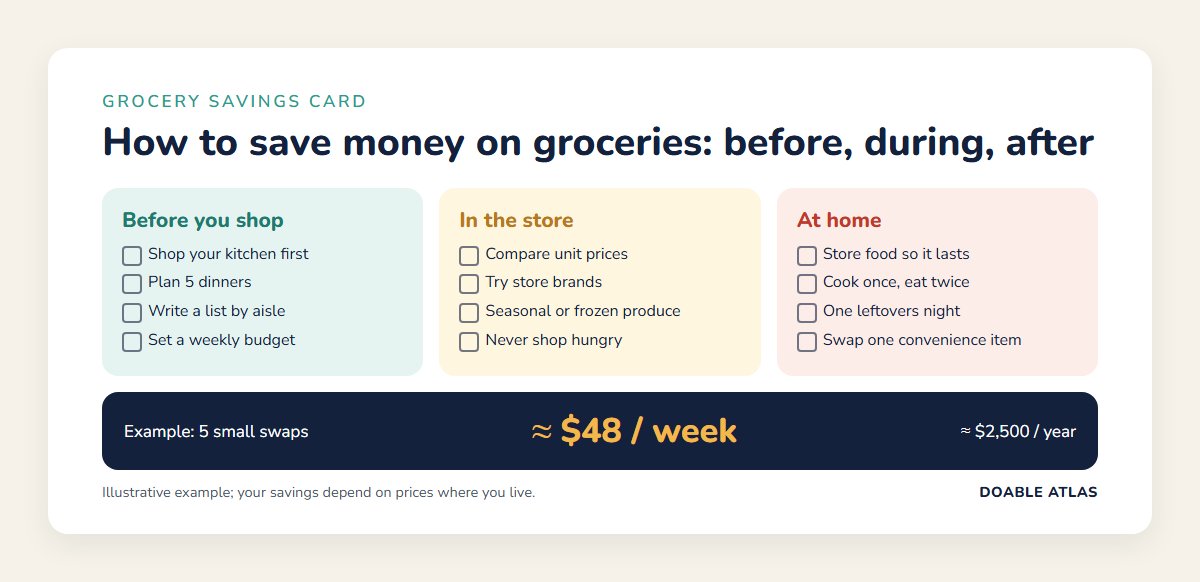
This guide shows you how to save money on groceries with 15 practical strategies, organized by when they happen: before you shop, in the store, and at home. You will also find a worked savings example, a “pick your five swaps” checklist, and a printable grocery savings card.
Quick answer
The fastest ways to save money on groceries are to plan meals around what you already have, shop with a list, compare unit prices, choose store brands, buy seasonal produce, and stop wasting the food you buy. Most families can trim their bill meaningfully by combining just four or five of these habits.
In this guide
Why grocery bills creep up
Before learning how to save money on groceries, it helps to understand where the money goes. Supermarkets are designed to encourage extra spending: essentials such as milk and eggs are often at the back, so you pass tempting displays; eye-level shelves hold pricier brands; and end-of-aisle displays make ordinary prices look like deals.
Then there is waste. A significant share of food bought at home ends up in the trash, which means part of every grocery bill buys nothing at all. The U.S. Environmental Protection Agency recommends planning meals, making a shopping list, and storing food properly as simple ways to cut household food waste (EPA). Saving money and wasting less food turn out to be the same project.
How to save money on groceries: 15 strategies
Here is how to save money on groceries step by step. You do not need all fifteen. Pick the ones that fit your life, and use the checklist further down to build your own plan.
Before you shop
1. Shop your kitchen first
Before writing a list, check your fridge, freezer, and pantry. Plan at least two meals around what you already have. That half bag of pasta, the frozen vegetables, and the can of beans in the back are already paid for.
2. Plan your meals for the week
Meal planning is the single most powerful habit for anyone learning how to save money on groceries. When you know what you will cook, you buy only what you need and order less takeout on busy nights. Plan five dinners, leave room for one leftovers night, and keep one flexible “use it up” meal. Our guide on how to plan your week shows how to fit this into a 30-minute Sunday routine.
3. Write a list, and stick to it
A list is your defense against impulse buys. Organize it by store section so you move through the aisles efficiently and spend less time near tempting displays. If something is not on the list, it waits until next week.
4. Set a weekly grocery budget
Decide how much you will spend before you go, and track what you actually spend. A simple budget turns vague worry into numbers you can work with. Our step-by-step guide to a simple budget spreadsheet includes a grocery category you can set up in minutes.
5. Check flyers and store apps
Spend five minutes looking at the weekly sales before you plan meals. If chicken thighs or broccoli are on sale, build meals around them. Store apps often include digital coupons that are faster than paper ones.
In the store
6. Compare unit prices, not package prices
The shelf tag usually shows a unit price, such as cost per ounce, pound, or count. This is the only fair way to compare a big box with a small one, or one brand with another. Bigger is often cheaper per unit, but not always, especially when the smaller size is on sale.
7. Choose store brands
Store-brand or “private label” products are frequently made to similar standards as name brands and typically cost less. Try switching staples such as flour, sugar, canned tomatoes, frozen vegetables, oats, and cleaning supplies. If you do not notice a difference, keep the savings.
8. Buy seasonal and frozen produce
Fruits and vegetables in season are usually cheaper and taste better. Out of season, frozen produce is a smart alternative: it is typically frozen soon after harvest, lasts for months, and creates almost no waste because you use only what you need.
9. Look high and low on the shelves
Eye-level shelves are prime real estate, often holding more expensive brands. Glance at the top and bottom shelves, where better-value options often sit.
10. Be smart about bulk buying
Buying in bulk saves money only if you use everything before it goes bad. Bulk works well for long-lasting items such as rice, dried beans, oats, frozen foods, toilet paper, and canned goods. It works poorly for fresh produce and large containers of things you rarely use.
11. Shop less often, and not hungry
Every extra trip is a chance for impulse purchases. Try one main shop a week with a quick top-up for fresh items if needed. And eat before you go: shopping hungry makes snacks and ready meals look far more appealing.
At home
12. Store food so it lasts
Food you throw away is money you throw away. Simple storage habits, such as keeping greens dry, separating apples and bananas from other produce, and setting your fridge cold enough, make groceries last days longer. Our guide on how to keep food fresh longer has a full fridge storage map.
13. Cook once, eat twice
Make a double batch of soups, stews, chili, or pasta sauce and freeze half. You save money on ingredients bought in larger amounts and avoid expensive takeout on nights when you do not feel like cooking.
14. Love your leftovers
Plan a weekly leftovers night, take leftovers for lunch, or turn them into something new: roast vegetables become a frittata, rice becomes fried rice, and stale bread becomes croutons.
15. Rethink a few pricey habits
Pre-cut fruit, single-serve snacks, bottled water, and ready-made salads carry a large convenience markup. You do not have to give them up entirely, but replacing even one or two with a homemade version adds up quickly. The same thinking applies to recurring expenses elsewhere; our guide to subscription vs one-time purchase covers it for other spending.
A worked example: how small swaps add up
Here is a realistic example of how to save money on groceries with a handful of swaps. The prices below are illustrative, so your own numbers will vary by location and store, but the pattern holds.
| Swap | Before (per week) | After (per week) | Weekly saving |
|---|---|---|---|
| Store brand for 6 staples | $24 | $18 | $6 |
| One takeout night becomes a freezer meal | $40 | $12 | $28 |
| Frozen instead of out-of-season berries | $9 | $5 | $4 |
| Less wasted produce (better storage) | $10 thrown away | $4 thrown away | $6 |
| Snacks bought in bulk and portioned at home | $12 | $8 | $4 |
| Total | $95 | $47 | $48 a week, roughly $2,500 a year |
None of these swaps is extreme. Together, they show how to save money on groceries without feeling deprived: change the defaults, and the savings take care of themselves.
Pick your five swaps
Trying to change everything at once usually backfires. Instead, choose five habits from this list and practice them for a month. Then add more.
- ☐ Check my fridge and pantry before every shop
- ☐ Plan five dinners each week
- ☐ Never shop without a list
- ☐ Set and track a weekly grocery budget
- ☐ Compare unit prices on every big purchase
- ☐ Switch five staples to the store brand
- ☐ Buy frozen fruit and vegetables out of season
- ☐ Cook a double batch once a week and freeze half
- ☐ Hold one leftovers night every week
- ☐ Eat before I go shopping
- ☐ Store produce properly so it lasts
- ☐ Replace one convenience item with a homemade version
Budget-friendly staples to keep on hand
Part of knowing how to save money on groceries is stocking a few inexpensive, versatile basics. With these on hand, you can almost always make a meal without an extra trip:
- Grains: rice, oats, pasta, and whole-wheat flour.
- Proteins: eggs, dried or canned beans, lentils, canned tuna, and peanut butter.
- Produce that lasts: onions, carrots, potatoes, cabbage, apples, and bananas.
- Frozen: mixed vegetables, spinach, berries, and a bag of chicken thighs.
- Flavor: canned tomatoes, stock cubes, garlic, spices, and a bottle of soy sauce.
A well-stocked pantry also doubles as emergency preparedness. Our emergency kit checklist for home shows which long-lasting foods are worth keeping in reserve.
How to save money on groceries for your household type
The best strategies depend on who you are feeding. Here is how to save money on groceries in a few common situations.
Living alone
- Buy loose produce so you can take exactly one onion or two carrots instead of a whole bag.
- Rely on the freezer: freeze bread in slices, portion meat, and cook big batches to freeze in single servings.
- Plan meals that share ingredients, such as a bunch of spinach used in an omelet, a pasta, and a smoothie.
- Split bulk purchases with a friend or neighbor.
Families with kids
- Plan a weekly menu together and let kids choose one dinner. They are more likely to eat what they helped pick.
- Make snacks at home: popcorn, cut fruit, homemade muffins, and yogurt with fruit cost far less than single-serve packs.
- Cook “base” meals that everyone can customize, such as taco nights or rice bowls, to avoid cooking separate dishes.
- Shop without the kids when you can. Fewer requests mean fewer extras in the cart.
Students and tight budgets
- Build meals around the cheapest filling staples: oats, rice, pasta, beans, lentils, eggs, and potatoes.
- Learn three or four simple recipes you can make in bulk, such as chili, lentil soup, fried rice, and pasta bake.
- Check reduced-price sections for items close to their sell-by date, and freeze or cook them the same day.
Does online grocery shopping save money?
It can. Ordering online makes it easier to stick to a list, compare unit prices side by side, and avoid impulse displays. You can also see your running total before you check out and remove items if you go over budget.
The trade-offs are delivery fees, service charges, tips, and sometimes higher item prices than in store. Substitutions can also cost more. If you shop online, choose free pickup when available, combine orders to reach free-delivery thresholds, and review substitutions carefully. For many people, a mix works best: an online order for heavy staples and a quick in-store trip for fresh produce.
Cheap, healthy meal ideas
Saving money does not mean eating badly. These budget-friendly meals use inexpensive ingredients and are easy to scale up:
- Bean and vegetable chili with rice: filling, freezer-friendly, and very low cost per serving.
- Egg fried rice with frozen peas and carrots: perfect for using leftover rice.
- Lentil soup with onions, carrots, and canned tomatoes.
- Sheet-pan chicken thighs with potatoes and whatever vegetables need using.
- Overnight oats with frozen berries for an easy, cheap breakfast.
- Pasta with a big-batch tomato sauce, bulked out with spinach or lentils.
Rotate a few of these and you will see why meal planning is at the heart of how to save money on groceries: cheap ingredients plus a plan beats expensive ingredients bought on impulse.
Common mistakes that cost you money
- Buying “deals” you will not use. A two-for-one offer is a waste if the second item expires in your fridge.
- Ignoring the unit price. The bigger package is not always cheaper per ounce.
- Shopping without a plan. No plan usually means more trips, more impulse buys, and more waste.
- Overbuying fresh produce. Buy what you will eat in the next few days and rely on frozen for the rest.
- Forgetting what you already own. Duplicates of spices, sauces, and snacks quietly drain the budget. A quick kitchen clear-out, like the one in our guide on how to declutter your home fast, helps you see what you have.
- Going too extreme. Plans that rely on willpower and bland food rarely last. Sustainable changes beat dramatic ones.
Make saving automatic
The secret to lasting savings is turning good choices into routines so you do not have to think about them. A few ideas:
- Keep a running list on your phone or fridge, and add items the moment they run low.
- Rotate a few favorite meal plans. Two or three tried-and-tested weekly menus make planning almost effortless.
- Do a weekly fridge check the day before you shop, and plan meals around what needs using.
- Review your spending monthly. Seeing progress keeps you motivated.
Like any habit, these get easier with repetition. Our guide on how to build better habits explains how to make routines like these stick.
Frequently asked questions
What is the fastest way to learn how to save money on groceries?
Start with three habits: plan your meals for the week, shop with a list, and check what you already have before you go. These alone reduce impulse buys, extra trips, and wasted food.
Are store brands really as good as name brands?
Often, yes, especially for staples such as flour, sugar, canned goods, and frozen vegetables. Quality varies by product and store, so try a few and keep the ones you like.
Is buying in bulk always cheaper?
No. Check the unit price, and only buy in bulk if you have space to store the item and will use it before it expires. Bulk is best for long-lasting staples.
How much should I spend on groceries each week?
It depends on household size, location, and dietary needs. The best approach is to track your spending for a month, then set a realistic weekly target slightly below your current average.
What are the cheapest healthy foods to buy?
Some of the best-value healthy foods are oats, brown rice, dried or canned beans, lentils, eggs, frozen vegetables, frozen berries, bananas, carrots, cabbage, potatoes, and canned fish. They are inexpensive, filling, versatile, and many keep for weeks or months, which also reduces waste.
Are cashback and coupon apps worth it?
They can be, if you use them only for items already on your list. The savings disappear the moment an app convinces you to buy something you did not plan to. Pick one or two apps tied to the stores you already use, check them while you plan your meals, and ignore the rest.
Does meal planning really save money?
Yes. Meal planning helps you buy only what you need, use what you already have, and avoid last-minute takeout, which are three of the biggest drivers of grocery overspending.
Your next step
Learning how to save money on groceries is not about deprivation. It is about small, smart defaults: a plan, a list, a quick price comparison, and a fridge where food does not get forgotten. Pick your five swaps from the checklist above, try them for four weeks, and compare your receipts.
Most people are surprised by the difference. And the money you save can go toward something that matters more to you than a bag of impulse snacks.