
Online reviews are one of the first things many of us check before buying a product, booking a contractor, or choosing a restaurant. That trust is exactly why fake reviews exist. Some are written by the business itself, some are bought from review sellers, and some are now generated by AI tools in seconds. Learning how to spot fake reviews helps you protect your money and make better decisions.
The challenge is that fake reviews are designed to look real, and there is no single sign that proves a review is fake. This guide gives you a practical system instead: the warning signs worth noticing, a step-by-step way to check reviews for any purchase, what U.S. rules say about fake reviews, and how to report them.
In this guide
Why fake reviews are a problem
Fake reviews distort what should be honest feedback. They can make a mediocre product look excellent, hide safety or quality problems, or unfairly damage a competitor with fake negative reviews. For shoppers, the result is wasted money, disappointing purchases, and sometimes real risk.
What U.S. rules say
In August 2024, the Federal Trade Commission announced a final rule banning fake reviews and testimonials (FTC). Among other things, the rule targets:
- Buying or selling fake reviews, including reviews attributed to people who do not exist, such as AI-generated reviews.
- Offering payment or other incentives in exchange for reviews that express a particular sentiment, such as only positive reviews.
- Reviews by company insiders, such as employees or close relatives, without clear disclosure.
- Company-controlled review websites that falsely present themselves as independent.
- Suppressing negative reviews through threats or intimidation.
- Buying or selling fake social media indicators, such as fake followers or views.
The rule gives the FTC stronger tools against businesses that knowingly break it. It does not mean every fake review has disappeared, so a careful, skeptical approach is still worthwhile.
Why you can’t always tell by reading one review
It is tempting to look for a single telltale phrase, but the FTC notes that you often cannot reliably spot a fake review just by reading it. Fake reviews can be positive or negative, short or detailed, and not every fake positive review gives five stars (FTC Consumer Advice). AI tools have also made it easier to produce natural-sounding text.
That is why the most reliable approach looks at patterns across many reviews, the reviewers themselves, and outside sources, rather than judging one review in isolation.
How to spot fake reviews: 10 warning signs
No single sign proves a review is fake. But when several of these appear together, it is a good reason to be cautious.
1. A sudden burst of reviews
Check the dates. A product with very few reviews for months that suddenly receives dozens within a few days may have bought or solicited them. The FTC specifically suggests watching for a burst of reviews over a short period (FTC).
2. Reviewers with thin or strange histories
Click on the reviewer’s profile when you can. Warning signs include an account that has posted only one review, accounts that review many unrelated products on the same day, or profiles that give almost everything five stars or one star.
3. Vague praise with no details
Genuine reviews often mention specific details: how long the person has used the product, how it compares with an older model, what they liked and what disappointed them. Reviews full of general enthusiasm, such as “Amazing product! Best ever! Highly recommend!”, without any concrete experience deserve less weight.
4. Similar wording across many reviews
When several reviews use the same unusual phrases, the same structure, or repeat the full product name in a way most people would not, they may come from the same source or template.
5. Ratings that are all extremes
Real products usually get a mix of ratings. A pattern of almost all five-star reviews, or a polarized split of five-star and one-star reviews with very few in between, can suggest manipulation, either positive inflation or a competitor attack.
6. Reviews that read like ads
Reviews that focus heavily on marketing claims, list features like a product description, or push you to “buy now” may not come from ordinary customers.
7. Reviews that don’t match the product
Some sellers merge listings or reuse reviews from a different product. If reviews describe a different color, size, or item entirely, the rating may not reflect what you are actually buying.
8. Incentivized reviews without clear disclosure
Some reviewers receive free products or discounts in exchange for reviews. That is not always deceptive, but it should be disclosed. Some platforms label incentivized reviews; others do not. Be cautious with reviews that mention a free product but still read like pure praise.
9. Negative reviews that seem to have vanished
If you remember seeing critical reviews that are now gone, or a product has suspiciously few complaints for its category, review suppression may be involved. Checking other sites can reveal what is missing.
10. A deal that seems too good to be true
Unusually low prices on brand-name products, combined with glowing reviews, can signal counterfeit goods or a scam store. The FTC notes that unusually low prices for brand-name items are a common sign of a scam (FTC).
A 5-minute review check before you buy
You do not need to become an investigator for every purchase. For anything that costs more than you would be comfortable losing, this quick routine helps. The summary card below makes it easy to save or print.
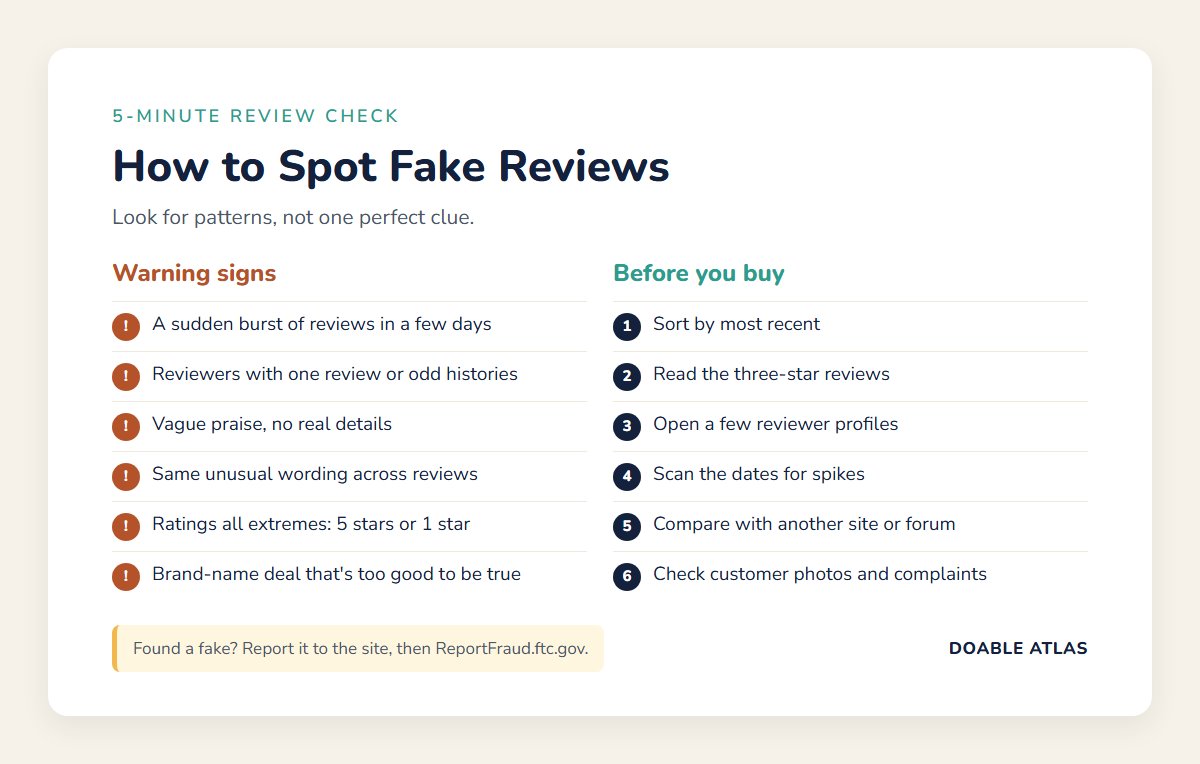
- Sort by most recent: Recent reviews show current quality, especially if a product has changed or the seller is new.
- Read the three-star reviews: Middle ratings are often the most balanced and specific.
- Check a few reviewer profiles: Look for normal, varied review histories.
- Scan the dates: Watch for sudden spikes in review volume.
- Compare with other sources: Check at least one other retailer, an independent review site, or a forum.
- Look at customer photos: Real photos from buyers are harder to fake than text, though not impossible.
- Read the negative reviews: Ask whether complaints are about issues that matter to you, and whether the seller responds constructively.
Red flags on the seller or store itself
Sometimes the clearest clues are not in the reviews at all but in the seller or website behind them. Before trusting glowing ratings, take a minute to check:
- How long the store has existed: A brand-new shop with hundreds of perfect ratings is unusual. Many marketplaces show when a seller joined.
- Contact information: Legitimate businesses usually list a real address, phone number, or customer service email. Vague or missing contact details are a warning sign.
- Return and refund policies: Clear, reasonable policies suggest a seller expects to stand behind its products. Missing or confusing policies deserve caution.
- Payment options: Be wary of sellers that push unusual payment methods, such as wire transfers, gift cards, or payment apps, instead of standard cards.
- Too many similar listings: A seller offering hundreds of unrelated products at steep discounts may be a reseller of low-quality or counterfeit goods.
A single red flag does not prove anything, but combined with suspicious review patterns, it is a strong reason to look elsewhere. Learning how to spot fake reviews works best alongside these basic checks of the seller.
Spotting fake reviews on different platforms
Online marketplaces
On large marketplaces, check whether reviews are tied to verified purchases, compare the seller’s other listings, and be careful with very new sellers that already have many perfect reviews. Look at the questions-and-answers section, which can reveal problems reviews do not mention.
Local businesses and contractors
For restaurants, contractors, and service providers, compare reviews across more than one map or listing service, look at how the business responds to complaints, and ask for references for bigger jobs. Licensing boards and the Better Business Bureau can add useful context for contractors.
Apps
App store reviews can be gamed. Check recent reviews after updates, look for complaints about subscriptions or billing, and read the developer’s responses.
Travel and hotels
Compare reviews on more than one booking site, focus on recent stays, and look for traveler photos. Reviews that mention specific room numbers, staff names, or nearby landmarks tend to be more useful than generic praise.
Tools and habits that help
A few simple habits make it much harder for fake reviews to mislead you:
- Use several sources: The FTC recommends reading reviews from a variety of sites and platforms rather than relying on one.
- Look beyond the star rating: An average rating hides important details. Read a sample of reviews at every star level.
- Consider expert reviews: Independent testing organizations and reputable publications often test products directly, which adds a different kind of evidence.
- Ask people you know: A recommendation from a friend, coworker, or local community group can be more reliable than anonymous reviews.
- Slow down: Fake reviews work best when we feel rushed. Waiting a day before a big purchase gives you time to check.
Thinking critically about online claims is a skill that helps far beyond shopping. Our guide on how to spot weak evidence in viral stories uses many of the same principles.
What to do if you find fake reviews
Reporting fake reviews helps other shoppers and puts pressure on platforms and sellers:
- Report it to the platform: Most sites have a “report” or “flag” option next to each review.
- Report it to the FTC: If the platform does not respond or fix the problem, you can report it at ReportFraud.ftc.gov. The FTC suggests including “fake review” in your report (FTC).
- Share your honest experience: If you bought the product, a detailed, honest review helps balance the record.
If you were misled into a purchase
Check the retailer’s return policy right away, keep records of your order and communications, and contact the seller first. If that fails, you may be able to dispute the charge with your card issuer. Acting quickly usually gives you the best chance of getting your money back.
Common myths about fake reviews
“Verified purchase means the review is real.”
Verified purchase labels help, but they are not a guarantee. Some schemes refund buyers after they post positive reviews. Treat the label as one piece of evidence, not proof.
“Long, detailed reviews are always genuine.”
Detail is a good sign, but AI tools can now generate long, specific-sounding text. Look at patterns and reviewer history as well as content.
“Only five-star reviews are fake.”
Fake negative reviews exist too, sometimes posted to harm competitors. Unusual spikes of one-star reviews deserve the same skepticism.
“A high average rating means a product is good.”
An average can hide manipulation or a small number of reviews. A 4.6 from thousands of varied reviews means more than a 5.0 from a dozen.
Frequently asked questions
Are fake reviews illegal in the United States?
Under the FTC’s rule announced in 2024, businesses can face penalties for practices such as buying or selling fake reviews, using undisclosed insider reviews, or offering incentives for reviews with a specific sentiment. Enforcement focuses on businesses and those who knowingly violate the rule.
Can AI write fake reviews?
Yes. AI tools can generate realistic-sounding reviews quickly, and the FTC rule covers reviews attributed to people who do not exist, including AI-generated ones. This is one reason to look at patterns and reviewer histories rather than writing style alone.
What is the most reliable sign of a fake review?
There is no single reliable sign. The strongest evidence comes from patterns: sudden bursts of reviews, reviewers with unusual histories, repeated wording, and big differences between one site and others.
Should I trust products with only a few reviews?
A small number of reviews is not necessarily bad, especially for new or niche products. Read what is there carefully, check the seller, and look for outside information before deciding.
Your next step
Knowing how to spot fake reviews is less about catching every fake and more about building a habit of checking patterns and sources. The next time you shop online, sort by most recent, read the three-star reviews, click on a couple of reviewer profiles, and compare with at least one other source before you buy.
Those few minutes can save you from a disappointing purchase and help you make choices you feel confident about.